Huapango Dance: Steps, Music & Where to See It
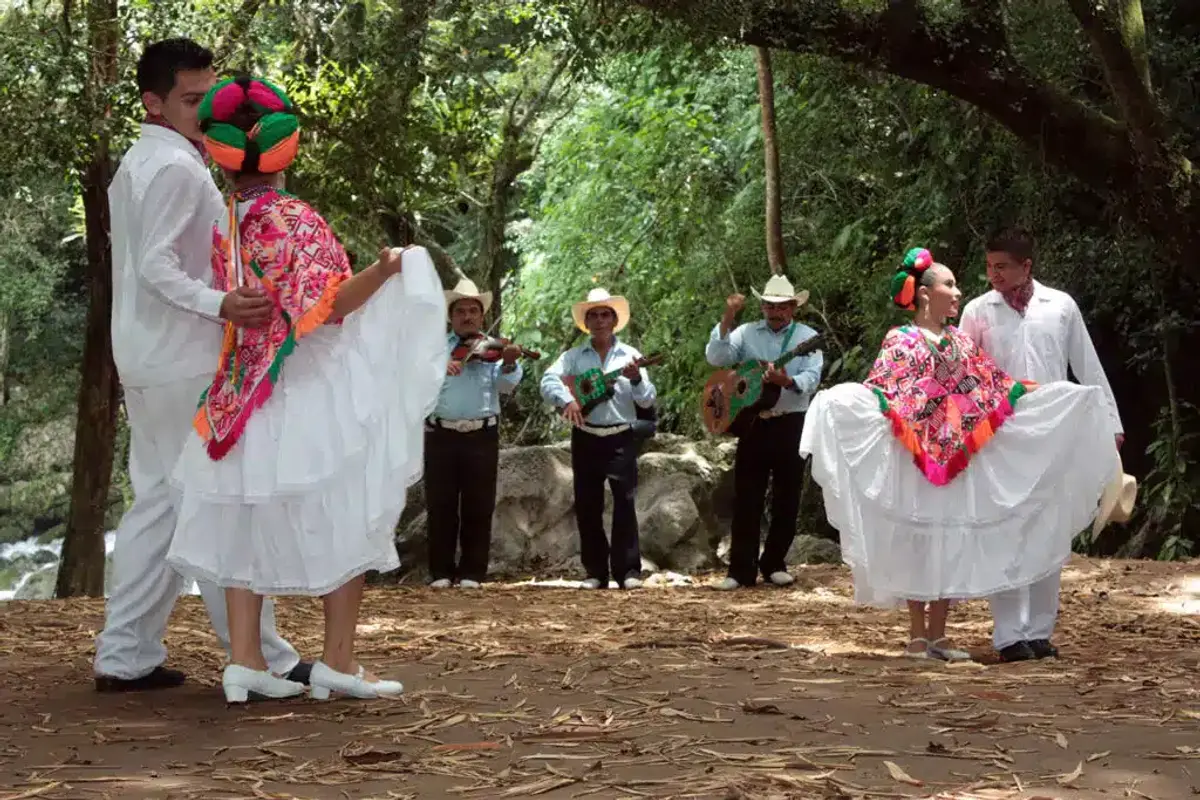
Huapango dance is a Mexican folk dance and music tradition from the Huasteca region, especially San Luis Potosí, Veracruz, Hidalgo, Tamaulipas, and Querétaro. If you need the quick answer, it means couples doing percussive zapateado footwork on a raised wooden tarima while a trio of violin, huapanguera, and jarana huasteca plays.
| Huapango at a Glance | |
|---|---|
| Origin | Huasteca region, northeastern Mexico (17th century) |
| Music | Trio: violin + huapanguera + jarana huasteca |
| Vocals | Falsetto duet (bravura style), improvised lyrics |
| Dance platform | Tarima (raised wooden platform) |
| Basic steps | 5: campanas, deslizados, puntas, paso de tres, jaranas |
| Couple style | Face each other, no touching, communication through footwork |
| 4 styles | Son huasteco, arribeño, norteño, mariachi |
| Famous examples | El Querreque, Cucurrucucú Paloma, Malagueña Salerosa |
| UNESCO status | Son huasteco recognized as intangible cultural heritage |
Huapango dance is a Mexican folk tradition from the Huasteca region, built around zapateado footwork, violin-led music, and a raised wooden platform called a tarima. If you searched for huapango origin, steps, instruments, or where to see it in Mexico, start here: it is not generic folklore. It is a living regional sound tied to San Luis Potosí, Veracruz, Hidalgo, Tamaulipas, and Querétaro.
What Is Huapango Dance?
Huapango dance is a traditional Mexican folk dance from the Huasteca region, performed by a couple facing each other on a raised wooden tarima while they do rhythmic zapateado footwork to live music. The classic sound comes from a violin, huapanguera, and jarana huasteca, and the dance is most strongly associated with San Luis Potosí, Veracruz, Hidalgo, Tamaulipas, and Querétaro.
If you only need the quick version, this is the key distinction: huapango is not just a generic Mexican folk dance. It is a specific regional tradition with its own instruments, footwork, vocal style, and festival culture.
| Huapango Quick Answer | |
|---|---|
| What is it? | A Huasteca folk dance and music tradition built around zapateado footwork |
| Where is it from? | The Huasteca region of eastern-central Mexico |
| Main states | San Luis Potosí, Veracruz, Hidalgo, Tamaulipas, Querétaro |
| How is it danced? | Couples face each other without touching on a raised tarima |
| Main instruments | Violin, huapanguera, jarana huasteca |
| What makes it special? | The dancers’ feet act like a fourth percussion instrument |
Huapango Origin in 30 Seconds
If you searched “huapango dance origin”, here is the clearest answer: huapango developed in the Huasteca cultural region during the colonial era, probably between the 17th and 18th centuries, from a mix of Indigenous Huastec and Nahua traditions, Spanish string music, and African rhythmic influence. Its strongest living centers today are in San Luis Potosí, Veracruz, Hidalgo, Tamaulipas, and Querétaro, and the classic form is still called son huasteco.
That regional context matters because many travelers assume huapango is just a generic “Mexican folk dance.” It is not. It is a specific living tradition tied to eastern-central Mexico, local festivals, and community musicians who still pass it on in person.
If your real question is whether huapango is worth seeking out on a trip, the answer is yes, especially if you care about live regional culture more than staged folklore-show versions. In the Huasteca, the music, dancing, and improvised verses are still part of community life, not just a museum piece.
Is huapango from Veracruz or San Luis Potosí?
Both, but not only those two. Huapango belongs to the broader Huasteca region, which crosses state lines. San Luis Potosí and Veracruz are the two states most travelers associate with it, but major huapango communities also exist in Hidalgo, Tamaulipas, and Querétaro. If you want the most traveler-friendly place to experience it live, start with the Huasteca Potosina around Ciudad Valles, then branch into smaller festival towns.
How to Dance Huapango: The 5 Zapateado Steps
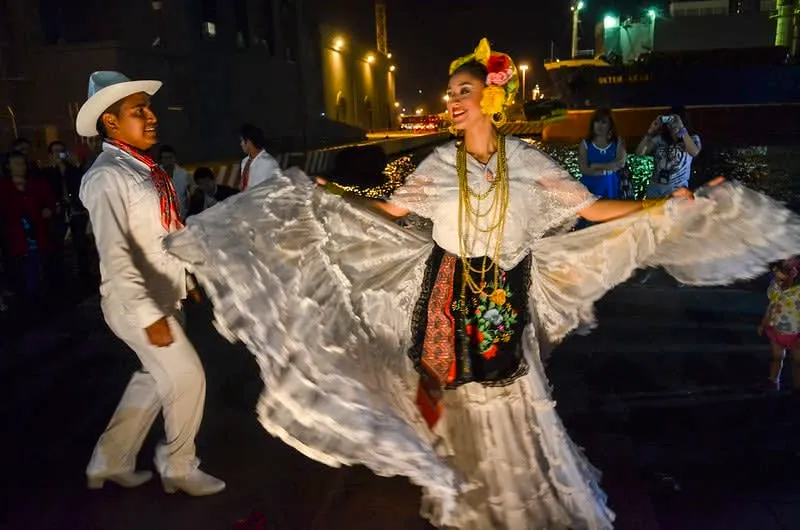
The dance is fundamentally zapateado — a percussive footwork tradition where heels and toes strike the tarima (wooden platform) in rhythmic patterns that complement the music. Huapango zapateado is more controlled and less flamboyant than flamenco — the upper body stays relatively still, the feet create intricate rhythmic patterns that respond to the music.
The five foundational steps:
1. Campanas (Bells): Weight shifts side to side with two heel strikes to the floor. The “bell” rhythm suggests two tones ringing alternately. This is usually the first step beginners learn — it establishes the basic weight transfer pattern.
2. Deslizados (Slides): The right foot taps and slides forward, returns with a heel strike, then the left foot repeats. The sliding quality distinguishes this from purely percussive steps — it creates a flowing quality between the sharp strikes.
3. Puntas (Tips): The right foot taps while the left toe points to the floor — a more delicate step that alternates between heel percussion and toe placement. Creates visual contrast with the heavier campanas.
4. Paso de Tres (Three-Step): A three-beat zapateado that marks the triple-metre aspect of the music. This step appears in several Mexican folkloric dances and is the most widely recognized outside the Huasteca.
5. Jaranas: The most complex and energetic step — right foot forward, left back, then right back, left forward, followed by five rapid strikes in one direction. This step generates the most sound and is typically used at musical climaxes. Named after the jarana instrument it rhythmically mirrors.
Key rules for all huapango dancing:
- Couples face each other without touching — communication is entirely through footwork, timing, and eye contact
- The tarima platform must be raised (typically 30-40cm) so the sound carries
- Steps are performed in response to the music — good zapateado feels like percussion accompanying the trio, not choreography imposed on top of it
- Upper body stays controlled — the visual drama comes entirely from the feet
Origins: Where Huapango Comes From
Huapango’s roots trace to the 17th century in the La Huasteca region — a cultural zone spanning eight Mexican states (Veracruz, San Luis Potosí, Hidalgo, Tamaulipas, Querétaro, Puebla, and parts of Guanajuato) named for the Huastec (Téenek) indigenous people who inhabited it before the Aztec expansion.
Three distinct cultural streams converged here during the colonial period:
- Indigenous Téenek and Nahua traditions — rhythmic footwork, communal celebration, connection between dance and cosmology
- Spanish colonial music — the guitar family of instruments, harmonic structures, the décima (10-line stanza form used for improvised lyrics)
- African musical influences — brought by enslaved people to the coastal lowlands, contributing syncopated rhythms and call-and-response vocal patterns
This collision produced something that sounds like none of its parents. The resulting son huasteco is both indigenous in its footwork and spatial relationship to the dance platform, Spanish in its harmonic language, and African in the way performers talk to each other musically — the conversation between instruments, voice, and feet that gives huapango its distinctive electricity.
By the 18th century, the style had spread throughout the Huasteca and begun differentiating into regional variants. By the 20th century, it had produced four distinct forms.
For travelers, the easiest modern entry point is usually the Huasteca Potosina, where waterfalls, river towns, and regional festivals make it realistic to pair outdoor travel with live music. If you are building a broader route through the region, our San Luis Potosí guide and Veracruz travel guide help connect the cultural dots.
The Four Styles of Huapango
1. Son Huasteco (Huapango Clásico)
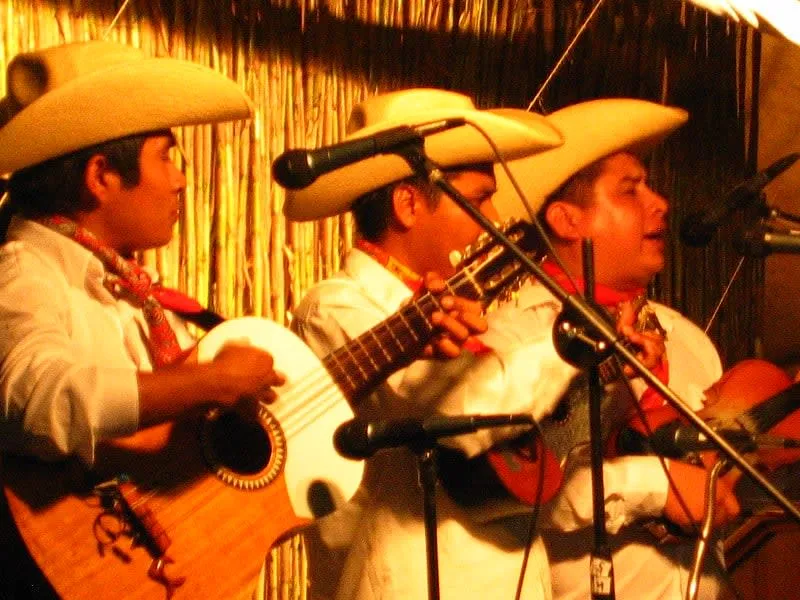
The original and most purely Huasteca form. A trio huasteco (three musicians) performs with:
- Violin — carries the melody; falls completely silent during vocal passages
- Huapanguera — provides harmonic bass and rhythm
- Jarana huasteca — provides high rhythmic counterpoint
The musical structure simultaneously implies duple metre (2 beats) and triple metre (3 beats) — which is why the dance steps look both syncopated and grounded. The dancers’ zapateado footwork fills the rhythmic space that the violin leaves when the singers begin.
Most famous son huasteco: El Querreque — a comedic call-and-response in which two singers trade increasingly elaborate verbal jabs.
2. Huapango Arribeño (Son Arribeño)
Played in the zona media and Sierra Gorda corridor, especially across southern San Luis Potosí, Querétaro, and Guanajuato. Instrumentation: two violins, one huapanguera, one jarana.
The defining feature of arribeño is the use of décimas — formal 10-line improvised verses in the tradition of Spanish colonial poetry. The competition format called topadas (see below) is most developed in this style.
Principal master: Guillermo Velázquez, from Xichú, Guanajuato — performing topadas for over 40 years.
3. Huapango Norteño
A northern adaptation incorporated into conjunto norteño — the border style that evolved into modern norteño. The rhythm is lifted from son huasteco but the instrumentation is different: accordion, bajo sexto, double bass, drums, and saxophone.
This is the most commercially successful branch — countless norteño hits use the huapango 6/8 rhythm.
4. Huapango de Mariachi
The mariachi adaptation preserves the falsetto vocal style and rhythmic alternation while adopting full mariachi instrumentation (trumpets, violins, guitar, vihuela, guitarrón). Famous examples:
- “Cucurrucucú Paloma” — made internationally famous by Caetano Veloso
- “Malagueña Salerosa” — recorded by Ry Cooder and Calexico
- “Rogaciano el Huapanguero” — a tribute to the tradition itself
The Three Instruments in Depth
Huapanguera (Quinta Huapanguera)
A large, deep-bodied guitar with five courses of strings (ten strings total). Significantly larger than a standard guitar — the deep body produces a booming bass resonance that fills the low-end role of a bass instrument. The huapanguera must simultaneously imply both duple and triple time — a technique that takes years to master.
Jarana Huasteca
A small, high-pitched guitar with five courses — conceptually the opposite of the huapanguera. Where the huapanguera is deep and resonant, the jarana is bright and cutting. The jarana creates the syncopated patterns that interact with the zapateado footwork. When the dancers’ heels hit the floor, they are responding to rhythmic cues from the jarana.
Violin
The melody carrier and most emotionally expressive voice. Son huasteco violin technique is highly specific — players use bowing techniques and ornamentation distinct from classical violin. The fiddle tradition developed in isolation, producing a raw, direct sound that prioritizes groove over polish.
The violin’s most striking characteristic: it stops completely when the singers begin. This creates dramatic contrast — the full three-instrument texture suddenly dropping to just two guitars and the percussion of feet.
The Falsetto Vocal Tradition: Bravura
The most immediately distinctive feature of son huasteco: the falsetto singing style — both vocalists sing in their upper register, producing a bright, high, somewhat piercing sound that carries across outdoor festival spaces.
This style is called bravura (bravery, boldness). It is not considered “feminine” in Huasteca culture — it is the opposite. Singing in bravura requires breath control, vocal strength, and the courage to perform in a style that sounds vulnerable. Young huapangueros spend years developing their falsetto before performing publicly.
The vocal duet structure is call-and-response: one singer makes a statement, the other responds. In topadas, this becomes actual competitive improvisation.
Topadas: Overnight Improvisation Competitions
A topada (literally “meeting” or “encounter”) is a competitive event in which two trios face each other and sing improvised verses for hours — sometimes overnight — attempting to out-wit, out-rhyme, and out-last the opposing group.
The format is most developed in son arribeño, where décimas (10-line verses in the espinela form) are composed on the spot. Themes include local events, philosophical arguments, romantic rivalry, humorous commentary on current affairs, and direct challenges to the opposing trio.
The best topadas in San Luis Potosí can last from dusk to dawn, with hundreds of people gathered around the tarima. The atmosphere combines the intensity of a verbal sparring match with the energy of a dance party. This is one of the most extraordinary folk art traditions in the Americas — and it happens in near-complete obscurity.
Traditional Costume
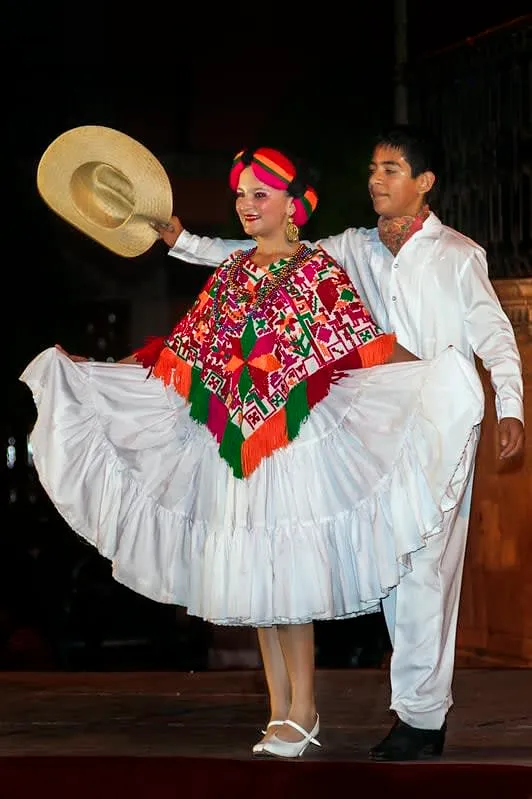
Men: White cotton manta pants and shirt. Black botines (ankle boots) with a heel designed for zapateado. Wide-brimmed hat and a bandana at the neck. The cueras — fringed leather jackets — appear in Tamaulipas-style huapango norteño.
Women: Colorful floor-length skirt with a white background and elaborate Huasteca embroidery in floral motifs. Embroidered white blouse. Hair braided with ribbons. Thick-heeled shoes — the heel height is specifically designed to maximize the zapateado sound on the tarima.
The embroidery style varies by state: San Luis Potosí favors dense floral cross-stitch with geometric borders; Veracruz uses more organic, curving botanical designs; Hidalgo often incorporates animals. Experienced observers can identify a performer’s home state from the embroidery alone. For more on this tradition, see the guide to traditional Mexican clothing.
The Moncayo Connection: When Folk Became Classical
In 1941, Mexican composer José Pablo Moncayo completed an orchestral piece called simply Huapango — a tone poem based on three traditional Veracruz sones: El Siquísirí, El Balajú, and La Presumida. The piece premiered with the Orquesta Sinfónica Nacional conducted by Carlos Chávez.
Huapango by Moncayo is now considered one of Mexico’s great national musical monuments — performed by symphony orchestras worldwide and used in international broadcasts to represent Mexican musical identity.
The irony: most Mexicans know Moncayo’s Huapango from TV and film soundtracks but may never have heard an actual son huasteco trio.
Where to See Huapango Live
Experience huapango in its homeland. Browse Huasteca Potosina tours on Viator to combine waterfalls, canyon hikes, and live music in one of Mexico’s most extraordinary regions.
| Location | Event | When |
|---|---|---|
| Ciudad Valles, SLP | Festival del Son Huasteco | April (check annually) |
| Xichú, Guanajuato | Festival de Son Arribeño + Topada | February |
| Tamazunchale, SLP | Xantolo / Huapango celebrations | Late October (Day of the Dead) |
| Huejutla de Reyes, Hidalgo | Regional festivals | Varies |
| Mexico City (Plaza Garibaldi) | Son huasteco trios alongside mariachi | Year-round evenings |
| Papantla, Veracruz | Corpus Christi festival | June |
The Xantolo Festival (the Huasteca’s Day of the Dead, celebrated over 4 days in late October) is arguably the best single event — not as staged performance but as living culture. Villages in Huasteca Potosina hold all-night huapango dances as part of the ancestor commemoration.
If traveling through San Luis Potosí, Xilitla, or the nearby Huasteca Potosina highlands, ask locals about upcoming topadas in the zona media. These spread through community networks, not online advertising, but they are completely open to anyone who shows up.
For the broader Huasteca region, our Huasteca Potosina waterfalls guide and best waterfalls in Mexico cover the natural attractions that pair perfectly with a cultural immersion trip.
Huapango vs. Son Jarocho: The Key Difference
This is one of the most common search-intent overlaps. Travelers see zapateado footwork and string instruments in both traditions and assume they are interchangeable. They are not.
These two traditions are frequently confused because both use zapateado footwork and originate in eastern Mexico:
| Huapango (Son Huasteco) | Son Jarocho | |
|---|---|---|
| Region | Huasteca (NE Mexico) | Coastal Veracruz |
| Instruments | Violin, huapanguera, jarana huasteca | Jarana jarocha, requinto, arpa (harp) |
| Famous song | El Querreque | La Bamba |
| Platform | Tarima (raised) | Fandango (also tarima) |
| Vocal style | Falsetto bravura | More conventional range |
| Feel | Intense, competitive | Festive, communal |
Both traditions are extraordinary — they just come from different parts of eastern Mexico and sound completely different to experienced ears.
How to Learn Huapango: Beginner’s Guide
Learning to dance huapango outside the Huasteca is genuinely possible. Here’s the realistic path:
Step 1: Watch before you try
Look up son huasteco videos before attempting any footwork. You need to internalize the 6/8 rhythm, counting “1-2-3, 1-2-3” in your head while watching. Notice how the feet sync with the musical accents, not a fixed beat.
Step 2: Master the basic weight shift first
Before any zapateado pattern, get comfortable shifting your full weight from foot to foot in a slow, controlled way. Most beginners rush this and lose balance when adding footwork.
Step 3: Learn campanas before anything else
Campanas (the basic heel-shift step) gives you the core rhythm. Practice it slowly — right heel strike, weight shift left, left heel strike, weight shift right — until it feels automatic. This alone will let you participate in a basic way.
Step 4: You need a tarima (or a substitute)
Authentic zapateado requires a surface you can hear. A sheet of plywood (30-40cm elevated) works for practice. Hard tile or wood flooring also amplifies the heel strikes. Carpet kills the sound and the joy.
Step 5: Find a community class
In Mexico City: look for ballet folklórico classes that include regional styles — many cover son huasteco. In the US, Ballet Folklórico companies in Texas, California, and Chicago regularly teach huapango as part of their northeastern Mexico repertoire. Mexican cultural centers (Casa Mexicana) often run workshops.
Common Beginner Mistakes
| Mistake | Fix |
|---|---|
| Watching your feet | Eyes forward — footwork is muscle memory, not visual |
| Using your whole leg | Huapango zapateado is from the knee down |
| Bouncing on impact | Land flat — percussion comes from controlled strike, not drop |
| Rushing the tempo | Son huasteco runs about 130-140 BPM — start at 100 |
| Ignoring the triple metre | Count “1-2-3” not “1-2” — most western dancers default to duple time |
| Upper body stiffness | Relax the torso — arms hang naturally, no arm choreography in zapateado |
Is huapango hard to learn?
Harder than most Mexican folk dances, easier than flamenco. The challenge is the rhythm — the simultaneous duple/triple time that the music implies. Beginners typically take 3-4 group classes to get the basic steps, several months to perform them confidently, and years to develop authentic musicality in the footwork.
Huapango Norteño: The Northern Version (And Why It Matters)
Huapango norteño is the most widely danced version of huapango in Mexico today — and the least understood internationally. If you’ve been to a Mexican family celebration, quinceañera, or rodeo anywhere in northern Mexico or the US Southwest, you’ve likely danced to it without knowing it.
What distinguishes it from son huasteco
| Son Huasteco | Huapango Norteño | |
|---|---|---|
| Instruments | Violin, huapanguera, jarana | Accordion, bajo sexto, bass, drums |
| Vocals | Falsetto bravura | Normal range, two voices |
| Dance style | Solo/couple zapateado on tarima | Couple partnered dance, more upright |
| Speed | 130-140 BPM | 140-160 BPM (generally faster) |
| Setting | Festival, village celebration | Cantina, wedding, norteña concert |
| Geography | Huasteca region | Nuevo León, Tamaulipas, Chihuahua, US border |
The footwork difference
Huapango norteño uses a simplified version of the zapateado — the five-pattern vocabulary of son huasteco is distilled down to a core shuffling step that’s easier to learn but still rhythmically distinct. Couples dance in partial hold (not fully apart like classic son huasteco).
Famous norteño huapangos
Artists like Los Cadetes de Linares, Ramón Ayala, Los Tigres del Norte, and later Grupo Intocable built careers partly on the huapango rhythm. “Las Isabeles,” “Caballo de Palo,” and countless others use the 6/8 huapango base.
This commercial branch is why huapango remains alive across generations — the Huasteca tradition is the root, but norteño music planted it across northern Mexico and the Mexican diaspora.
Huapango’s Place in Mexican Culture
Unlike mariachi — which became a national symbol through commercial promotion and government cultural policy — huapango survived through community transmission without institutional support. Topadas in Xichú happen because people in that community have organized them for generations.
This grassroots resilience makes huapango one of the most authentic expressions of Mexican folk culture still in active practice. The tradition is not museum-preserved; it is alive, competitive, and evolving, with young musicians learning from masters and adding their own voices to the ongoing improvisation.
For the broader context of Mexico’s cultural traditions, the guide to Mexican culture covers major folk dance and music forms across the country’s regions. The Chinelos dance of Morelos represents another regional folk tradition with its own distinct history. For Mexican traditional drinks that share the same Huasteca roots, see the traditional Mexican drinks guide. And if you want a second Huasteca trip idea after this one, Xilitla and the Ciudad Valles travel guide are two of the easiest nearby destinations to pair with a live-music detour.
Conclusion
Huapango is what happens when three musical cultures — Nahua, Spanish, and African — spend 400 years talking to each other through feet, strings, and falsetto voices on a wooden platform in the hills of northeastern Mexico.
It produced four styles, three essential instruments, one of the world’s most demanding vocal traditions, and competitive all-night improvisation contests that make freestyle rap battles look brief. It also, indirectly, produced one of Mexico’s greatest classical orchestral works.
If you travel to the Huasteca Potosina — do not leave without hearing it live. The waterfalls of Huasteca Potosina are extraordinary. The music playing near them at a village festival is extraordinary in a completely different way.
And if you encounter a topada — stay until dawn.