Cancun vs Playa del Carmen 2026: Which Is Right for You?
Cancun and Playa del Carmen are 68 kilometers apart on Mexico’s Caribbean coast, connected by one of the most-traveled highway stretches in the country. Most first-time visitors to the Riviera Maya end up choosing between the two — and the choice matters more than people expect.
This is the direct comparison: what each place actually delivers, what it costs, and which traveler profile fits which destination.
The Short Answer
Choose Cancun if: you want an all-inclusive resort, non-stop international flights, big nightlife, or a first-time Caribbean vacation with maximum convenience.
Choose Playa del Carmen if: you want to walk everywhere, prefer boutique hotels and local restaurants, want easy access to cenotes, or you’re tired of the mega-resort formula.
Choose both: if you have 10+ days. Stay 4–5 nights in each. The ADO bus makes the switch trivially easy.
Head-to-Head Comparison
| Category | Cancun | Playa del Carmen |
|---|---|---|
| Population | ~890,000 | ~350,000 |
| Location | Northern end, Hotel Zone peninsula | 68km south of Cancun |
| Beach access | Hotel Zone beach (resort-controlled), public Playa Delfines | 5th Avenue-adjacent beaches (less crowded) |
| Sargassum exposure | Moderate (northeast-facing) | Moderate-High (east-facing, Apr–Oct) |
| Sargassum escape | Drive north to Puerto Morelos or Isla Mujeres | Ferry to Cozumel (west coast, always clear) |
| Nightlife | Mega-clubs: Coco Bongo, The City, Mandala | Boutique bars + La Santanera, Zenzi |
| All-inclusive options | 250+ resorts | ~20–30 smaller AI properties |
| Uber | Works in El Centro, banned at airport | Completely banned |
| Transport from airport | ADO 85–100 MXN, authorized taxis | ADO 232 MXN from Terminal 4 |
| Cenote access | Day trips (45–90 min each way) | In-town: Chaak-Tun 2km, Cristalino 10km |
| Tulum day trip | ADO ~2.5 hrs | ADO ~1 hr |
| Chichen Itza day trip | ADO ~2.5 hrs or tour | ADO ~2.5 hrs or tour |
| Cobá (climbable pyramid) | 2.5–3 hrs | 1.5 hrs |
| 5th Avenue walking | Not applicable | ✅ Primary attraction |
| Budget range/night | $25–$80 (El Centro), $100–$500+ (Hotel Zone) | $40–$150 |
| Spring break intensity | ⭐⭐⭐⭐⭐ | ⭐⭐⭐ |
| Family all-inclusives | Excellent selection | Limited |
| International flights | Major hub: 17M passengers/year | No airport — fly into CUN + bus |
Cancun: What It Actually Is
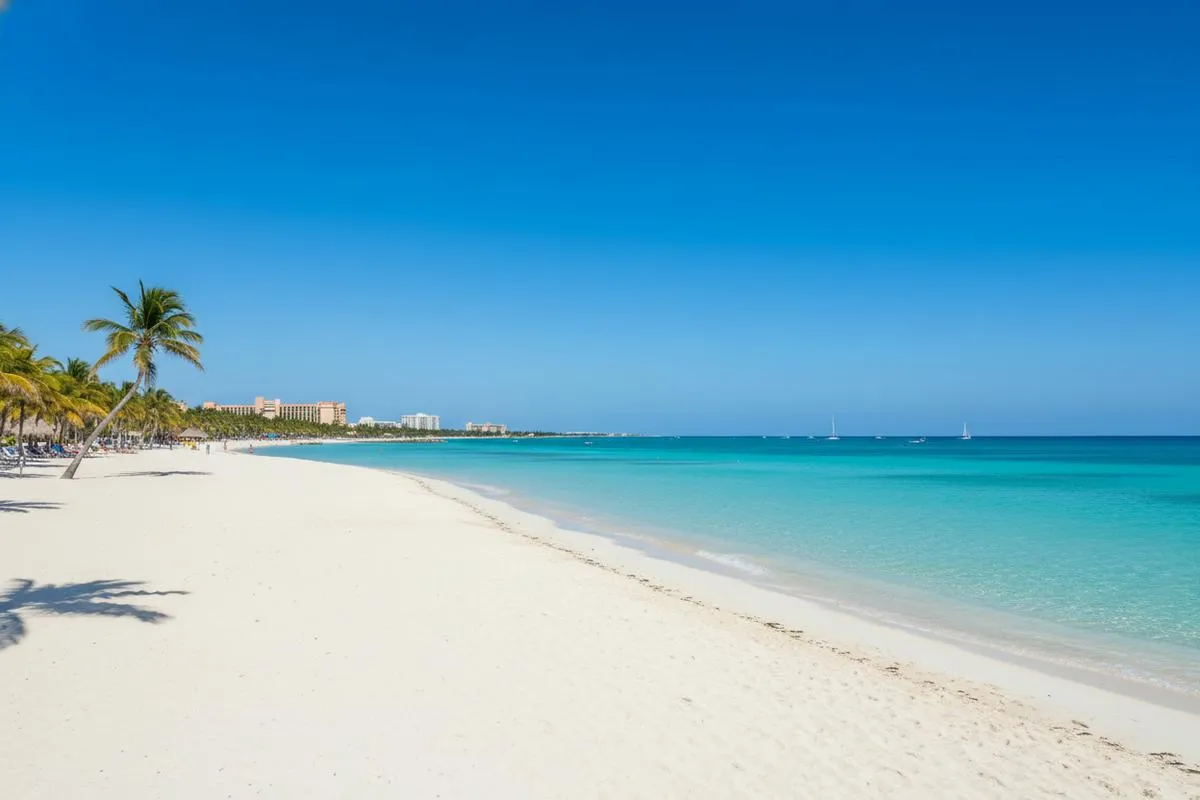
Cancun’s Hotel Zone (Zona Hotelera) is a 22-kilometer peninsula — a strip of resorts, malls, and restaurants with the Caribbean on one side and a lagoon on the other. It’s not a traditional Mexican city. It’s a resort complex that happens to be in Mexico.
That’s not a criticism. For what it is — a Caribbean beach vacation with full infrastructure — it’s excellent.
What Cancun does well:
- Non-stop flights from most major US, Canadian, and European cities (17M+ passengers/year)
- All-inclusive resorts at every price point ($80–$1,000+/person/night)
- Nightlife that operates at a scale PDC simply can’t match: Coco Bongo holds 3,000+ people, The City holds 5,000
- Protected lagoon water for watersports (Nichupté Lagoon)
- Proximity to every Riviera Maya destination via ADO
What Cancun does less well:
- Walking culture — you need transport between most points in the Hotel Zone
- Local/authentic food requires leaving the Hotel Zone and going to El Centro downtown
- Spring break weeks (March–April): the Hotel Zone becomes extremely crowded and noisy
- Sargassum: Hotel Zone beaches face northeast, which is better than PDC but still seasonal
Cancun’s hidden advantage most guides miss: Playa Delfines is a free public beach at the southern end of the Hotel Zone, accessible by bus, with consistently good swimming and no resort crowds.
Playa del Carmen: What It Actually Is
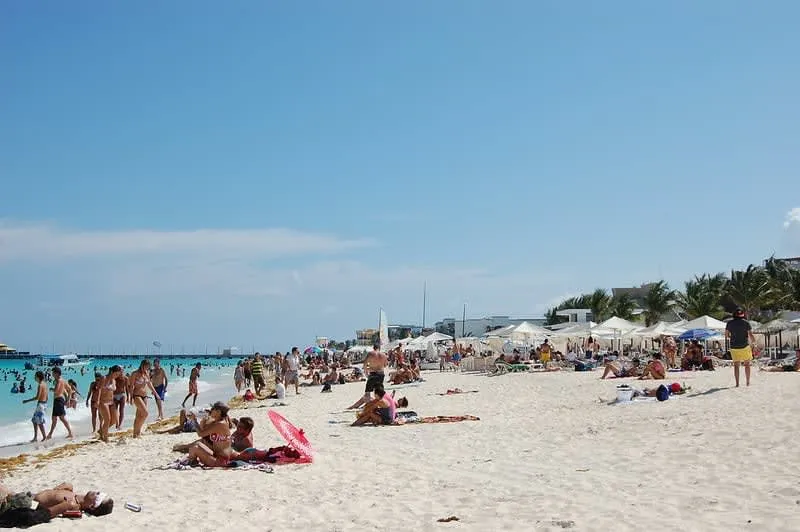
Playa del Carmen is a real town with a tourist overlay. It has a downtown, a bus station, local neighborhoods, and a central street (Quinta Avenida / 5th Avenue) that functions as a pedestrian corridor from the beachfront to the ADO station.
The appeal is walkability: you can walk from your hotel to the beach, to 5th Avenue restaurants and bars, to the ADO bus, to the colectivo for Tulum — all on foot. That’s almost impossible in the Cancun Hotel Zone.
What PDC does well:
- Walkable — 5th Avenue extends ~26 blocks; most travelers never need a car
- Better access to cenotes: Chaak-Tun is literally 2km from the town center; Cristalino is 10km
- Boutique hotels and locally-owned restaurants dominate
- Ferry to Cozumel departs directly from the beachfront (40 min, sargassum-free on arrival)
- Quieter than Cancun during spring break
- Better base for Tulum (1 hour vs 2.5 from Cancun)
What PDC does less well:
- No airport — you fly into CUN and take the ADO bus (1.5 hours, 232 MXN from T4, or 152 MXN from downtown CUN)
- Uber is completely banned — taxi unions have blocked it with no workaround
- All-inclusive options are limited (~20–30 properties vs 250+ in Cancun)
- Sargassum: east-facing beaches, moderate-high exposure April–October
- 5th Avenue can feel tourist-trap-heavy after a few days
Nightlife: Different Leagues
This is the clearest split between the two destinations.
Cancun nightlife operates at a scale that’s genuinely unique in Mexico:
- Coco Bongo (Hotel Zone): $70–95 USD cover, no seating, choreographed Las Vegas-style shows mixing live acts, acrobatics, and club music. Divisive — some love the spectacle, others hate the chaos. Starts at 10:30 PM.
- The City: 5,000-person capacity, multiple floors, imported DJs. The largest club in the Riviera Maya.
- Mandala: Rooftop + poolside setup, slightly more upscale
- Peak spring break (late March–April 5): Hotel Zone nightlife is relentless 24/7
PDC nightlife is smaller but more organic:
- La Santanera: Split venue, both indie and electronic music
- Zenzi: Beach bar on the sand, reggae and chill vibes, no cover
- Calle 12 Norte: Local bar strip with craft beer and mezcal spots
- Coco Bongo PDC: Yes, there’s a Cancun Coco Bongo spin-off, smaller than the original
- No mega-clubs operating at Cancun scale — this is either a feature or a bug depending on your preferences
Sargassum Reality Check
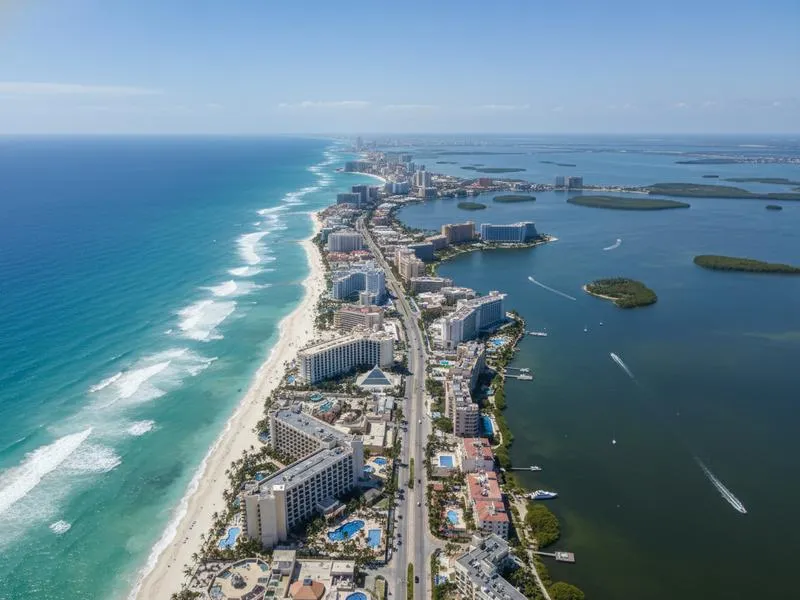
Both destinations are on the east-facing Caribbean coast. Sargassum is a real issue April–October, particularly August–September.
Cancun vs PDC for sargassum:
- Cancun’s Hotel Zone beaches face northeast, catching slightly less Atlantic sargassum drift than PDC’s more eastward-facing beaches
- Puerto Morelos (between Cancun and PDC) often has less sargassum than either — a good day-trip option when conditions are bad
- Best escape from both: Take the ferry from PDC to Cozumel (40 min, 260–300 MXN). The western coast of Cozumel is structurally protected from sargassum year-round — completely different water conditions
Both cities have beach-cleaning equipment that runs daily during sargassum season. Many mornings start with clear beaches before afternoon drift arrives.
Cenotes: PDC Wins This Round
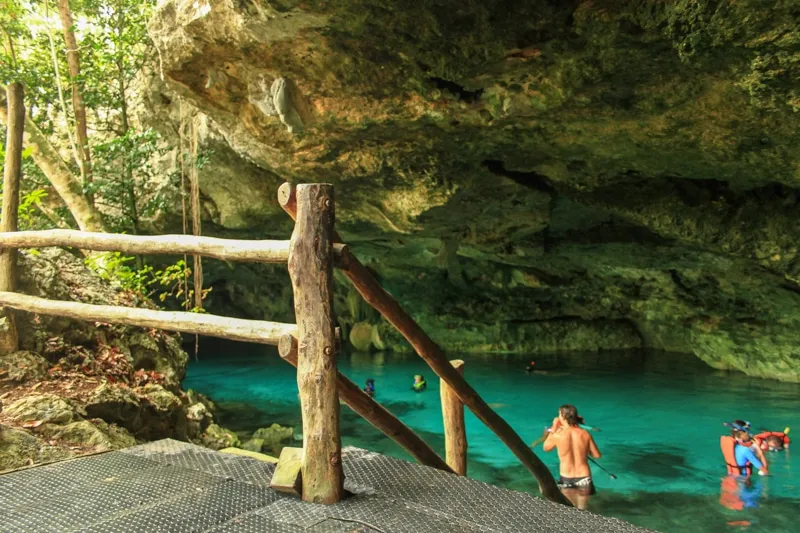
If cenotes are a priority, Playa del Carmen has a structural advantage:
- Chaak-Tun: 2km from 5th Avenue, inside the town limits, two connected cenotes (150 MXN + small trail fee)
- Río Secreto: 8km away, underground river cave system (~1,000 MXN)
- Cenote Cristalino: 10km south, open-air jungle cenote with rope swings (80 MXN)
- Cenote Azul: 12km south on Highway 307
- Dos Ojos: 25km south, connected cave diving system (150 MXN surface, more for diving)
From Cancun, cenotes require 45–90 minutes of travel each way. From PDC, the closest takes 15 minutes by taxi.
Tulum’s cenote cluster is 1 hour from PDC vs 2.5 hours from Cancun.
Wildlife: Where Cancun Wins
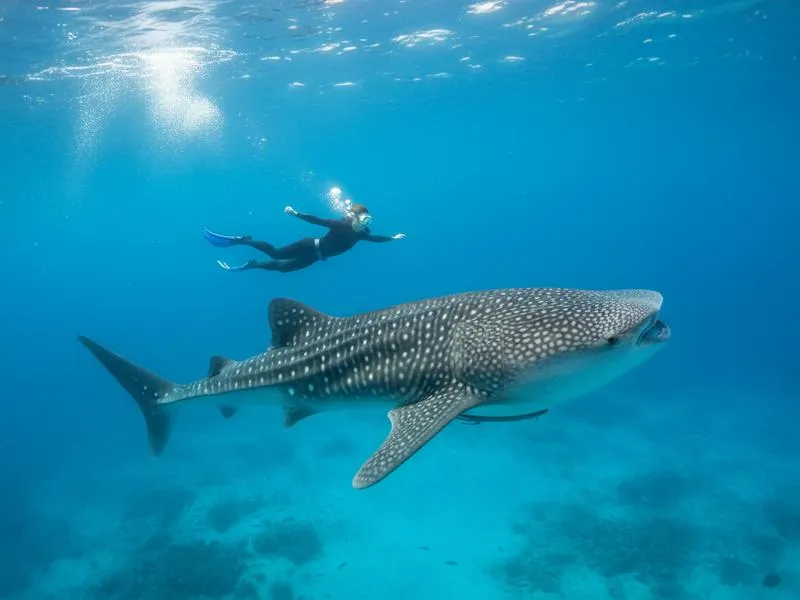

From Cancun:
- Whale sharks: June–September at Isla Mujeres and Holbox (tours depart Cancun, 4–6 hrs)
- Isla Contoy: Day trip to protected bird sanctuary, 200-person daily limit
- Isla Mujeres: 15-min ferry, sea turtles, snorkeling, golf carts
From PDC:
- Akumal sea turtles: 20km south, green sea turtles year-round in the bay (most accessible in Mexico)
- Whale sharks: Tours depart from PDC too, but slightly longer travel to the whale shark zone
- Cobá climbable pyramid: 1.5 hours, the only easily climbable pyramid in the Yucatan (Ek Balam is another option from Valladolid)
Cost Comparison (Real Numbers)
Budget breakdown for 7 days
| Budget Style | Cancun (Hotel Zone) | Cancun (El Centro) | Playa del Carmen |
|---|---|---|---|
| Budget backpacker | $80–100/day (AI entry-level) | $40–60/day | $55–80/day |
| Mid-range | $150–250/day (AI mid-tier) | $80–120/day | $90–140/day |
| Upscale | $300–600+/day (AI luxury) | $150–250/day | $160–280/day |
Cancun El Centro figures = hostel/mid hotel + street food + local transport. No significant difference vs PDC at the non-AI level.
The key difference: Cancun’s all-inclusive system creates a unique pricing tier that doesn’t exist in PDC. For travelers who want everything pre-paid in one transaction — food, drinks, activities, room — Cancun at $100–250/person/night can be cheaper than building the same trip à la carte in PDC.
Transport: How to Get Between Them
Getting from Cancun to Playa del Carmen (or vice versa) is straightforward:
From Cancun Airport (Terminal 4):
- ADO bus direct to PDC downtown: 232 MXN, ~1.5 hours, departures every 15–30 minutes
- Private transfer: 600–1,200 MXN, 1.5 hours
- Uber: banned in PDC, but works from CUN airport to Hotel Zone/El Centro
From Cancun Hotel Zone:
- ADO from downtown terminal: 152–200 MXN
- Colectivo from El Centro: 75–100 MXN (no luggage, not comfortable for hotels)
From Playa del Carmen to Cancun Airport:
- ADO bus to Terminal 4: 232 MXN
- ADO bus to downtown + taxi/Uber: 152 + 80–150 MXN
- The ADO specifically stops at CUN Terminal 4 before continuing to downtown — critical info for travelers connecting to flights
No Uber in PDC: to get to the ADO station from your PDC hotel, you walk (most areas are walkable) or take a 30–80 MXN taxi.
Who Should Choose Which
Cancun is the better choice for:
- All-inclusive seekers — far more options, better deals
- Non-stop international flight connections — CUN is a major hub
- First-time Caribbean vacation — infrastructure is maximal
- Big nightlife priorities
- Families who want resort amenities and kids’ clubs
- Groups traveling for spring break
- Anyone flying home from the Yucatan — better to end in CUN
Playa del Carmen is the better choice for:
- People who don’t want a resort — boutique hotels and local restaurants dominate
- Cenote access as a priority
- Base for Tulum and the southern Riviera Maya (1 hour vs 2.5)
- Walkability and “real town” atmosphere
- Couples, solo travelers, digital nomads
- Anyone who’s been to Cancun before and wants something different
Split the difference (recommended for 10+ days):
- Fly into CUN, spend 4–5 nights in Playa del Carmen (cenotes, Tulum day trips, 5th Avenue)
- Take the ADO north and spend 3–4 nights in Cancun (whale sharks if June–Sep, Isla Mujeres, Chichen Itza if you haven’t done it)
- Fly home from CUN
Where to Stay
Cancun — Hotel Zone: Hyatt Ziva, Le Blanc (adults-only luxury), Sandos Cancun Lifestyle, Iberostar Selection Cancun. Budget AI: Park Royal Beach. Mid: Dreams Natura.
Cancun — El Centro (El Centro): Standard hotels, budget hostels. Far cheaper than Hotel Zone. No beach access — you need to taxi or bus to the Hotel Zone or Playa Delfines.
Playa del Carmen: Calle 38 Norte neighborhood (quietest), Aldea Coba area, anywhere within 3 blocks of 5th Avenue for walkability. Look for hotels with small plunge pools — PDC has many boutique options in the $80–150/night range that beat equivalent Hotel Zone properties on value.
Final Verdict
There’s no objectively better destination between Cancun and Playa del Carmen — they serve different travel styles. The question is which style matches yours.
If you want to arrive, check in, drink unlimited piña coladas at a swim-up bar, and not think about logistics for a week: Cancun’s all-inclusive Hotel Zone was designed exactly for you.
If you want to walk out your hotel door, grab a taco from a street stand, rent a bike to the cenote, and decide on dinner by wandering: Playa del Carmen is the right pick.
Most experienced Riviera Maya travelers end up loving both.
Getting there: Cancun International Airport (CUN) serves both destinations. ADO connects them in 1.5 hours. More on getting around the Riviera Maya →