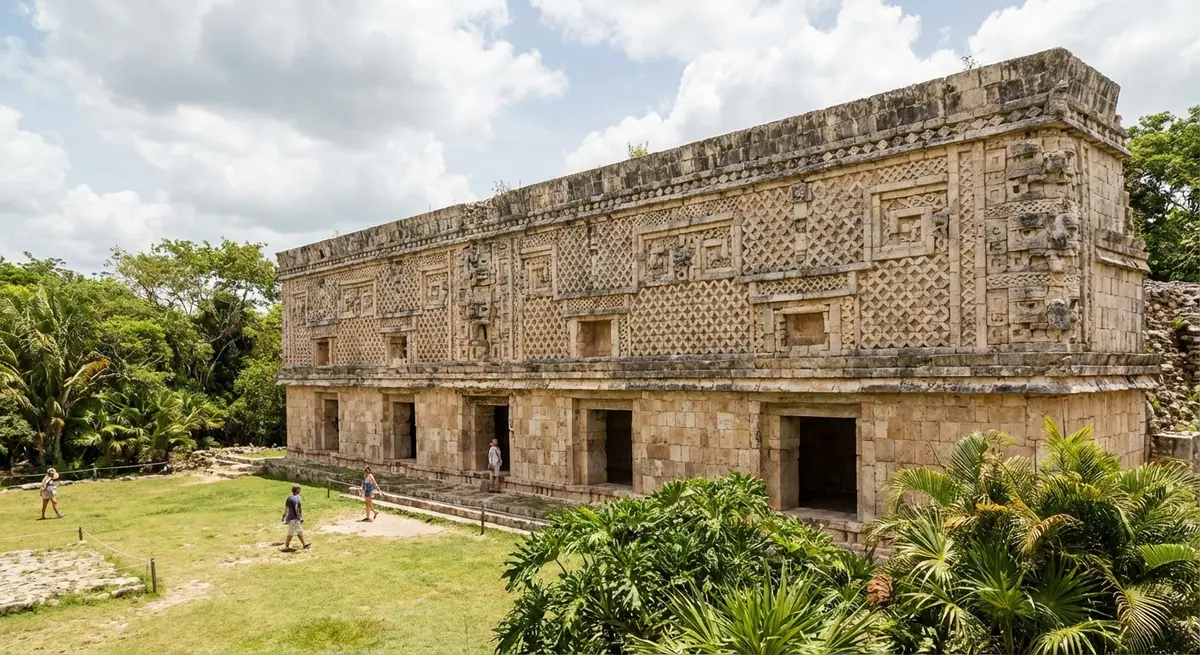
Uxmal Light Show & Ruins Guide 2026: Hours, Tickets
Planning the Uxmal light show? Ecos de Uxmal is a 45-minute nighttime videomapping walk with evening sessions currently listed from 7:30 PM; it uses a separate ticket from daytime admission, so confirm the session and price before traveling. For the ruins, Uxmal opens daily from 8 AM to 4 PM, with last entry at 3 PM.
Uxmal is a pre-Columbian Maya city in the Yucatán Peninsula, Mexico, located 80 kilometers south of Mérida. Built primarily between 700 and 1000 CE during the late Classic and Terminal Classic periods, it represents the highest achievement of Puuc-style Maya architecture and receives around 500,000 visitors per year — a fraction of Chichen Itza’s 2 million.
Quick Facts
| Location | Santa Elena municipality, Yucatán, Mexico |
| Distance from Mérida | 80 km south (1 hour by car) |
| Distance from Cancún | 270 km (3–3.5 hours by car) |
| Entry fee | 566 MXN total (461 MXN state + 105 MXN INAH federal) |
| Opening hours | 8 AM – 4 PM daily; last entry 3 PM |
| Ecos de Uxmal light show | Daily evening videomapping sessions; separate ticket |
| Annual visitors | ~500,000 |
| UNESCO designation | 1996 |
| Can you climb? | No — climbing closed since 2012 |
| Time needed | 2–3 hours (site only) or 5–6 hours (full Puuc Route) |
Why Uxmal Beats Chichen Itza (For Most People)
Chichen Itza is the most visited archaeological site in Mexico. Uxmal is arguably the most impressive. Here’s the honest comparison:
| Factor | Uxmal | Chichen Itza |
|---|---|---|
| Architecture style | Puuc (intricate mosaic carvings) | Toltec-Maya (monumental scale) |
| Crowds | Low — 500K visitors/year | Packed — 2M visitors/year |
| Midday experience | Tolerable | Miserable (shoulder-to-shoulder) |
| UNESCO designation | 1996 | 1988 |
| Can you climb? | No (2012) | No (2006) |
| Distance from Mérida | 1 hour | 2 hours |
| Distance from Cancún | 3.5 hours | 2.5 hours |
| Entry fee | 566 MXN | 646 MXN |
| Puuc Route extension | Yes — 4 more sites nearby | No |
| Night show | Yes — atmospheric | Yes — touristy |
The honest verdict: If you’re based in Mérida and want depth over crowds, Uxmal wins. If you’re based in Cancún on a one-week Caribbean trip and can only see one major site, Chichen Itza’s scale and global iconic status still justify the journey.
Most visitors who see both say Uxmal’s architecture is more beautiful. Most also say Chichen Itza’s atmosphere — despite the crowds — is uniquely powerful.
The Main Structures
Pyramid of the Magician (Pirámide del Adivino)
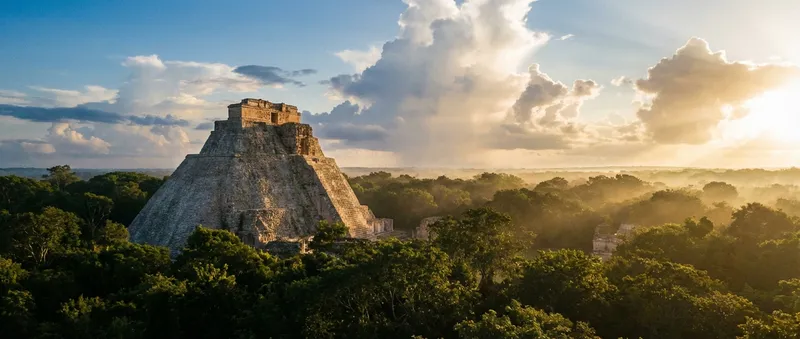
The Pyramid of the Magician is Uxmal’s signature structure: a 35-meter pyramid with an unusual oval base, unique in Mesoamerica. The name comes from a Maya legend that a dwarf god built it in a single night — likely a mythological memory of the pyramid’s rapid construction phases.
Five construction phases built one atop the other over three centuries. The rounded edges created by this layered construction give the pyramid its distinctive egg-shaped profile, visible from throughout the site.
The west staircase leads to Temple IV, decorated with elaborate Chaac (rain god) masks. The east staircase climbs to Temple V. Both stairways are steep — 60° angles compared to 45° at most other Maya sites — but climbing was closed in 2012 to protect the structure from erosion.
Tip: The best photography angle is from the southwest corner of the Nunnery Quadrangle, about 30 minutes after opening. The morning light hits the pyramid’s west face directly.
Nunnery Quadrangle (Cuadrángulo de las Monjas)
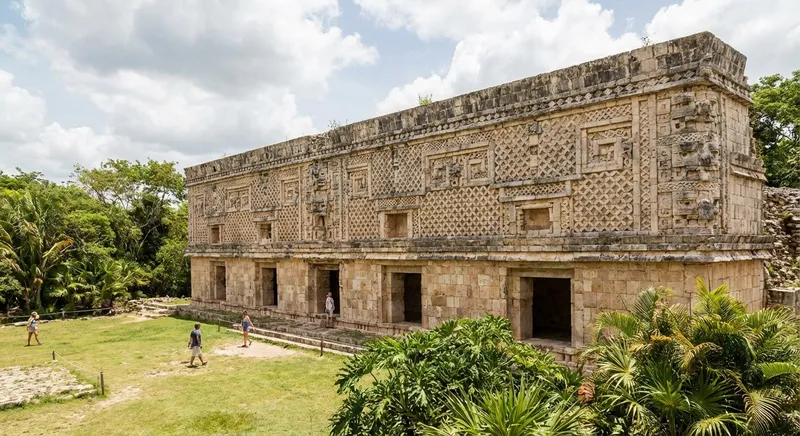
The Nunnery Quadrangle is four buildings arranged around a central courtyard — named by Spanish explorers who thought it resembled a convent. It’s the most photographically rich structure at Uxmal and arguably in all of Yucatán.
Each of the four buildings has a distinct decorative program on its upper facade:
- North building: 300 individual mosaic masks of the rain god Chaac, arranged in interlocking geometric patterns
- East building: Serpent motifs with thatched-roof hut facades representing the dwellings of common Maya
- West building: Two-headed serpents weaving through geometric lattice
- South building: The most restrained — geometric patterns and step-fret motifs
The entire complex is covered in carved stone mosaic — tens of thousands of individually cut pieces fitted without mortar into elaborate patterns. No other Maya site has decoration at this density.
Governor’s Palace (Palacio del Gobernador)
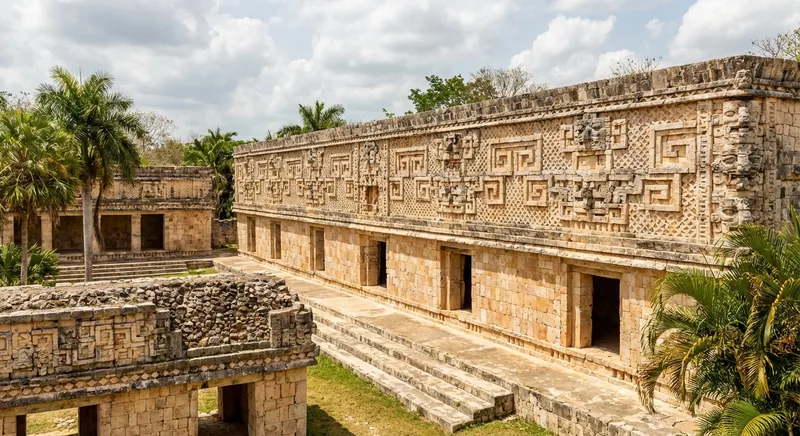
Many Maya scholars consider the Governor’s Palace the finest single building in all of pre-Columbian Mesoamerica. It’s easy to see why.
The structure spans 98 meters wide — longer than a football field — and sits on a three-tier platform that elevates it to overlook the entire site. The mosaic facade runs continuously for the entire length, incorporating over 20,000 individual stone pieces into geometric patterns, Chaac masks, and lattice work. The detail visible from 30 meters away remains crisp from 3 meters.
The building was deliberately oriented to align with Venus’s southernmost rising point — a deliberate astronomical alignment that proves this wasn’t just decoration but cosmological statement.
Ball Court (Juego de Pelota)
Uxmal’s ball court is smaller than Chichen Itza’s Great Ball Court (which is the largest in Mesoamerica) but better preserved. The parallel stone rings that players aimed at — a nearly impossible target to hit — survive intact. What the ball game meant ritually remains debated: ceremonial, competitive, possibly with sacrifice implications depending on the match’s significance.
Temple of the Phalluses (Templo de los Falos)
Located in the south of the site, this small structure features carved stone phalluses — fertility symbols in Maya cosmology. Its existence rarely makes tour guides’ highlight lists, but it’s one of the more unusual structures in Yucatán.
House of the Turtles (Casa de las Tortugas)
A smaller but elegant building featuring stone turtles along the upper cornice — symbols associated with rain and fertility. The simplicity after the elaborate Nunnery Quadrangle makes it refreshingly restrained.
The Puuc Route: Going Beyond Uxmal
The Ruta Puuc is a 31-kilometer archaeological corridor south of Uxmal with four additional major sites: Kabah, Sayil, Xlapak, and Labná. Together with Uxmal, these five sites represent the heartland of the Puuc Maya civilization.
Kabah — Palace of the Masks
Kabah sits 23 kilometers south of Uxmal on Highway 261 and contains one of the most visually striking structures in all Maya archaeology: the Codz Poop (Palace of the Masks).
The entire facade — east, west, and north — is covered with approximately 250 interlocking stone masks of the rain god Chaac, each with the god’s hooked nose serving as a step. Every block, every corner, every surface features a Chaac face. The visual effect is almost hallucinatory — a building made entirely of rain god faces stacked floor to ceiling.
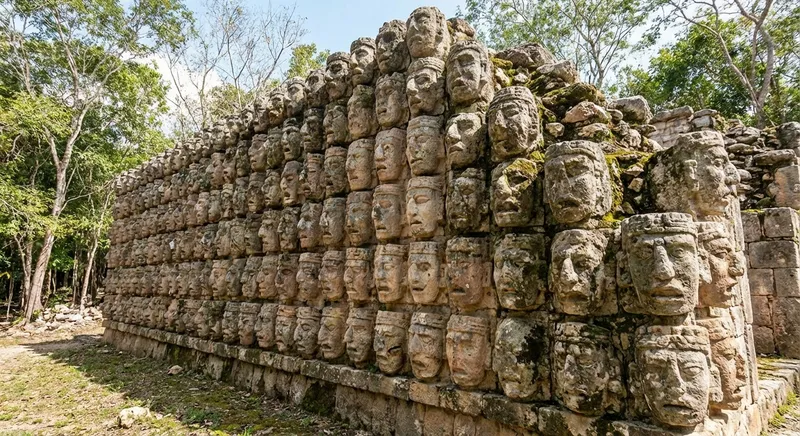
Kabah also preserves a large corbeled arch — an ancient gateway on the Sacbe (white road) that once connected Kabah to Uxmal, 18 kilometers north.
Entry: ~65 MXN | Time needed: 45–60 minutes
Sayil — The Three-Story Palace
Sayil’s main structure, the Grand Palace, rises three stories with colonnaded galleries on each level — an architectural form that makes it look almost Greco-Roman at first glance. The columns (over 100 of them) are the most extensive in Yucatán.
Entry: ~65 MXN | Time needed: 30–45 minutes
Xlapak — Small But Exquisite
Xlapak (“old walls” in Maya) is the smallest of the Puuc Route sites, easily walkable in 20 minutes, featuring one ornate palace with excellent Chaac mask decoration. Low tourist numbers make it one of the most atmospheric ruins you’ll find anywhere in Mexico.
Entry: ~65 MXN | Time needed: 20–30 minutes
Labná — The Famous Arch
Labná is best known for its Arch of Labná — a corbeled arch connecting two building complexes, decorated with representations of Maya thatched-roof houses. It’s one of the most photographed architectural elements in Yucatán.
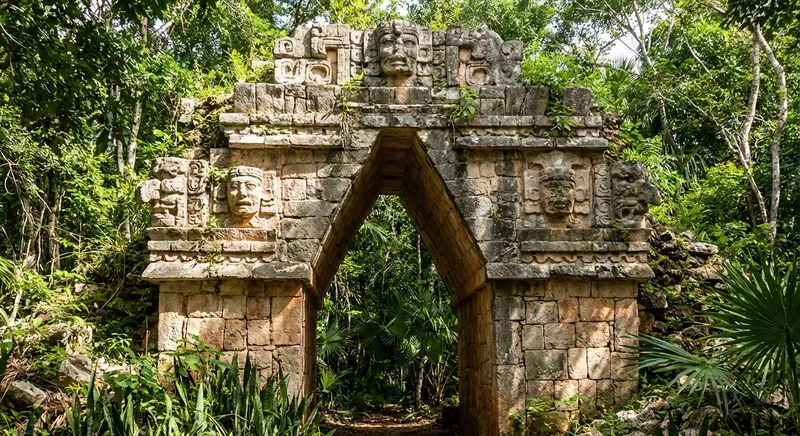
The El Mirador pyramid at Labná has a well-preserved roof comb — a decorative wall rising above the building’s roof, characteristic of Puuc and Petén Maya styles.
Entry: ~65 MXN | Time needed: 45–60 minutes
Grutas de Loltún (Bonus)
The Grutas de Loltún (Loltún Caves) sit 9 kilometers from Labná — a vast cave system with Maya petroglyphs, sculptures, and ancient water management features. Tours run at 9:30 AM, 11 AM, 12:30 PM, 2 PM, and 3 PM, requiring a guide (included in entry). Cost: around 200 MXN.
If you’re doing the full Puuc Route, Loltún caves make an excellent late-afternoon addition before returning to Mérida.
Puuc Route Itinerary (Full Day)
| Time | Location | Duration | Notes |
|---|---|---|---|
| 7 AM | Depart Mérida | — | Avoid highway peak at 8–9 AM |
| 8 AM | Arrive Uxmal | 2.5 hrs | Beat the heat — finish by 10:30 AM |
| 10:30 AM | Drive to Kabah | 25 min | 23 km south on Hwy 261 |
| 11 AM | Kabah (Codz Poop) | 45 min | Palace of the Masks |
| 12 PM | Drive to Sayil | 15 min | 9 km further south |
| 12:15 PM | Sayil (Grand Palace) | 35 min | Three-story colonnade |
| 1 PM | Xlapak | 20 min | Smallest, worth a quick stop |
| 1:30 PM | Labná | 50 min | Famous arch + El Mirador pyramid |
| 2:30 PM | Optional: Loltún Caves | 1.5 hrs | Tour at 3 PM (last chance) |
| 4–5 PM | Return to Mérida | 1.5 hrs |
Total route length: ~60 km from Uxmal, all on well-paved roads.
Pack: Water (no vendors at smaller sites), hat and sunscreen, small bills for entry fees (cards not always accepted at minor sites), lunch (no restaurants on the route between Kabah and Labná).
How to Get from Mérida to Uxmal
| Option | Price | Time | Best For |
|---|---|---|---|
| Rental car | $25–50/day | 1 hr | Full Puuc Route, flexibility |
| SUR bus | 65–80 MXN | 1.5 hr | Budget, Uxmal-only visitors |
| Taxi one-way | 600–900 MXN | 1 hr | Small groups (split the cost) |
| Organized day tour | 600–1,200 MXN | 8–10 hrs | Guided experience, transport included |
| Colectivo + taxi | 40–200 MXN | 2+ hrs | Very budget, complex, not recommended |
By Rental Car (Best Option)
Rent from Mérida city or the airport. Google Maps routes you south on Highway 261 — it’s a straight, well-signposted road through small Yucatecan villages. The entire route passes through flat henequen country with occasional roadside topes (speed bumps) as you enter towns.
Parking at Uxmal: free, large lot at the site entrance.
Check rental car rates for Mérida →
By SUR Bus
Buses leave from Mérida’s Noreste bus terminal (not the ADO terminal on Calle 69) on Calle 52 between Calles 65 and 67. The SUR line runs to Uxmal and Kabah.
Approximate departures: 6 AM, 8 AM, 10 AM from Mérida. Return from Uxmal at approximately 2 PM, 4 PM, 6 PM. Confirm current times at the Noreste terminal — schedules change seasonally.
Important: The bus drops you at the Uxmal entrance. For the Puuc Route, you’d need to coordinate a tour or taxi from the site — the bus doesn’t continue to Kabah/Sayil/Labná.
By Organized Tour
Mérida has dozens of legitimate tour operators offering Uxmal + Puuc Route full-day tours. Check prices at your hotel or along the Paseo de Montejo tourist corridor. Typical cost: 600–1,200 MXN per person depending on group size and whether lunch is included.
The advantage: a guide who explains the iconography at each site (the Chaac masks, the astronomical alignments, the glyphic writing) significantly enriches the experience.
Ecos de Uxmal Light Show
Ecos de Uxmal is a nighttime walk and videomapping experience offered daily. Yucatán’s official tourism listing currently shows three 45-minute session windows:
- 7:30–8:15 PM
- 8:15–9:00 PM
- 9:00–9:45 PM
The night experience uses a separate ticket from daytime archaeological-zone admission. The official listing does not publish a fixed price, so confirm the available session and current cost before making the trip.
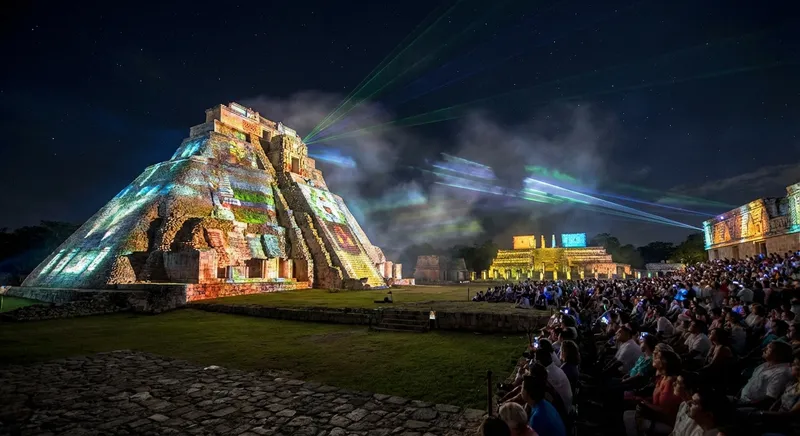
The show uses projections and audio to tell stories about Maya history and cosmology while the ancient structures become the screen. It is atmospheric rather than a substitute for a guided daytime visit.
Practical note: Even the earliest listed session ends after 8 PM. Unless you’re staying at the Uxmal resort or a nearby hacienda, this means a late return to Mérida. Plan accordingly or book a night in the area.
Where to Stay Near Uxmal
Most visitors do Uxmal as a day trip from Mérida (1 hour). For those who want to catch the sound and light show or wake up at the ruins, local options exist:
| Property | Type | Notes |
|---|---|---|
| The Lodge at Uxmal | Hacienda-style hotel | On-site, owned by the same group as the ruins |
| Hacienda Uxmal Plantation & Museum | Heritage hotel | Historic property adjacent to the entrance |
| Hacienda Santa Elena | Budget-friendly | 15 km away in Santa Elena, rustic rooms |
| Ticul town | Budget | 20 km, shoe-manufacturing town, local restaurants |
Best Time to Visit Uxmal
| Month | Crowds | Heat | Verdict |
|---|---|---|---|
| Nov–Feb | Low | 24–31°C | ✅ Best — comfortable, dry, good light |
| Mar–Apr | Medium | 30–35°C | ✅ Good — before peak heat, busy spring break |
| May | Low | 36–40°C | 🟡 Hot — manageable at 8–10 AM only |
| Jun–Oct | Low | 28–33°C | 🟡 Rain possible (afternoon), fewer crowds |
Best time of day: 8–11 AM, always. Heat and tour groups both peak 11 AM–2 PM. If you arrive by 8 AM, you’ll have the Nunnery Quadrangle largely to yourself for the first 30–45 minutes — one of the great Maya ruins experiences available in Mexico right now.
Semana Santa (March 29–April 5, 2026): Crowds double at Uxmal during Holy Week, but remain far below Chichen Itza levels. Still recommend early arrival.
Uxmal vs Other Yucatán Ruins
| Site | Distance from Mérida | Crowds | Can Climb? | Entry Fee | Unique Feature |
|---|---|---|---|---|---|
| Uxmal | 80 km (1 hr) | Low | No | 566 MXN | Puuc architecture, Nunnery Quadrangle |
| Chichen Itza | 120 km (2 hrs) | Very High | No | 646 MXN | Scale, El Castillo, ball court |
| Ek Balam | 160 km (2.5 hrs) | Very Low | ✅ Yes | 250 MXN | Climbable Acropolis (43m), frescos |
| Dzibilchaltún | 16 km (20 min) | Very Low | No | 95 MXN | Closest to Mérida, equinox alignment, cenote |
| Kabah | 100 km (1.2 hrs) | Very Low | No | 65 MXN | Palace of the Masks (Codz Poop) |
Practical Information
Address: Carretera Mérida-Campeche Km 78, Santa Elena, Yucatán
Entry fees (2026):
- Adults: 566 MXN total (461 MXN state + 105 MXN INAH federal)
- Children under 13: Free
- Ecos de Uxmal: separate ticket; confirm the current price when booking
- Kabah: ~65 MXN
- Sayil: ~65 MXN
- Xlapak: ~65 MXN
- Labná: ~65 MXN
- Loltún Caves: ~200 MXN with guided tour
Facilities:
- Restaurant and café at the entrance (decent quality for a ruins cafeteria)
- Museum on-site (included in entry) with stone monuments and artifacts
- Large free parking lot
- No lockers — leave valuables in your car
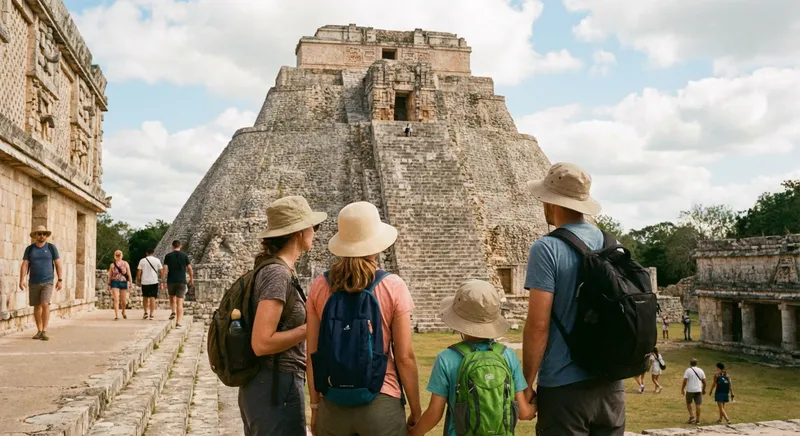
What to bring:
- Water (buy extra at the entrance — no vendors at most Puuc Route sites)
- Sunscreen and hat (open ruins with minimal shade 10 AM–3 PM)
- Small bills (100–200 MXN notes; cards not always accepted at minor Puuc sites)
- Comfortable walking shoes (cobblestones and uneven terrain throughout)
- Insect repellent (rainy season May–October)
Budget Guide
| Category | Budget | Mid-Range | Comfort |
|---|---|---|---|
| Transport (from Mérida) | 130 MXN (bus return) | 600–900 MXN (tour) | 1,200–2,000 MXN (private tour) |
| Entry (Uxmal only) | 566 MXN | 566 MXN | 566 MXN |
| Puuc Route add-ons | +260 MXN (4 sites) | +260 MXN + guide | Included in tour |
| Lunch | 80–120 MXN (onsite cafeteria) | 150–250 MXN | 300+ MXN (hacienda) |
| Ecos de Uxmal light show | — | Separate ticket; price varies | Separate ticket; price varies |
| Total (Uxmal only) | ~800 MXN/person | ~1,400–2,000 MXN | ~2,500–4,000 MXN |
Getting There Without a Car (Day-Trip Plan)
If you’re in Mérida without a rental car and want to see Uxmal:
- Morning: Walk or taxi to the Noreste terminal (Calle 52 × Calles 65–67), about 2 km from Centro Histórico
- Take the 8 AM SUR bus (arrive 15 minutes early to buy tickets, 65–80 MXN)
- Spend 8:30 AM–noon at Uxmal — you’ll beat the heat and the tour groups
- Lunch: Cafeteria on-site (80–120 MXN)
- Afternoon options: Either wait for the 4 PM bus back to Mérida, or bargain with a taxi driver at the site for a half-day tour of Kabah and Sayil (negotiate a round price before departure)
- Return: SUR bus at 4 PM or 6 PM
Note: Uxmal is car-friendly but manageable without one. The Puuc Route (Kabah, Sayil, etc.) really requires a car or tour.
Internal Links for Planning
- Day Trips from Mérida — full list of 12 excursions →
- Mérida Travel Guide →
- 7 Days in Yucatán — full itinerary featuring Uxmal →
- Chichen Itza Guide — how it compares →
- Ek Balam — the only climbable pyramid near Mérida →
- Best Time to Visit Yucatán →
- Things to Do in Mérida →
- Merida to Chichen Itza transport guide →
Uxmal entry fees and schedules verified for 2026. Contact INAH Yucatan for updates before your visit.