What to Eat in Puebla: 15 Dishes, Street Food & Where Locals Eat (2026)
Puebla is where Mexican food got serious. Two of Mexico’s national dishes were invented here — mole poblano and chiles en nogada. The city’s 16th-century Spanish nuns, Lebanese immigrant community, and indigenous Nahua cooking traditions collided to produce a culinary legacy that the rest of Mexico still borrows from.
This isn’t a city where you eat well by accident. You need to know what to order, when it’s available, and where to avoid the tourist-facing imitations. This guide covers 15 essential dishes with honest guidance on where to find the real versions.
For trip planning, see our Puebla travel guide. For specific attractions, things to do in Puebla covers the full city.
Puebla’s Food Identity: Why It Matters
Puebla’s food history is inseparable from its colonial history. When the Spanish established one of New Spain’s most important cities here in 1531, they brought nuns, missionaries, and European cooking techniques. The convents — particularly Santa Catalina de Siena and Santa Mónica — became culinary laboratories where indigenous ingredients (chiles, chocolate, pumpkin seeds, tomatoes) were transformed using European techniques (braising, grinding, sauce-making) into dishes that defined Mexican cuisine.
Key Puebla food facts:
- Mole poblano originated at the Convent of Santa Catalina de Siena in the 17th century
- Chiles en nogada was created in 1821 to honor Agustín de Iturbide — the colors match the Mexican flag
- Lebanese immigrants arrived from 1895-1920s and invented tacos árabes (the ancestor of tacos al pastor)
- Puebla sits at 2,160m above sea level in a volcanic valley — its temperate climate produces unique ingredients like pápalo herb and Castilla walnuts
- The state is the world’s largest producer of poblano chiles
Puebla Food At a Glance
| Dish | Type | Season | Price | Notes |
|---|---|---|---|---|
| Mole poblano | Main course | Year-round | 180-350 MXN | Order over turkey (guajolote) for traditional version |
| Chiles en nogada | Main course | Late Jul-Sep | 280-420 MXN | Pomegranate + fresh walnut = seasonal requirement |
| Cemita poblana | Street food | Year-round | 60-120 MXN | Pápalo herb is what makes it authentic |
| Tacos árabes | Street food | Year-round | 40-70 MXN | Pan árabe (flour tortilla), not corn |
| Chalupas | Street food | Year-round | 15-25 MXN | Breakfast/morning only at best spots |
| Molotes | Street food | Year-round | 20-40 MXN | Crispy masa stuffed with potato or chorizo |
| Mixiote | Main course | Year-round | 120-200 MXN | Lamb in maguey leaf — Sunday dish |
| Pambazo | Street food | Year-round | 40-70 MXN | Tomato-soaked bread with potato and chorizo |
| Pipián rojo | Main course | Year-round | 150-280 MXN | Pumpkin seed sauce — lighter than mole |
| Enchiladas poblanas | Main course | Year-round | 100-180 MXN | Mole sauce, not standard chile sauce |
| Chilatole | Soup | Year-round | 80-130 MXN | Corn masa-thickened chile broth |
| Tinga poblana | Main/filling | Year-round | 80-150 MXN | Shredded chicken in chipotle-tomato |
| Pepián verde | Main course | Year-round | 150-280 MXN | Tomatillo + pumpkin seed — lighter than red |
| Memelas | Breakfast | Year-round | 20-35 MXN | Thick oval masa cake with beans |
| Buñuelos de viento | Dessert | Nov-Jan peak | 30-60 MXN | Fried dough with piloncillo syrup |
15 Essential Puebla Dishes
1. Mole Poblano
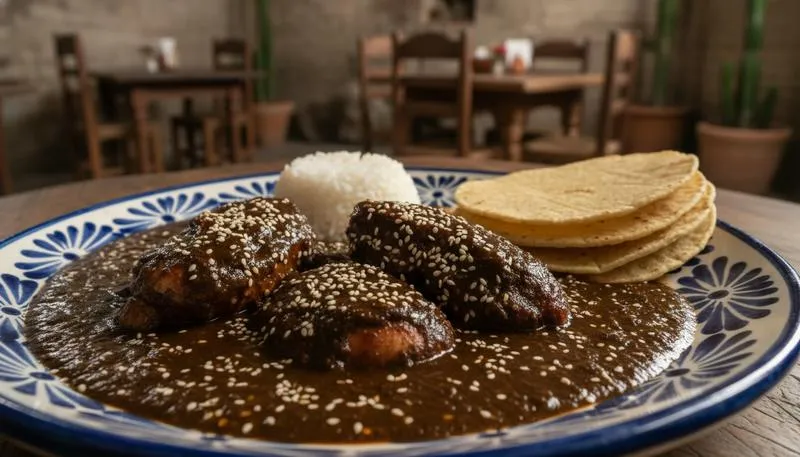
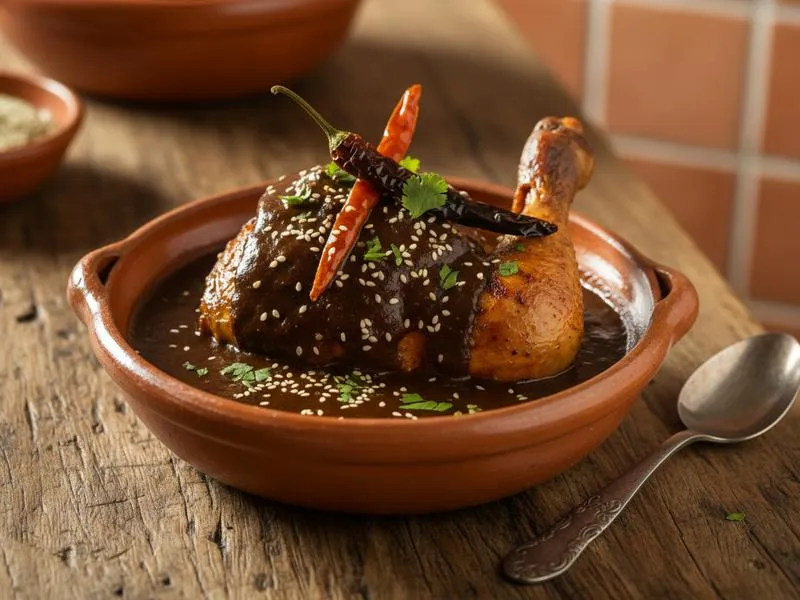
Mexico’s most complex sauce, and the one that defines Puebla’s culinary identity. Mole poblano is a dark, rich sauce made from 20+ ingredients: mulato, ancho, pasilla, and chipotle chiles, chocolate (usually Oaxacan dark chocolate, not sweet), ground pumpkin seeds, almonds, peanuts, raisins, plantain, sesame seeds, burnt tortilla, tomatoes, garlic, and a spice blend including cumin, clove, black pepper, and cinnamon.
A proper mole takes 3-5 days to make. The chiles are toasted, soaked, and blended separately. The nuts and seeds are toasted and ground. Everything is fried in lard and then combined, adjusted, and slow-cooked until it reaches the right consistency — thick enough to coat the back of a spoon, dark as dark chocolate, with a flavor that is simultaneously smoky, sweet, earthy, spicy, and savory.
What to order: Mole over guajolote (turkey) is the traditional version. Mole enchiladas are the everyday version. Ask if they make it in-house (casero) — good restaurants will say yes proudly.
Best spots:
- Fonda de Santa Clara (Avenida 3 Poniente) — institutional, open since 1965, makes their mole in-house
- La Casita del Mole (Barrio del Artista) — smaller, more intimate, excellent mole negro
- El Mural de los Poblanos (16 de Septiembre) — midrange, painted mural of Puebla history, solid mole
- Market stalls at Mercado de Sabores Poblanos — cheapest authentic mole over rice for 120-180 MXN
2. Chiles en Nogada
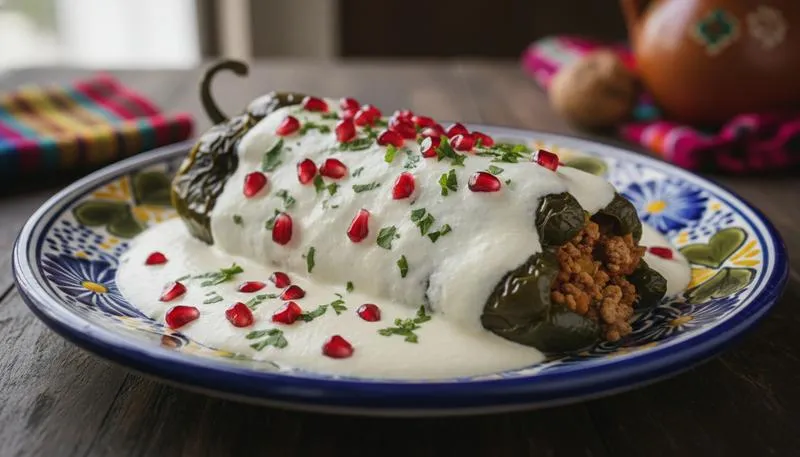
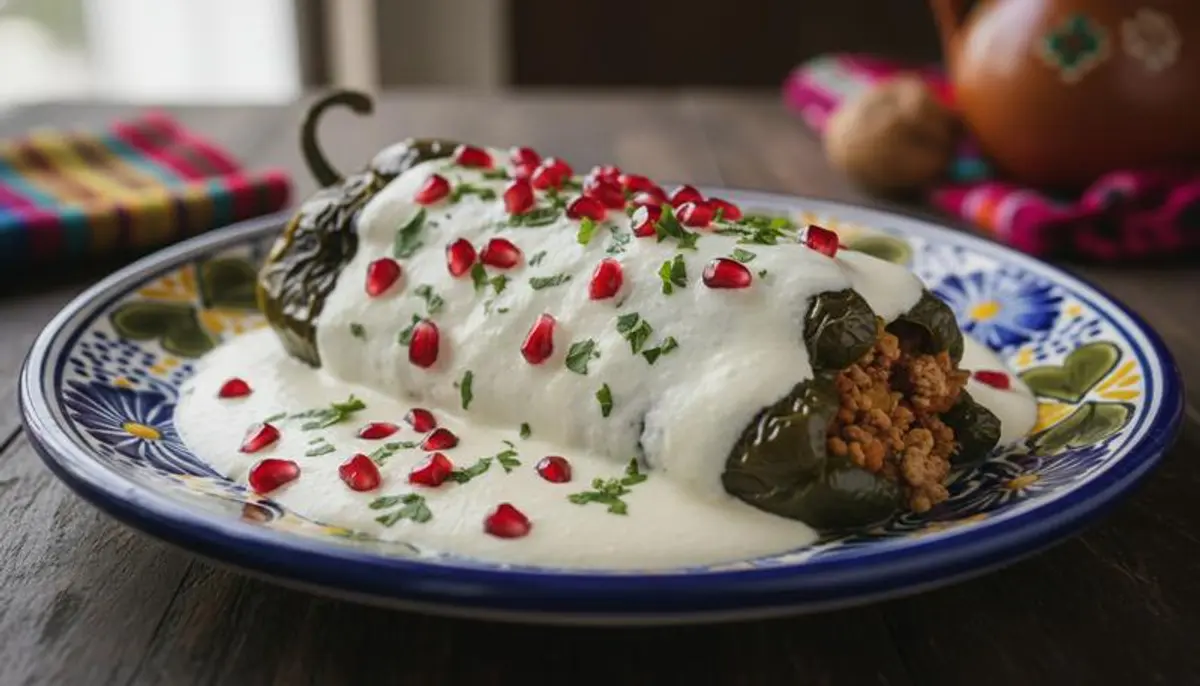
The most celebrated dish in Mexican cuisine, and strictly seasonal. Chiles en nogada consists of a fresh poblano chile (large, dark green, mild) stuffed with picadillo — ground pork and beef cooked with onion, garlic, tomato, dried fruits (raisins, peach, plantain, pear), nuts (almonds, pine nuts), and spices — topped with nogada (walnut cream sauce made from fresh Castilla walnuts, cream cheese, and sherry), pomegranate seeds (granada), and fresh flat-leaf parsley.
The three colors — green (chile + parsley), white (nogada), red (pomegranate) — mirror the Mexican flag. The dish was invented in August 1821 by Augustinian nuns of the Convent of San Agustín to honor Agustín de Iturbide on the Day of San Agustín after Mexican Independence was signed. The combination is uniquely Pueblan: no other region in Mexico produces all the required fresh ingredients simultaneously.
Critical timing: plan for late July through September, with August the safest month for the widest choice. Puebla’s 2026 tourism guidance places the core season between July and September, while individual towns and restaurants may use slightly different opening and closing dates as the harvest moves. The Castilla walnut harvest is what starts the season. Fresh walnuts have a creamy, bitter skin that is peeled and soaked, producing a sauce that tastes nothing like one made with dry walnuts.
Use the chiles en nogada season guide for harvest timing and booking advice. If the dish is the reason for your trip, the two-night Puebla chiles en nogada itinerary turns the meal into a practical weekend plan rather than leaving it to chance.
Best spots:
- Restaurante San Agustín (near Barrio de Analco) — traditionally first in the city to serve it each August
- La Casita del Mole — seasonal tasting menu version
- Fonda de Santa Clara — reliable institutional version, 320-380 MXN
- Any restaurant displaying “Temporada de Chiles en Nogada” signs in September
3. Cemita Poblana
Puebla’s signature sandwich and one of Mexico’s great street foods. Cemita refers to both the bread — a round, slightly sweet, sesame-seed brioche roll with a denser crumb than telera or bolillo — and the sandwich made with it.
A proper cemita filling: milanesa (breaded and fried beef or chicken), pulled or sliced so it fits the roll; quesillo (Oaxacan string cheese, layered), pápalo (a pungent herb native to central Mexico with a sharp, herbal, slightly bitter flavor — the non-negotiable element), aguacate (avocado slices), chipotle (chipotles in adobo, spread directly on the roll), and onion rings. No cilantro. No tomato. No guacamole.
The pápalo is what elevates a cemita above a regular torta. It grows wild in Puebla and Oaxaca, tastes like a cross between cilantro, rue, and something vaguely medicinal, and cuts through the richness of milanesa and cheese perfectly. In Puebla, vendors keep a bunch of fresh pápalo on the counter and pull leaves directly into your sandwich. If it’s not there, it’s not a real cemita.
Best spots:
- Mercado 5 de Mayo (near the forts) — multiple cemita vendors, 70-100 MXN
- Barrio de Analco — traditional neighborhood cemita spots open from 9 AM
- Cemitas Las Poblanitas (Calle 9 Norte) — consistent, popular, good milanesa
- Mobile vendors around the Loreto and Guadalupe forts on weekend mornings
Price: 60-120 MXN depending on filling. Milanesa de res (beef) is the standard.
4. Tacos Árabes
The Lebanese contribution to Puebla’s food scene, and the direct ancestor of tacos al pastor. Tacos árabes use spit-roasted pork (the trompo rotating on a vertical spit — the same equipment as shawarma or döner) but serve it in pan árabe — a thin, slightly chewy disc of flour dough, more like a thick pita than a tortilla.
Lebanese immigrants from Greater Syria began arriving in Puebla in the late 19th century. By the 1920s-30s, family businesses had adapted their shawarma tradition to local pork and Mexican spices. The al pastor tacos found in Mexico City today — corn tortilla, guajillo-marinated pork, pineapple — is what happened when Puebla’s tacos árabes traveled north and got adapted to Mexico City tastes.
In Puebla, they’re served with chipotle salsa, nothing else. No cilantro, no onion, no pineapple. The pan árabe folds around the meat rather than the flat corn tortilla.
Best spots:
- Tacos Arabes Beto (Avenida 6 Oriente) — the most cited traditional spot, open since 1970s, cash only, closes when they run out (usually 2-3 PM)
- El Oasis (Calle 4 Norte) — slightly larger, more consistent hours
- Any taquería displaying “Tacos Árabes — Pan Árabe” on a handwritten sign
Price: 40-70 MXN for 2-3 tacos
5. Chalupas
Puebla’s quintessential breakfast street food. Chalupas are small oval corn masa cakes (about palm-sized), fried in lard until the base is crispy while the interior stays soft, then topped with red or green salsa (roja or verde), shredded chicken or pulled pork, diced white onion, and crumbled fresh cheese.
The best chalupas come from the women who’ve been frying them at the same spot since 5 AM and are sold out by 10 AM. The masa should be hand-pressed (not machine-formed), the lard should be clearly visible, and the salsa should be made fresh that morning. The combination of crispy masa + warm salsa + shredded meat + cold onion and cheese is simple and perfect.
Best spots:
- Women vendors at the base of the Loreto and Guadalupe forts, weekday mornings from 7-10 AM
- Mercado 16 de Septiembre (food hall) — multiple vendors, slightly later hours
- Barrio de Analco streets, weekend mornings
Price: 15-25 MXN each. Order four.
6. Molotes
Crescent-shaped fried masa pockets, the Puebla version of a empanada but made from corn masa (not flour). Molotes are stuffed with potato and chorizo (the classic), black beans and cheese, or picadillo, then deep-fried until golden and crispy. Served with crema, salsa, shredded lettuce, and queso fresco.
The masa is slightly thicker than for a regular taco and pressed around the filling, sealed at the edges, then fried. The result is a shell that’s crunchier than a chalupa but more forgiving than a tlacoyo. Street vendors sell them from deep-frying carts throughout Puebla’s center, particularly in the Mercado el Carmen and around the university.
Price: 20-40 MXN each.
7. Pambazo
The bread matters: a pambazo uses pan de pambazo, a white, slightly spongy roll that is dipped in chile guajillo sauce (which turns it red) and then toasted on a comal. The filling: potato and chorizo mixture, crema, salsa verde, shredded lettuce, and queso fresco.
The result is a sandwich where the exterior bread is slightly crispy, deeply red, and chipotle-smoky, while the interior is soft and warm with the potato-chorizo filling. It’s Puebla street food at its most honest — cheap, filling, flavorful.
Price: 40-70 MXN. Street carts around the Mercado 16 de Septiembre and near the Loreto forts.
8. Mixiote
A slow-cooked Mexican barbecue tradition: mixiote is lamb (or chicken) marinated in chile sauce — typically guajillo, ancho, and cumin — wrapped in the thin membrane of the maguey leaf (the mixiote skin, which gives the dish its name) and slow-steamed or baked for several hours until completely tender. The maguey membrane acts like a natural papillote — it seals in the moisture and imparts a subtle earthy flavor.
Mixiote is a Sunday dish. Families line up at specialized mixioteros who’ve been cooking since Saturday night. The packet arrives wrapped in the membrane: you open it at the table and eat with fresh corn tortillas, salsa borracha (pulque chile sauce), and raw onion.
Best spots: Weekend-only restaurants in the Barrio de Santiago and Barrio del Artista. Look for hand-painted signs reading “Mixiotes de Borrego”.
Price: 120-200 MXN for a packet.
9. Pipián Rojo and Pipián Verde
Mole’s siblings — also Pueblan in origin, also built around a ground-paste base, but lighter and faster to make. Pipián (also written pepián) uses toasted and ground pumpkin seeds (pepitas) as the thickening agent instead of chocolate and dried fruit.
- Pipián rojo: Red pipián with tomato, guajillo chile, and sesame seeds. Served over chicken or pork. Nuttier and lighter than mole poblano.
- Pipián verde: Green pipián with tomatillo, fresh chiles (serrano or poblano), pumpkin seeds, and herbs. Brighter, more acidic, often served over chicken or with nopal cactus.
Both are year-round dishes and excellent entry points if mole feels too heavy.
10. Tinga Poblana
Shredded chicken braised in a chipotle, tomato, and onion sauce until deeply smoky and slightly sweet. Tinga is Puebla’s great multi-purpose protein: stuffed into cemitas, used as a tostada topping, served over rice, or eaten straight with tortillas.
What makes Puebla tinga distinct from the CDMX version is a higher ratio of chipotle and slower braising time — the chicken shreds completely into the sauce rather than staying in distinct pieces. The color is a deep terracotta red from the chipotles.
Price: 80-150 MXN as a main with rice and beans.
11. Chilatole
A pre-Hispanic corn soup adapted through the colonial period. Chilatole is a thick, broth-based soup made from masa de maíz (corn dough dissolved into water), dried chiles, epazote herb, and corn kernels. Sometimes it includes chicken or pork. Sometimes it’s purely vegetarian.
The texture is somewhere between a thin porridge and a broth-based soup — thicker than consommé, thinner than atole. The corn flavor is dominant, with a background heat from the chiles and the herbal note of epazote. It’s one of Puebla’s oldest dishes and rarely appears on tourist menus.
Where to find it: Mercado 16 de Septiembre morning stalls, 8-11 AM. Comida corrida restaurants in the Barrio de Analco.
12. Enchiladas Poblanas
Not the same as enchiladas anywhere else in Mexico. Enchiladas poblanas use mole negro or mole poblano as the sauce — not the red chile sauce standard in northern Mexico or the green tomatillo sauce common in CDMX. Filled with shredded chicken or cheese, topped with the dark mole, crema, onion, and sesame seeds.
At a good Puebla restaurant, enchiladas poblanas arrive looking like a serious main course — dark, glossy, aromatic — not the quick-service version common elsewhere.
Price: 100-180 MXN.
13. Buñuelos de Viento
Puebla’s most beloved dessert, particularly during Día de Muertos (November 1-2) and the Christmas season. Buñuelos de viento (wind fritters) are thin, circular fried dough rounds — almost like a crispy crepe — sprinkled with sugar or drizzled with dark piloncillo syrup.
The name “de viento” (of wind) refers to their lightness — these are not dense donuts but almost translucent fried dough that shatters when you bite it. The tradition in Puebla is to eat them while watching the Quema de Judas (burning of the Judases) on Holy Saturday, and during Día de Muertos altars.
Where to find: Street vendors around the Zócalo in November, Barrio de Analco during Semana Santa.
14. Memelas
The Puebla breakfast staple that visitors rarely discover. Memelas are thick, oval-shaped corn masa cakes topped with black bean paste (frijoles negros), salsa, and fresh cheese — essentially an open-faced gordita. Cooked on a comal with lard, they develop a slightly crispy exterior while staying soft inside.
Eaten standing at a market stall between 6 and 10 AM. Paired with a café de olla (coffee brewed with cinnamon and piloncillo in a clay pot).
Price: 20-35 MXN each.
15. Rompope Poblano
Puebla’s contribution to the drinks world: rompope is a thick, eggy, cream-based liqueur made from egg yolks, milk, sugar, vanilla, cinnamon, and alcohol — Mexico’s answer to eggnog, but smoother and more intensely vanilla-flavored. It was invented by the nuns of the Convent of Santa Clara in the 17th century.
Modern rompope is sold in bottles throughout Puebla (the Santa Clara brand is the institutional version) and served cold, sometimes over ice or mixed with coffee. It’s sweeter and thicker than eggnog, more like a drinkable crème brûlée. The artisanal versions at the Barrio del Artista market include chocolate and almond variants.
Where to buy: Dulcería de Celaya-style sweet shops on 6 Oriente near the Zócalo. Markets around the Barrio de Analco. The Santa Clara brand is sold everywhere.
Where to Eat in Puebla
Best Markets
| Market | Specialty | Location | Hours |
|---|---|---|---|
| Mercado 16 de Septiembre | Comida corrida, chalupas | Near Zócalo | 7 AM - 5 PM |
| Mercado de Sabores Poblanos | All Puebla dishes, mole | 16 de Septiembre | 8 AM - 6 PM |
| Mercado 5 de Mayo | Cemitas, antojitos | Near Loreto forts | 7 AM - 4 PM |
| Mercado el Carmen | Molotes, memelas | Barrio del Carmen | 7 AM - 2 PM |
Restaurants Worth Knowing
| Restaurant | Specialty | Price | Notes |
|---|---|---|---|
| Fonda de Santa Clara | Mole, chiles en nogada | $$ | Open since 1965, institutional quality |
| La Casita del Mole | Mole negro, chiles en nogada | $$ | Seasonal menu highlight late Jul-Sep |
| El Mural de los Poblanos | Mole, regional dishes | $$ | Great setting near Zócalo |
| Tacos Arabes Beto | Tacos árabes | $ | Cash only, closes ~2 PM, lunchtime queue |
| La Bola Roja | Cemitas | $ | Long-established, open mornings |
| Restaurante China Poblana | Mole tasting | $$$ | Fine dining, tasting menu format |
Neighborhoods by Food Type
| Neighborhood | Best For |
|---|---|
| Barrio de Analco | Cemitas, chalupas, Sunday mixiote |
| Zócalo area (5+ min away) | Comida corrida, market stalls |
| Barrio del Artista | Rompope, sweets, artisan food |
| Near Loreto forts | Morning chalupas, cemitas vendors |
| Mercado 16 de Septiembre | Mole, enchiladas, chalupas |
What to Drink in Puebla
Atole: A warm, thick corn masa-based drink flavored with chocolate, guava, or plain — sold at market stalls mornings and evenings.
Café de olla: Coffee brewed in a clay pot with cinnamon stick and raw piloncillo sugar. The standard breakfast drink at market stalls.
Rompope: Sweet egg-and-cream liqueur, invented by Puebla nuns in the 17th century. Cold or over ice.
Pulque: Though not specific to Puebla, it’s widely available. The Pulquería Dulce Patria near the university is one of the best in the region.
Agua de horchata de coco: Puebla-style horchata made with coconut, not the standard rice version. Sold by juice vendors throughout the center.
What to Bring Home from Puebla
Mole paste: Local producers sell dried mole paste in vacuum-sealed bags — Doña María is the mass-market brand, but the artisan versions at the Mercado 16 de Septiembre are worth the extra cost.
Rompope Santa Clara: The institutional Puebla rompope brand, available at supermarkets and sweet shops.
Talavera pottery: Not food, but the UNESCO-certified ceramic tradition is sold throughout the Barrio del Artista — look for the Certificado Talavera seal to ensure authenticity.
Chipotles en adobo: Puebla chipotles are considered superior to those canned elsewhere — available at markets.
Camote dulce: Candied sweet potato rolls (camote de Santa Clara) are Puebla’s most traditional sweet, made since the 16th century. Sold wrapped in paper in flavors including vanilla, strawberry, and pineapple.
Budget Guide
| Budget | Daily Food Cost | What You Get |
|---|---|---|
| Budget | 150-250 MXN | Market stalls: chalupas + comida corrida + street snacks |
| Mid-range | 300-550 MXN | Cemitas + restaurant lunch (mole) + dinner tacos |
| Splurge | 600-1,200 MXN | Restaurant lunch with mole tasting + chiles en nogada (late Jul-Sep) + rompope |
Food Calendar
| Month | What to Look For |
|---|---|
| January-July | Mole year-round, rompope, chalupas daily |
| Late July | Chiles en nogada season begins as restaurants source fresh local ingredients |
| August-September | Core chiles en nogada season — August offers the widest choice |
| September | Independence Month — special mole and chiles en nogada menus everywhere |
| October-November | Buñuelos de viento (Día de Muertos), tamales nejos (black bean tamales) |
| November 1-2 | Día de Muertos altar foods: pan de muerto, mole negro with turkey, buñuelos |
| December-January | Buñuelos peak, ponche (fruit punch), tamales on Día de Reyes (Jan 6) |
Food Tour or Self-Guided?
Puebla’s food culture is accessible without a guide — the market system is well-organized and vendors expect tourists. But if you want to understand the why behind the dishes (which convent invented what, why the chiles en nogada is seasonal, how mole differs by family), a 3-4 hour food tour is worth the cost.
Look for tours that include at least one market visit, one cemita, one mole tasting, and — if in season — chiles en nogada. Standard price: $45-70 USD per person for a well-structured morning tour.
For where to stay, how to get around, and full Puebla itinerary planning, see our Puebla Mexico travel guide. For the best day trips from Puebla including Cholula’s pyramid and the Huejotzingo Franciscan convent, see day trips from Puebla.