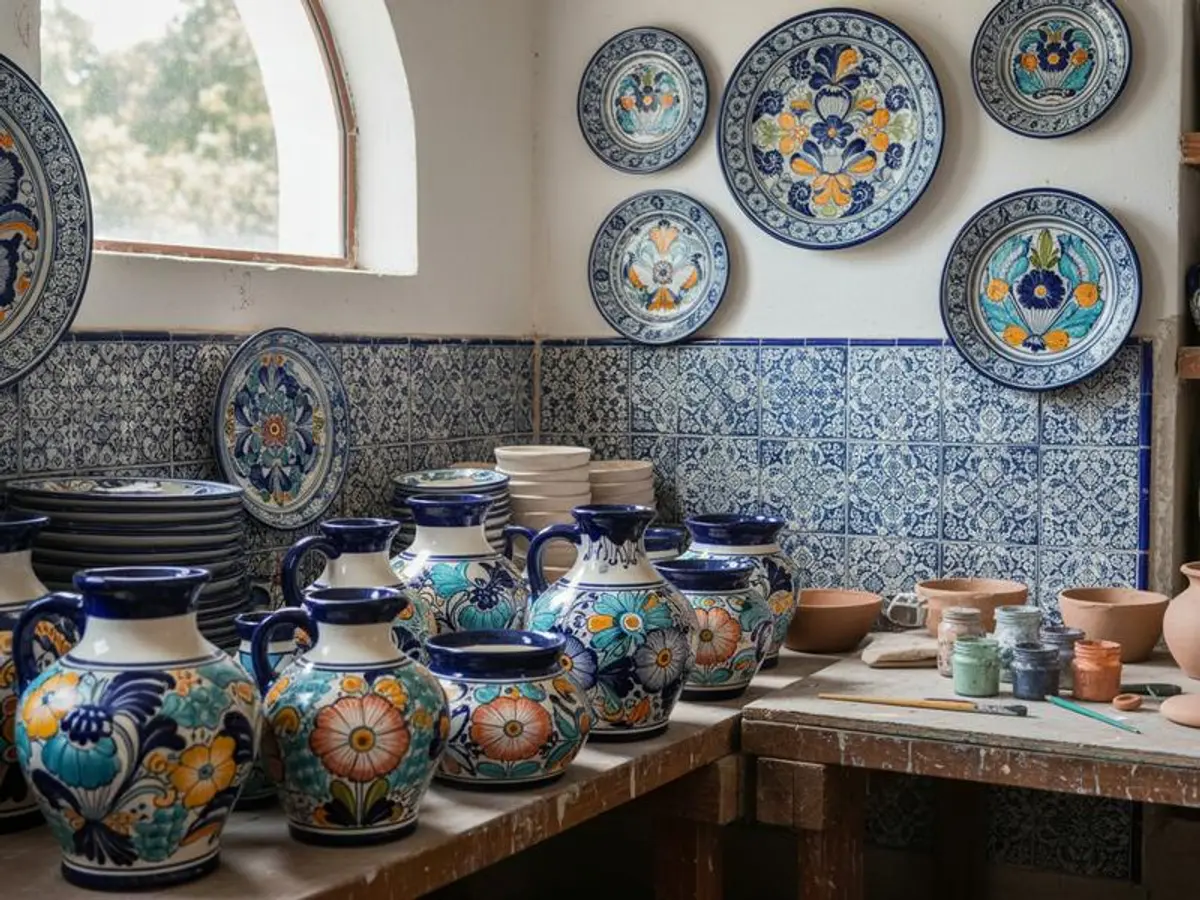
Puebla Mexico Travel Guide 2026: UNESCO City, Mole & Cholula
Puebla is Mexico’s fourth-largest city and one of its most rewarding to visit. Two hours from Mexico City, it packs a UNESCO World Heritage historic center, the world’s largest pyramid by volume, a food scene anchored by dishes that shaped Mexican cuisine, and a Talavera ceramic tradition recognized by UNESCO as Intangible Cultural Heritage.
It gets less attention than Oaxaca or San Miguel de Allende. That’s your advantage.
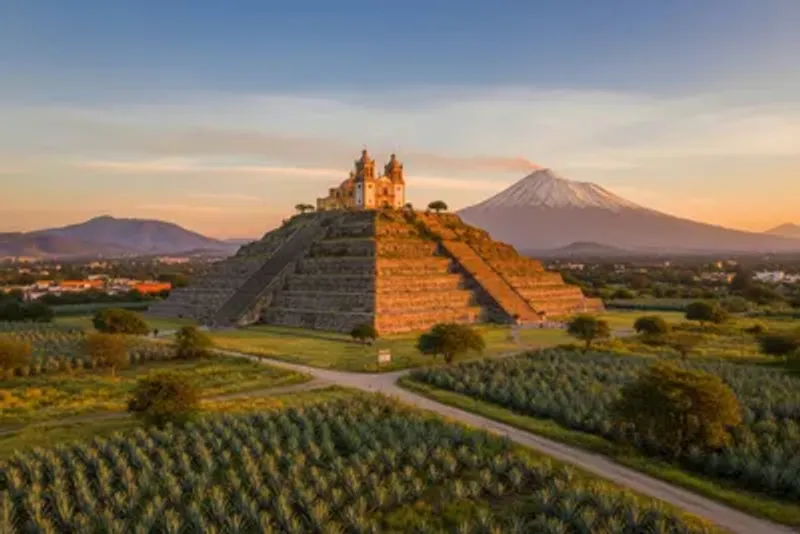
Quick Facts: Puebla
| Location | State of Puebla, central Mexico, 135km from CDMX |
| Elevation | 2,135m (7,005 ft) — similar altitude to Mexico City |
| Population | 1.7M city / 3.2M metro area (4th largest in Mexico) |
| UNESCO status | World Heritage City since 1987 |
| Climate | Mild year-round, 15–24°C average |
| Nearest airport | Hermanos Serdán International (PBC), or fly into CDMX (2hr bus) |
| Best for | Food travelers, history, architecture, day trips |
| Skip if | You only want beaches — head to Puerto Escondido or Cancun instead |
Top Attractions in Puebla
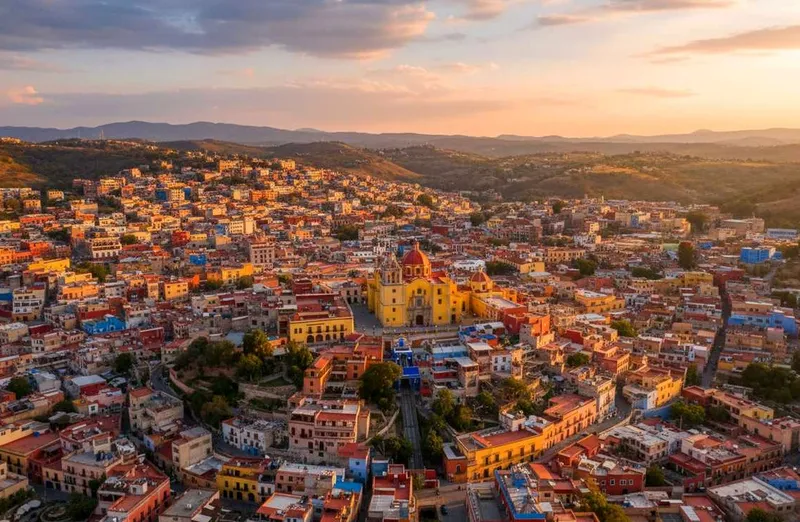
The Zócalo and Cathedral
Puebla’s main plaza is the second-largest zócalo in Mexico after Mexico City’s. The cathedral, completed in 1649 after 76 years of construction, has two of the tallest towers in Mexico — good landmark for navigation.
Walk the zócalo at dusk when locals come out and street food carts appear. The covered portales (arcaded buildings) on the north and west sides have been lined with restaurants and cafes since colonial times.
Tip: The Palacio Municipal (City Hall) facing the zócalo lets you walk through its courtyard for free — murals by Jorge Bernal showing Puebla’s history line the walls.
Barrio de los Sapos
The frog neighborhood (named for the old ponds where frogs lived) is Puebla’s antique market district, eight blocks southeast of the zócalo. On weekends, vendors spread vintage ceramics, books, clothing, and Talavera seconds on the street.
The bars and restaurants along Calle 6 Sur fill on weekends — this is where Poblanos actually go out, not the tourist zócalo area.
Ex-Convento de Santa Mónica
A former Augustinian convent that operated secretly for 60 years after Mexico’s Reform Laws expelled religious orders in 1861. The nuns hid behind concealed doors and received food through rotating walls while pretending the building was abandoned.
Opened as a museum in 1934 when the hiding nuns finally came out. Genuinely strange and fascinating. Entry: 60 MXN.
Amparo Museum
One of Mexico’s best pre-Hispanic art collections in a beautifully restored colonial building. The permanent collection runs from Mesoamerican pieces through colonial religious art to 20th-century Mexican design. Free on Mondays. Entry: 80 MXN.
Note: More intellectually rewarding than Mexico City’s Anthropology Museum for colonial-era Puebla context, though smaller in scale.
Cholula: The Must-Do Day Trip
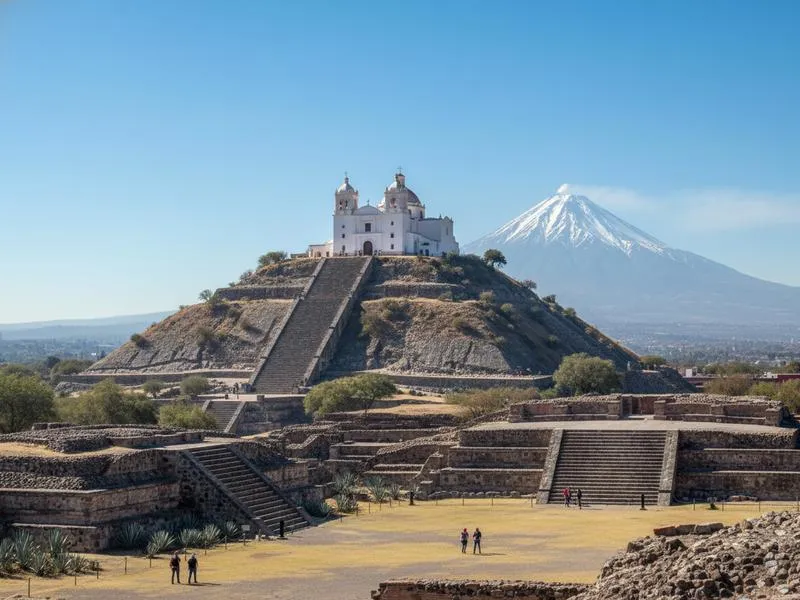
Cholula, 15 minutes west of Puebla by bus or taxi, contains the world’s largest pyramid by total volume — bigger than the Great Pyramid of Giza. The Spanish built a church on top of it in 1594, not realizing what was underneath.
The Spanish thought the flat-topped hill was a natural landform. It is actually a pyramid that was plastered over and then covered with vegetation over centuries. Archaeological excavations began in the 1930s and revealed 8 kilometers of tunnels underneath.
What you see:
- The Spanish church (Nuestra Señora de los Remedios) sitting on the pyramid summit — the most photographed angle includes Popocatépetl volcano behind it
- Accessible tunnel network through the pyramid’s interior (guided tours available, included with entry)
- Excavated sections showing the four construction phases stacked on top of each other
- The Zone of Altars where human sacrifice evidence was found
Practical info:
- Entry: 90 MXN (includes tunnels)
- Hours: 9 AM–5 PM daily
- How to get there from Puebla: Colectivo from Calle 4 Poniente near 5 de Mayo (8 MXN, 15 min); Uber (60–80 MXN)
- Combine with the nearby Zona Arqueológica and the San Gabriel Ex-Monastery in Cholula’s zócalo
- Allow 2–3 hours total
See the full Cholula pyramid guide for detailed visit planning.
Puebla Food Guide
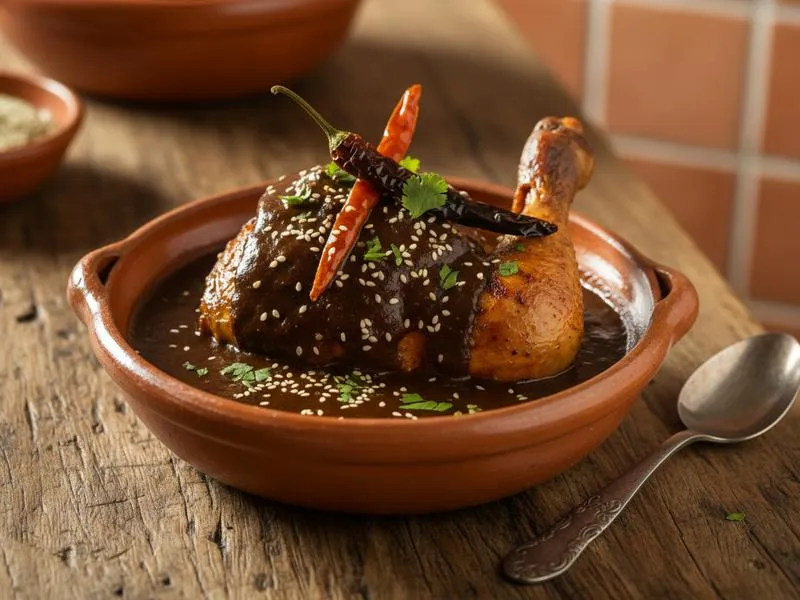
Puebla has one of Mexico’s most important food histories. Two of the country’s most complex dishes — mole poblano and chiles en nogada — were invented here.
Mole Poblano
Mole poblano is the version most people mean when they say “mole” — a sauce of more than 20 ingredients including multiple dried chiles (mulato, ancho, pasilla, chipotle), Mexican chocolate, plantain, peanuts, sesame, pumpkin seeds, bread, tomato, and spices. It takes hours to prepare.
Where to eat it in Puebla:
- El Mural de los Poblanos — Zócalo view, reliable mole, tourist-priced (280–380 MXN per main)
- Fonda de Santa Clara — Institution since 1965, oldest mole restaurant in the city, two locations
- El Jardín de los Sabores — More creative versions including a mole tasting menu
- Mercado Hidalgo — Cheapest option, comidas corridas with mole for 60–80 MXN
Honest note: Mole poblano at most restaurants comes from a commercial paste base. The real difference is in the final cooking, stock used, and balance. Ask if it’s made in-house (“¿lo hacen aquí?”) — honest restaurants will tell you.
Chiles en Nogada (Late July–September)
Puebla’s most celebrated seasonal dish: a poblano chile stuffed with picadillo (ground pork and beef, almonds, raisins, peaches, plantain, spices), covered in walnut cream sauce (nogada), and decorated with pomegranate seeds and parsley.
The dish represents the Mexican flag colors — green parsley, white walnut sauce, red pomegranate — and was supposedly created for Agustín de Iturbide in 1821 after Mexican independence.
The seasonal reality: Puebla’s restaurant season usually runs from late July through September, although exact opening and closing dates vary by kitchen and ingredient supply. August and early September are the safest dates if the dish is the main reason for your trip; confirm availability directly before booking a special lunch.
For the current seasonal window, use our where to eat chiles en nogada in Puebla guide to compare restaurant styles, reservation strategy, and realistic prices. If the dish is the reason for your trip, the Puebla chiles en nogada weekend itinerary turns one long lunch into a practical two-night plan.
Other Essential Puebla Dishes
Cemitas: Sesame roll sandwiches filled with breaded cutlet (milanesa), Oaxacan string cheese, avocado, chipotle, papalo herb. Better here than anywhere else. Look for cemita stands in Mercado de Sabores Poblanos. Cost: 40–60 MXN.
Chalupas: Small oval masa cakes fried and topped with green or red salsa, shredded chicken or pork, and onion. Eaten by the handful as a snack. Very different from Tex-Mex “chalupas.” Cost: 8–12 MXN each.
Memelas: Thick oval masa cakes topped with black beans and fresh cheese. Breakfast food, found at any morning market. Cost: 15–25 MXN.
Tacos árabes: Puebla’s Lebanese immigrant community invented a local taco variant in the early 20th century — pork slow-cooked on a vertical spit, served in a thick pita-style tortilla with chipotle. Antojitos de la Calle (5 de Mayo area) is the classic spot.
Molotes: Deep-fried masa pockets filled with potato and chorizo or black beans. Common street food snack.
Talavera Pottery: Puebla’s Living Craft
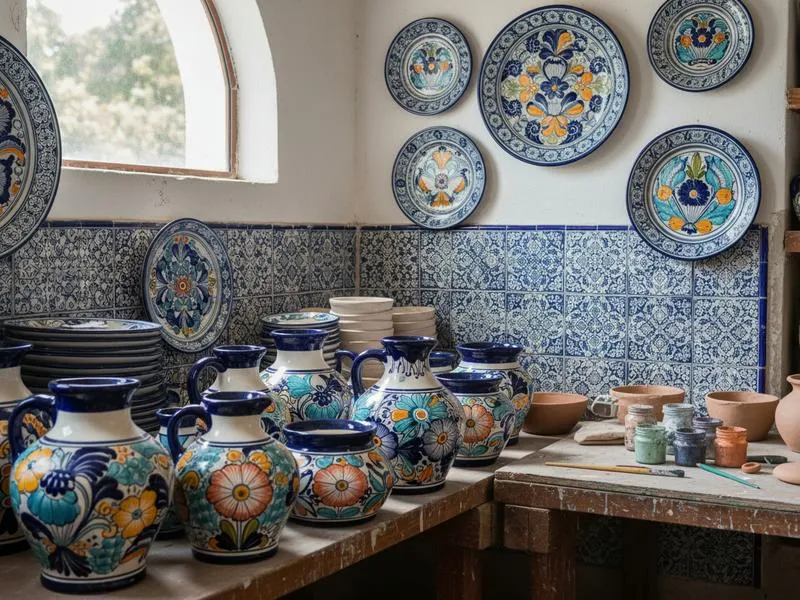
Talavera is tin-glazed earthenware produced in Puebla and nearby Tlaxcala since the 16th century, when Spanish potters from Talavera de la Reina arrived and merged their technique with local Mixtec and Chinese ceramic traditions (the latter arriving via Manila Galleon trade).
In 2019, UNESCO added Talavera to the Intangible Cultural Heritage list.
What makes it authentic:
- White base glaze from local clay and minerals
- Painted by hand using cobalt blue, manganese black, iron red, copper green, antimony yellow
- Kiln-fired twice at high temperature
- Only produced in Puebla, Tlaxcala, and four neighboring municipalities
How to spot fakes: Cheap “talavera” sold everywhere is mass-produced in Guanajuato or China using a stencil process — uniform lines, no imperfections, much lower price. Authentic pieces show slight hand-painting variations, cost 300–2,000 MXN per piece, and come with a certificate from CATAP (the Talavera regulatory council).
Where to visit a workshop:
- Talavera Uriarte (4 Poniente 911) — oldest active workshop, established 1824, free 30-minute tours, no appointment needed
- Talavera La Encantada — smaller, more artisan-focused, you can watch painters at work
- Talavera de la Reyna — wholesale showroom with the widest selection
Cinco de Mayo: The Real Story
Puebla is where Cinco de Mayo actually happened — and it’s nothing like the US commercial holiday.
On May 5, 1862, Mexican forces under General Ignacio Zaragoza defeated a much larger French expeditionary army at the Battle of Puebla. The French, considered the most professional military in the world at the time, were on their way to support the Habsburg Emperor Maximilian and potentially the Confederacy during the US Civil War.
The victory was temporary — France occupied Mexico City a year later — but symbolically enormous. Mexican independence and sovereignty in the face of European imperialism.
In Puebla itself: May 5 is observed as a serious historical commemoration, with a military parade and ceremony at the Forts of Loreto and Guadalupe (the battle site, now a museum complex). The forts are worth visiting for the view over the city and the decent museum explaining the battle. Entry: 60 MXN.
Outside Puebla, Cinco de Mayo is barely celebrated in Mexico — it’s almost exclusively a US phenomenon. See our full Cinco de Mayo in Mexico guide for the reenactment schedule, logistics, and what to expect if you visit on May 5.
Day Trips from Puebla
Puebla’s location in central Mexico puts multiple destinations within easy reach:
| Destination | Distance | Time | Why Go |
|---|---|---|---|
| Cholula | 15 km | 20 min | World’s largest pyramid |
| Atlixco | 37 km | 45 min | Flower market, Balcón del Mundo views |
| Cuetzalan | 180 km | 3 hrs | Cloud forest, waterfalls, colonial market |
| Tehuacán | 130 km | 1.5 hrs | Cactus valley, Coxcatlan Cave (cradle of corn) |
| Chignahuapan | 110 km | 2 hrs | Christmas ornament capital, hot springs |
| Huauchinango | 120 km | 2 hrs | Flower festival (Feb–Mar), sierra views |
| Xicotepec | 140 km | 2.5 hrs | Coffee farms, cloud forest Pueblo Mágico |
| Tlaxcala | 30 km | 40 min | Smallest state capital, pre-Columbian site |
| Mexico City | 135 km | 2 hrs | See CDMX guide |
Getting to Puebla
From Mexico City (Most Common)
ADO first-class buses are the standard. Depart from TAPO terminal (Metro: San Lázaro) every 15–30 minutes starting at 5 AM. Journey: 2 hours. Fare: 180–280 MXN. You can also board at the ADO terminal on Avenida Norte in Terminal 1 of the airport, which saves going into CDMX. See our complete Mexico City to Puebla transport guide for all options including driving the libre highway through Cholula. For the return journey, see our Puebla to Mexico City transport guide.
Alternatively, Estrella Roja buses run from Mexico City airport Terminal 1 directly to Puebla’s city center (CAPU terminal). Convenient for arrivals connecting straight to Puebla.
By Car: Mexico City to Puebla via the cuota (toll highway 150D) takes about 2 hours. Tolls cost approximately 250 MXN each way. Traffic can add significant time on Friday afternoons and Sunday evenings.
From Oaxaca: ADO buses run daily, ~4.5 hours, 380–450 MXN. Scenic route through mountains.
Flying in: Hermanos Serdán Airport (PBC) has limited flights — mostly domestic routes from Monterrey and Guadalajara. Most international visitors fly to CDMX (MEX) and take the bus.
Getting Around Puebla
Walking: The historic center is compact and very walkable. Zócalo to Barrio de los Sapos: 10 minutes. Zócalo to Barrio del Artista: 8 minutes. Most of the main sights fall within a 1.5km radius.
Taxis: Pink-and-white taxis are plentiful. Zócalo to CAPU bus terminal: 50–70 MXN. Always negotiate or confirm the meter is running before departing.
Uber: Fully operational in Puebla. Convenient for Cholula (60–80 MXN) or longer cross-city trips.
Colectivos: Shared minivans serve routes including Puebla→Cholula for 8 MXN. Ask locals at Calle 4 Poniente for Cholula colectivos.
Not recommended: Own car. Driving and parking in the historic center is frustrating. Park at the periphery and walk or take a taxi.
Where to Stay in Puebla
| Budget | Area | Price/Night | Notes |
|---|---|---|---|
| Budget | Near CAPU terminal | 250–400 MXN | Basic but functional; remove yourself from center |
| Mid-range | Historic center | 700–1,200 MXN | Best value — colonial buildings, walking distance to everything |
| Boutique | Zócalo / Los Sapos area | 1,500–2,500 MXN | Converted convents and colonial homes |
| High-end | Analco / Historic zone | 2,500–5,000 MXN | Luxury boutique hotels in restored mansions |
Best area: Stay in the historic center within 10 minutes’ walk of the zócalo. This puts you in the UNESCO zone with most restaurants, sights, and nightlife easily accessible on foot.
Weekend vs. weekday: Puebla fills with CDMX day-trippers on weekends, especially Saturdays. Weekday visits are significantly quieter. If you’re staying, weekend evenings are actually pleasant as day crowds leave and locals take over.
Best Time to Visit Puebla
| Season | Conditions | Notes |
|---|---|---|
| Mar–May ✅ | Dry, 18–24°C | Best weather; Cinco de Mayo May 5 |
| Jun–Jul | Rainy season starts | Afternoon showers, still manageable |
| Late Jul–Sep ✅ | Rainy afternoons, 16–22°C | Chiles en nogada season — go for the food |
| Nov–Feb | Cool and dry | Good weather; Día de Muertos (Oct 31–Nov 2) spectacular |
For chiles en nogada specifically: Go in August or early September for the most reliable restaurant availability. The season usually runs from late July through September, but confirm directly before planning a special meal.
Popocatépetl visibility: The volcano (17km from Cholula) is clearest in the dry season, especially in the morning before afternoon haze develops. In March and April with clear skies, you can see it from Puebla’s streets.
Puebla Budget Table
| Budget Level | Daily Cost | What You Get |
|---|---|---|
| Budget | $30–45 USD (550–830 MXN) | Hostel or budget hotel, market meals, free attractions |
| Mid-range | $60–90 USD (1,100–1,650 MXN) | Colonial hotel, restaurant meals, entrance fees, taxis |
| Comfortable | $100–150 USD (1,850–2,750 MXN) | Boutique hotel, restaurant dining, Cholula day trip included |
Puebla is 20–30% cheaper than Mexico City or San Miguel de Allende. Food especially is excellent value — full market meals cost 60–80 MXN, and even upscale restaurants charge significantly less than comparable quality in CDMX.
Puebla vs. Other Destinations
| Puebla | Oaxaca | San Miguel | Mexico City | |
|---|---|---|---|---|
| Distance from CDMX | 2 hrs | 6 hrs | 3 hrs | — |
| Food scene | ⭐⭐⭐⭐⭐ | ⭐⭐⭐⭐⭐ | ⭐⭐⭐ | ⭐⭐⭐⭐⭐ |
| Colonial architecture | ⭐⭐⭐⭐⭐ | ⭐⭐⭐⭐ | ⭐⭐⭐⭐⭐ | ⭐⭐⭐⭐ |
| Day trips | ⭐⭐⭐⭐ | ⭐⭐⭐⭐⭐ | ⭐⭐⭐ | ⭐⭐⭐⭐⭐ |
| Crowds | Low–Medium | Medium | High | Very High |
| Budget-friendly | ⭐⭐⭐⭐⭐ | ⭐⭐⭐⭐ | ⭐⭐⭐ | ⭐⭐⭐ |
Puebla is the right call if you want serious food, UNESCO architecture, and a genuine Mexican city without the tourist overlay that San Miguel carries. If you’re based in CDMX, it makes an ideal overnight or weekend trip.
For a full breakdown of Puebla’s attractions, see Things to Do in Puebla 2026 — 30 activities ranked with costs and honest takes. For Holy Week, see our dedicated Semana Santa in Puebla guide — Cholula pyramid processions, Huejotzingo, Ley Seca rules, and the full 2026 schedule. For the right timing, see Best Time to Visit Puebla 2026 — chiles en nogada season, Semana Santa, and Cinco de Mayo. For the full food guide covering all 15 essential dishes, where to eat mole, chiles en nogada season truth, and budget breakdown, see What to Eat in Puebla 2026.
Puebla also makes an excellent base for regional exploration. See our Day Trips from Puebla 2026 guide for Cholula, Cuetzalán, Cacaxtla, Popocatépetl, and 8 more excursions. Continuing south? See our Puebla to Oaxaca transport guide — ADO bus 4.5–5 hours (280–450 MXN), Tehuacán stopover option, and Semana Santa booking tips.
For complete Mexico trip planning, see our Mexico City travel guide, colonial Mexico travel guide, and day trips from Mexico City.
travel insurance before any Mexico trip.
Book Puebla tours and experiences with Viator — Cholula pyramid guided tours, mole cooking classes, Talavera workshop visits.