Day Trips from Oaxaca City 2026: 14 Best Excursions Ranked
Oaxaca City is one of the best-positioned bases in all of Mexico. Within two hours in any direction, you have ancient pyramid complexes, the world’s widest tree, petrified waterfall mineral pools, the most intricate pre-Hispanic stone mosaics in the Americas, living weaving villages still using natural dyes from insects and plants, and a mezcal heartland producing spirits that have been made the same way for four centuries.
Most visitors do Monte Albán (mandatory) and maybe one valley circuit. Fewer make it to Hierve el Agua, fewer still to the mezcal palenques of Santiago Matatlan or the jaw-dropping stone craftsmanship at Mitla. This guide covers all 14 best day trips from Oaxaca — ranked by ease and impact — with honest transport, exact costs, and the details most guides leave out.
At a Glance: 14 Day Trips from Oaxaca City
| Destination | Distance | Travel Time | Entry Cost | Best For |
|---|---|---|---|---|
| Monte Albán | 12km | 30 min | 90 MXN | Zapotec ruins, hilltop views |
| El Árbol del Tule | 9km | 15 min | 20 MXN | World’s widest tree trunk |
| Teotitlán del Valle | 29km | 40 min | Free | Zapotec rug weaving workshops |
| Mitla | 46km | 1 hr | 80 MXN | Geometric stone mosaics (unique in Americas) |
| Tlacolula Market | 32km | 45 min | Free | Best Sunday market in the valley |
| Hierve el Agua | 71km | 1.5 hr | 25 MXN | Petrified waterfalls, mineral pools |
| Santiago Matatlan | 47km | 1 hr | Free | World mezcal capital, palenque tours |
| Yagul | 36km | 45 min | 80 MXN | UNESCO rock art, hilltop fortress |
| San Bartolo Coyotepec | 21km | 25 min | Free | Black pottery workshops |
| Atzompa | 7km | 15 min | 70 MXN | Green ceramics, less-crowded ruins |
| Ocotlán de Morelos | 30km | 40 min | Free | Friday market, folk art center |
| Cuilapam de Guerrero | 10km | 15 min | 55 MXN | Roofless Dominican monastery |
| Zaachila | 17km | 25 min | 60 MXN | Mixtec tombs, Thursday market |
| San José el Mogote | 12km | 15 min | Free | Earliest writing in the Americas |
Getting Around from Oaxaca
Rental car is the most flexible option and opens every destination on this list. Roads through the Central Valleys are well-maintained and signposted. Hertz and Budget operate at Oaxaca International Airport (OAX); expect $35–55 USD/day for a compact. Gas stations are plentiful along Highway 190.
| Transport | Best For | Cost | Notes |
|---|---|---|---|
| Rental car | Hierve el Agua, full circuits | $35–55 USD/day | Most flexible; required for some routes |
| Microbus (Monte Albán) | Monte Albán only | 25–30 MXN | From Calle Mina 518, every 30 min |
| Colectivo | El Tule, Teotitlán, Mitla, Tlacolula | 15–25 MXN/leg | From 2nd-class bus station on Mercaderes |
| Organized tour | Hierve el Agua, mezcal circuit | $30–60 USD | Pickup, guide, transport included |
| Taxi (day rate) | Short circuits | $30–50 USD/day | Negotiate in advance |
For the El Tule–Teotitlán–Mitla circuit (the classic Oaxaca valley day), colectivos departing from the 2nd-class bus station on Calle Mercaderes run every 10–15 minutes along Highway 190. Each leg costs 15–25 MXN. You can do the full circuit without a car; allow 9–10 hours with walking time.
1. Monte Albán — The Zapotec Capital
Distance: 12km | Time: 30 min | Entry: 90 MXN | Hours: 8 AM–5 PM
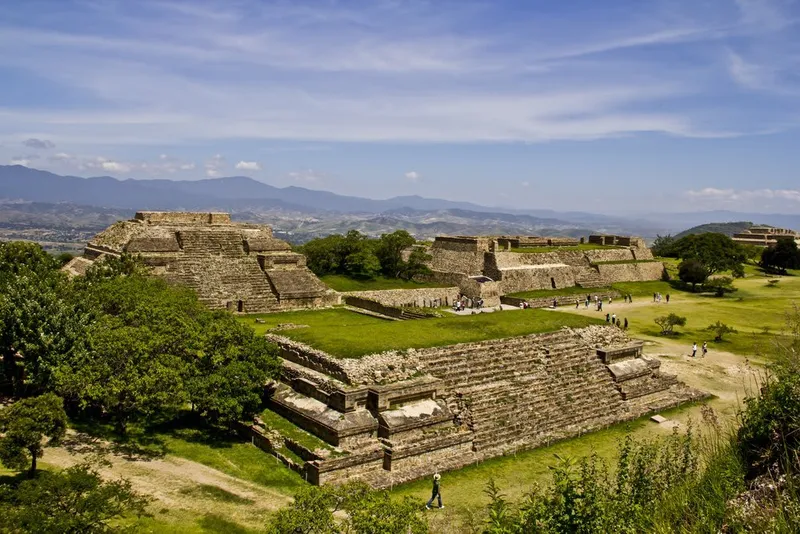
Monte Albán sat at the center of one of Mesoamerica’s first true cities for 1,500 years — from around 500 BC to 700 AD — governing a population that eventually reached 25,000. The Zapotecs leveled an entire mountaintop and built a ceremonial center that could be seen from all three arms of the valley.
What makes Monte Albán exceptional is the scale you feel on the ground. The Great Plaza stretches 300 meters and is flanked by massive platform pyramids on all sides. The Building J (the Observatory) is a distinctive arrowhead shape, oriented 45 degrees off the main axis of the city to align with certain star rises. The Ball Court features the sloped surfaces typical of the Mesoamerican game. And Tomb 104 — one of the most complete tombs found intact in Mexico — is open to visitors, with original fresco paintings still visible on the walls.
Los Danzantes (The Dancers) wall deserves close attention: 300 carved stone slabs depicting captives in contorted positions, many castrated, representing the Zapotec power over rival groups. These are among the oldest stone carvings in Mexico.
Practical tips:
- Go at 8 AM when it opens — tour buses from Cancun and Mexico City arrive from 10 AM onward, and the site becomes crowded quickly
- Bring water and sunscreen — the hilltop offers no shade
- The on-site museum near the entrance has the original finds from the tombs, including jade masks and elaborate jewelry
- Getting there: Microbus from Calle Mina 518, near the market. Departs every 30 minutes (25 MXN, 30-minute ride). Buy your ticket for the return at the site entrance before going in.
2. El Árbol del Tule — The World’s Widest Tree
Distance: 9km | Time: 15 min | Entry: 20 MXN | Hours: 8 AM–6 PM
The Tule Tree (El Árbol del Tule) holds a Guinness World Record for the widest trunk circumference of any tree on Earth: 14.05 meters in diameter, 42 meters tall, estimated to be between 1,400 and 3,000 years old. It’s a Montezuma cypress (Taxodium mucronatum) — a species sacred to the Zapotecs — growing in the churchyard of the village of Santa María del Tule.
The trunk’s bark forms fantastical ridges and bulges that locals have given names over centuries: look for the elephant, the lion, the jaguar face, the deer, and the hand of God, which guides will point out for a small tip. The full circumference is 54 meters — it takes 30 adults holding hands to encircle it.
This is a short stop (30–45 minutes maximum) that combines naturally with the El Tule–Teotitlán–Mitla circuit. It’s 9km east of Oaxaca on Highway 190, easy to reach by any colectivo heading toward Mitla.
3. Teotitlán del Valle — Living Zapotec Weaving Village

Distance: 29km | Time: 40 min | Entry: Free (village) | Hours: All day; workshops typically 9 AM–6 PM
Teotitlán del Valle has been producing woven textiles for at least 2,000 years. Today, roughly 80% of the 5,000 residents make their living from weaving — entire families working together, with grandmothers spinning thread while teenagers operate the looms. The rugs and tapetes sold here are not tourist crafts; they are technically complex works of art using wool that families shear, clean, spin, and dye themselves.
The natural dye process is what distinguishes Teotitlán from imitation weavings. Cochineal (a scale insect that lives on prickly pear cactus) produces the deep reds, pinks, and purples — you need 70,000 insects to produce 500 grams of dye. Indigo from the añil plant creates the blues. Moss, marigolds, and pomegranate produce the yellows and golds. In authentic workshops, you can watch the dyeing process and see the raw insects and plants on display.
To tell authentic Teotitlán pieces from imitations:
- Ask to see the skeins of hand-spun wool before weaving
- Look for slight irregularities in pattern (machine-made pieces are too perfect)
- Authentic pieces take 2–6 weeks to produce; prices range from $80–$600 USD for quality rugs
- The Mercado Artesanal at the village entrance has fixed prices; individual workshops often negotiate
The village also has a small archaeological zone (the ruins of the original temple, now underneath the Spanish colonial church built atop it) and a community museum covering Zapotec weaving history.
Getting there: Colectivo from Oaxaca’s 2nd-class bus station to Teotitlán (25 MXN, 45 minutes). Return colectivos wait near the market.
4. Mitla — The Most Intricate Stone Mosaics in Pre-Hispanic Mexico
Distance: 46km | Time: 1 hr | Entry: 80 MXN | Hours: 8 AM–5 PM
If Monte Albán shows Zapotec power, Mitla shows Zapotec artistry taken to its absolute extreme. The mosaic stonework on the Palace of Columns — intricate geometric fretwork assembled from thousands of individually cut stone pieces, without mortar — is unique in all of Mesoamerica. No other pre-Hispanic culture anywhere in the Americas built this way. The patterns (called grecas or xicalcoliuhqui) represent clouds, lightning, and the sky serpent; the precision of the fit is so exact that a knife blade cannot be inserted between the stones.
Mitla served as the religious capital of the Zapotec world from roughly 750 AD until the Spanish conquest, functioning alongside and eventually superseding Monte Albán. The site name comes from Nahuatl Mictlan — the underworld — reflecting its role as a center of priestly activity, death rituals, and the oracle.
What to see:
- Group of the Columns: The most elaborate and best-preserved structures, with the famous mosaic frieze wrapping the exterior walls
- North Group: Contains a Spanish colonial church built directly atop a Zapotec platform — one of the most visible examples of the conquest in the valley
- East Group: Less-visited, equally detailed, with carved columns inside a sunken courtyard
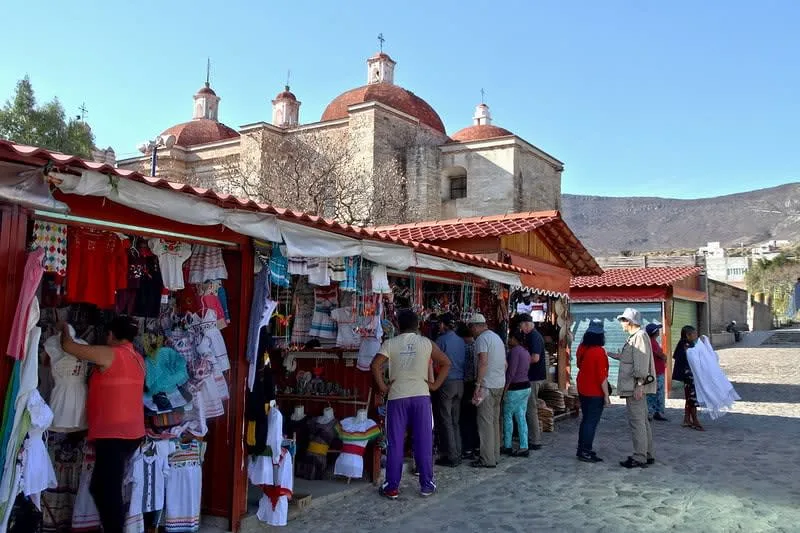
- The on-site market (just outside the entrance) sells good-quality local crafts and mezcal at village prices
Mitla is 46km east of Oaxaca along Highway 190 — the same road as El Tule and Teotitlán — making it the natural endpoint of the classic Valley circuit.
5. Tlacolula Sunday Market
Distance: 32km | Time: 45 min | Entry: Free | When: Every Sunday, 8 AM–2 PM
Every Sunday, Tlacolula transforms into the most complete traditional market in the Oaxaca Valley — and one of the great market experiences in southern Mexico. It’s not a craft market for tourists. It’s where the valley’s Zapotec communities come to trade, eat, gossip, and stock up for the week, much as they have since before the Spanish arrived.
The market occupies the area around the church and main plaza, spilling into surrounding streets. Different sections specialize in different goods:
- Produce hall: Chiles, herbs, squash, copal resin, dried insects (chapulines, chicatanas), seeds
- Meat section: Tasajo (dried beef), cecina enchilada, chorizo negro — buy vacuum-packed to bring home
- Cheese corridor: Quesillo (Oaxacan string cheese) in large twisted balls, still warm; queso fresco
- Cooked food section: Tlayudas made to order (50–80 MXN), memelas, mole negro, estofado
- Mezcal stalls: Artisanal mezcal sold from unmarked jugs — bring an empty bottle to fill ($5–10 USD/liter for excellent quality)
- Textile and craft section: Zarapes, huipiles, barro negro pottery, rebozos
The Tlacolula mezcal market inside the covered section deserves a specific mention: local producers bring clay cups of their mezcal and offer free tastings. You’re not obligated to buy; the quality is often extraordinary. Bring 200–500 MXN if you want to fill a bottle to take home.
Getting there: Colectivo from Oaxaca’s 2nd-class bus station (15–20 MXN, 45 minutes). Return colectivos wait near the market all morning.
Combine with: If you’re here on Sunday, build the full valley circuit — El Tule (15 min), Teotitlán (40 min), Tlacolula market, Mitla, Yagul (on the way back). It’s the ideal Oaxaca full day.
6. Hierve el Agua — Petrified Waterfalls and Mineral Pools
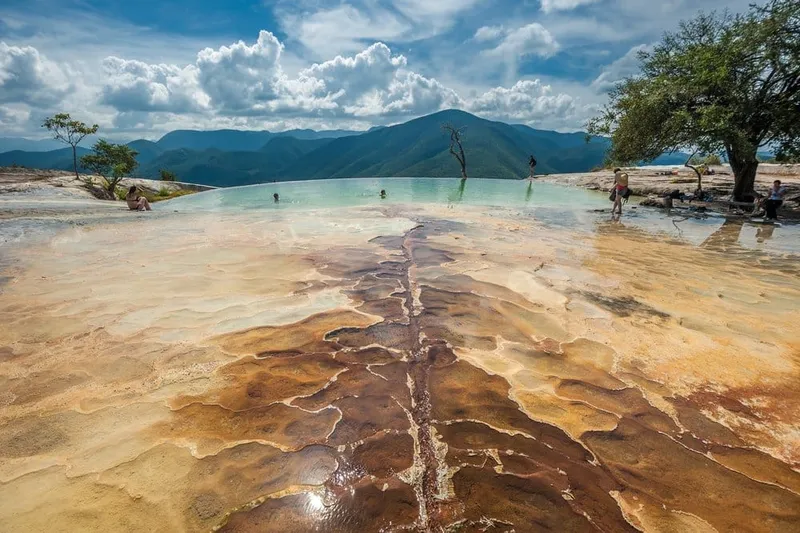
Distance: 71km | Time: 1.5 hr | Entry: 25 MXN | Hours: Typically 9 AM–5 PM
Hierve el Agua (literally “the water boils”) is named for the way mineral-rich spring water bubbles up from the ground — though it’s cold, not hot. Over thousands of years, the calcium carbonate in the water has precipitated and hardened as it flows over the cliff edge, building up the extraordinary petrified waterfall formations that drop 30–50 meters down the cliffside. From a distance, they look exactly like frozen waterfalls. Up close, you can stand on the edge and look 500 meters down to the valley floor.
The site has two mineral pools (Piscina Grande and Piscina Chica) fed by the same springs. The water is 68°F (20°C), clear, and smells faintly of sulfur. You can swim in the pools while looking out over the valley — one of the more spectacular natural settings you’ll find anywhere in Mexico.
⚠️ Critical warning: Hierve el Agua has a history of unexpected closures. The site is jointly managed by two communities (San Isidro Roaguía and San Lorenzo Albarradas) who periodically block access over revenue-sharing disputes. It typically closes June–October for the rainy season (muddy roads) and sometimes stays closed longer. Confirm it’s open the morning you plan to go — ask your hotel, call Oaxaca tourism (+52 951 516 0123), or check the Facebook page for Hierve el Agua before making the 1.5-hour drive.
Getting there: Without a car, you need an organized tour ($25–45 USD) or a taxi at a day rate (~$50–70 USD round-trip with waiting time). Public colectivos exist but require two transfers and are unreliable for the final stretch. Most people book a combo tour that includes Mitla, El Tule, Teotitlán, and Hierve el Agua in one day — efficient but rushed.
7. Santiago Matatlan — The World Mezcal Capital

Distance: 47km | Time: 1 hr | Entry: Free | Hours: Distilleries open 9 AM–5 PM most days
Santiago Matatlan produces more mezcal than any other municipality on Earth. The town sign proudly declares it “Capital Mundial del Mezcal.” More than 200 registered palenques (traditional distilleries) operate here — and dozens more make mezcal without registration, as they have for centuries, for personal use and local trade.
A palenque visit is unlike any brewery or winery tour. You’ll see:
- Wild agave plants (mostly espadín, but also tobalá, madrecuixe, and bicuixe) in the surrounding hills — some wild-harvested, some cultivated, all taking 7–30 years to mature before harvest
- The underground stone pit where agave hearts (piñas) are roasted over wood and rock for 3–7 days, creating the characteristic smoky flavor
- Wooden mallets or a horse-drawn stone wheel crushing the roasted piñas
- Cypress wood fermentation vats where wild yeasts do their work over 5–15 days
- Clay pot or copper stills for double distillation
What to do: Most palenques welcome visitors who simply show up and ask for a tour. The experience typically ends with a tasting of different expressions — ancestral mezcal, different agave varieties, different smoke levels. Buying a bottle directly from the producer (400–1,200 MXN) costs far less than the same product in Oaxaca city boutiques, and you know exactly where it came from.
Good entry-point palenques: El Rey Zapoteco, Vago partner producers in the village, and several unnamed family operations will welcome you if you arrive respectfully and with basic Spanish.
8. Yagul — Hilltop Fortress with UNESCO-Inscribed Rock Art
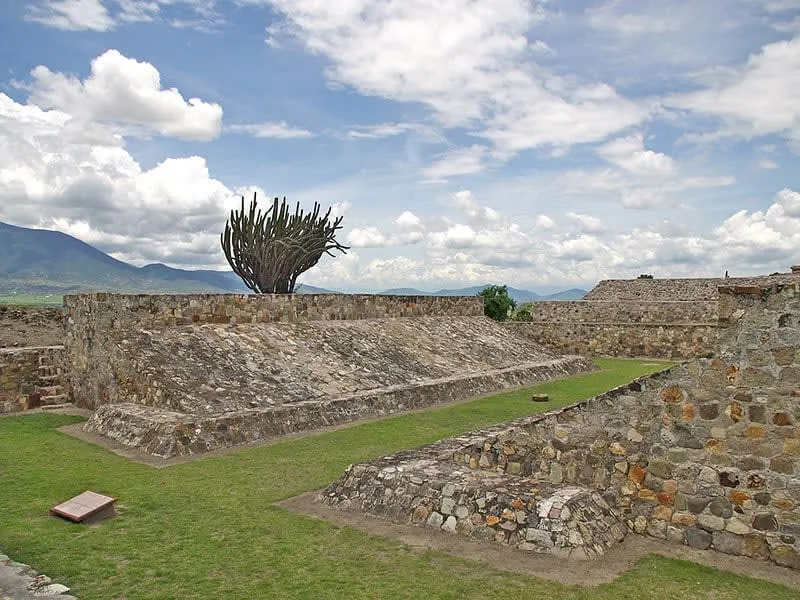
Distance: 36km | Time: 45 min | Entry: 80 MXN | Hours: 8 AM–5 PM
Yagul is what Mitla and Monte Albán are not: a relatively undiscovered site where you might be the only non-local visitor. The ruins occupy a limestone hill above the Valley of Oaxaca, built by the Zapotecs and later occupied by the Mixtecs between roughly 500 and 1200 AD.
The site has the largest ball court in Oaxaca (not the Americas — that’s at Chichen Itza — but still impressive), six residential and ceremonial courts, a royal tomb, and a Council Hall (Palacio de los Seis Patios) with six interconnected rooms. The hilltop fortress above the main plaza offers the best 360-degree views of the valley you’ll find anywhere.
But Yagul’s UNESCO designation (2010, as part of the Prehistoric Caves of Yagul and Mitla) comes from something far older: rock art and evidence of early agriculture in the surrounding caves dating back 8,000 years. INAH researchers discovered some of the earliest evidence of domesticated squash and corn in the Americas here. The caves themselves require a guide and permission to enter, but the story they tell — that this valley is where Mexican civilization essentially began — changes how you see everything else in Oaxaca.
Combine with: Mitla (10km further along Highway 190) for a half-day ruins circuit. Many visitors do Yagul in the late afternoon when the light on the valley is best for photography.
9. San Bartolo Coyotepec — Black Pottery Village
Distance: 21km | Time: 25 min | Entry: Free | Hours: Workshops 9 AM–5 PM
Barro negro (black clay pottery) is Oaxaca’s most recognizable craft — the shiny, jet-black ceramic used for mezcal cups, plates, vases, and figures. San Bartolo Coyotepec is where essentially all of it comes from. The pottery tradition existed before the Spanish conquest, but it was Doña Rosa Real de Nieto who, in the 1930s, developed the distinctive high-gloss burnishing technique using a quartz stone — a technique that spread through the whole village and transformed the craft into an art form.
The pottery gets its black color not from paint or glaze but from the iron-rich local clay combined with low-oxygen firing in a traditional kiln. The burnishing (polishing the unfired clay with a quartz stone in slow circles) takes hours per piece and creates the reflective surface.
What to do: Visit the family workshop of the Nieto family (Doña Rosa’s descendants still operate it as a museum and workshop, open 10 AM–5 PM, small donation). Most other workshops on the main road also welcome visitors and allow you to watch or try basic hand-building. Quality varies widely at roadside stalls — established workshops produce finer, more durable pieces.
Getting there: Colectivo from the 2nd-class bus station in Oaxaca (15 MXN, 25 minutes). The village center is a short walk from where the colectivo drops you.
10. Atzompa — Green Ceramics and a Less-Crowded Ruin
Distance: 7km | Time: 15 min | Entry: 70 MXN | Hours: 8 AM–5 PM
Santa María Atzompa is one of Oaxaca’s least-visited archaeological zones — and also its most underrated. The site is directly affiliated with Monte Albán (they were effectively the same political entity) and the ruins are significant and well-preserved, but the crowds go to Monte Albán instead, which means you can walk the platforms here alone.
The Atzompa ruins feature three ball courts (the most at any site in the Oaxaca valley), multiple residential complexes, and a ceremonial center with pyramid platforms offering clean views of Monte Albán on the opposite hill. INAH restored the site properly, and the small museum at the entrance displays ceramics, figurines, and the story of the settlement.
The village of Atzompa is equally worth a stop for its distinctive green-glazed pottery — a tradition dating to the pre-Hispanic period when the clay was fired with lead-based minerals to create the olive-green sheen. Modern Atzompa potters use lead-free glazes (required by law since the 1990s) but maintain the visual tradition. The result is a warm, earthy green distinctive from the jet-black of San Bartolo.
Combine with: Monte Albán (on the same side of the city, 5km further). Do Atzompa first (fewer crowds, morning light on the platforms) then continue to Monte Albán for the main event.
11. Ocotlán de Morelos — Friday Market and Folk Art
Distance: 30km | Time: 40 min | Entry: Free | Best Day: Friday (market day)
Ocotlán is a smaller market town that doesn’t make most itineraries — which is exactly why it’s worth going. Every Friday morning, the town holds its weekly tianguis around the 16th-century Dominican church: fresh produce, live animals, regional textiles, and food prepared in the market’s covered section.
The town is also the hometown of Rodolfo Morales (1925–2001), one of Mexico’s most celebrated surrealist painters, who spent the last decade of his life restoring the church and founding the Fundación Cultural Rodolfo Morales. The Casa de la Cultura on the main plaza houses permanent exhibitions of his work — bright, dreamlike canvases pulling from Zapotec mythology and rural Oaxacan life.
Next door, the Aguilar family workshop produces distinctive painted clay figures (known globally as “Oaxacan wood carvings” — a confusion, since Aguilar figures are clay) that have made it into the Smithsonian collection. Josefina Aguilar is the most famous; her daughters now run the main workshop.
12. Cuilapam de Guerrero — The Roofless Monastery
Distance: 10km | Time: 15 min | Entry: 55 MXN | Hours: 9 AM–5 PM
The Dominican monastery of Santiago Apóstol in Cuilapam (1556) never finished construction. The church was left roofless — either by design, lack of funds, or the expulsion of the Dominican order in the 1700s — and has remained that way for 400 years. Today the massive stone walls and carved arches frame an open sky, creating an eerie beauty that doesn’t exist anywhere else in Mexico.
The monastery is also a significant historical site: Vicente Guerrero, one of the fathers of Mexican independence and the country’s second president, was imprisoned and executed here in 1831. A small monument in the courtyard marks where he fell.
Cuilapam is small and easily combined with a Monte Albán morning — it’s 10km south of the city in the opposite direction, making a logical circuit: city → Cuilapam → back to city → up to Monte Albán.
13. Zaachila — Mixtec Tombs and Thursday Market
Distance: 17km | Time: 25 min | Entry: 60 MXN | Best Day: Thursday (market day)
Zaachila holds the only Mixtec-period tombs in Oaxaca open to the public — two underground burial chambers discovered in 1962 that still contain original carved figures, including owls (symbols of death), turtles, and serpents in high relief. The Mixtecs were among the finest goldsmiths and codex-painters in Mesoamerica; the tombs’ artwork reflects that sophistication.
On Thursdays, Zaachila also holds its weekly market around the church — more local and less curated than Tlacolula, with outstanding food stalls (mole amarillo, tamales de rajas, tejate). Worth combining if you’re planning any valley circuit during the week.
14. San José el Mogote — The Earliest Writing in the Americas
Distance: 12km | Time: 15 min | Entry: Free | Hours: 8 AM–5 PM
San José el Mogote is the least-visited significant archaeological site in the Oaxaca Valley — and arguably the most important. The site was the dominant settlement in the valley from 1500 BC to 500 BC, before Monte Albán was founded. Researchers found here the earliest example of writing in the Western Hemisphere: a carved stone monument from around 600 BC depicting a sacrificed figure with glyphs below that have not been fully decoded but are undeniably a writing system.
The site itself is modest — a few exposed platforms, a community museum with original finds — but the story it anchors is extraordinary: this valley, not the Valley of Mexico, is where Mesoamerican civilization began to read and write.
For the historically minded traveler who has already done Monte Albán, El Mogote provides essential context. The small museum on-site is one of the best in rural Oaxaca, and it’s completely free.
The Best Oaxaca Day Trip Circuits
Classic Valley Circuit (full day, rental car or colectivos)
El Árbol del Tule → Teotitlán del Valle → Tlacolula Market (Sunday) → Mitla → Yagul
The definitive Oaxaca day trip. Works best on Sunday when Tlacolula market is running. Start with the Tule tree (30 min), continue to Teotitlán for weaving demonstrations and shopping (90 min), hit Tlacolula market at its peak (90 min), continue to Mitla for the stone mosaics (90 min), then finish at Yagul in afternoon light (60 min). Return to Oaxaca for dinner. Total: 9–10 hours.
Ruins Day (half day)
Monte Albán → Atzompa (or Monte Albán → Cuilapam)
Do Monte Albán first thing (8 AM opening), spend 2.5–3 hours there, then drive or taxi to Atzompa for the quieter counterpart. Back in the city for a 2 PM lunch. This is the move if you only have a half-day.
Mezcal and Craft Circuit (full day, rental car recommended)
San Bartolo Coyotepec → Ocotlán de Morelos (Friday) → Santiago Matatlan palenques
South of Oaxaca along Highway 175 and 190: black pottery workshops, the Friday folk art market, then end at the mezcal capital with a palenque tour and tasting. Works any day for the pottery and mezcal; Fridays add the market.
Hierve el Agua Day (full day — confirm open)
Mitla → Hierve el Agua (combine on the same road)
Hierve el Agua is 25km past Mitla. Stop at Mitla (90 min) then continue to the petrified waterfalls for the afternoon. Allow 2–3 hours at Hierve el Agua. Return to Oaxaca by 6–7 PM. Confirm Hierve el Agua is open before going — call your hotel the morning of the trip.
Budget Guide
| Budget | Per Day | What You Get |
|---|---|---|
| Budget | $25–40 USD | Colectivos, site entries, market food ($5–8 USD/meal) |
| Mid-range | $50–80 USD | Rental car, all site entries, sit-down meals, mezcal tasting |
| Comfort | $80–130 USD | Private driver, guided tours with expert commentary, upscale dining |
Site entries averaged out: Most Oaxaca archaeological sites cost 60–90 MXN ($3–5 USD). A full circuit hitting Monte Albán, Mitla, Yagul, Atzompa, and Zaachila costs under 400 MXN ($20 USD) in entry fees total.
When to Visit
| Month | Conditions | Notes |
|---|---|---|
| Nov–Feb | Dry, cool 15–22°C days | Best weather; Día de Muertos peak in November |
| Mar–May | Dry, warm 20–28°C | Ideal; shoulder season, fewer crowds than July |
| Jun–Aug | Rainy season begins | Hierve el Agua may close; Guelaguetza festival in July |
| Sep–Oct | Rainy season peak | Some roads muddy; Hierve el Agua typically closed |
More Oaxaca Guides
- Oaxaca Travel Guide — Complete city overview, neighborhoods, food, logistics
- Things to Do in Oaxaca — 30 best activities ranked
- 5 Days in Oaxaca Itinerary — Full day-by-day plan with the valley circuit
- Best Time to Visit Oaxaca — Month-by-month weather, festivals, crowds
- Oaxaca Pyramids and Ruins Guide — Deep dives on all 12 archaeological sites
- Oaxacan Food Guide — The seven moles, tlayudas, mezcal, markets
Planning your trip? Compare rental car rates for Oaxaca — a car unlocks every destination on this list. travel insurance should include emergency medical treatment including rural Oaxaca.