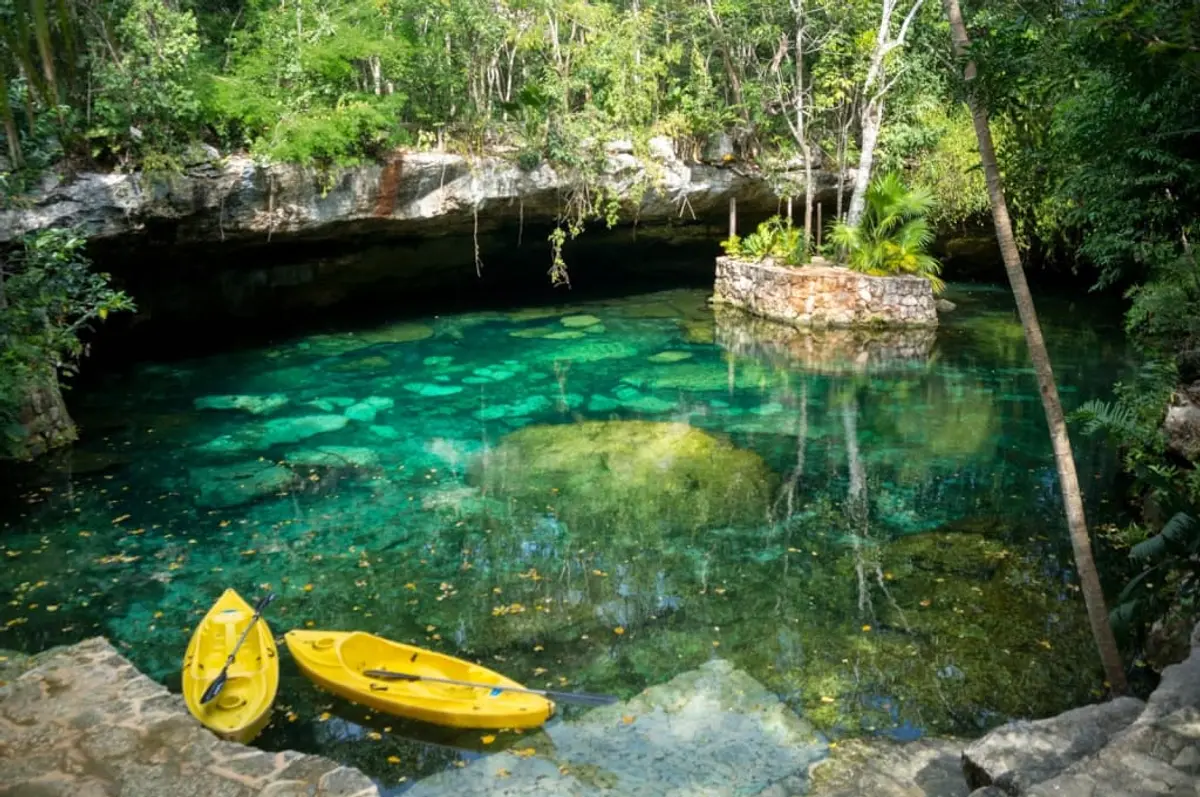
Mexico Cenotes Guide 2026: Types, Safety & How to Visit
No other place on Earth has cenotes like the Yucatan Peninsula. More than 6,000 of these natural freshwater sinkholes dot the landscape between Cancún and the Guatemalan border. Swimming in a cenote is one of the defining experiences of traveling Mexico, but it comes with real safety considerations, operator rules, and context that many travel guides skip.
This guide covers what cenotes are, the science behind why the Yucatan has so many, how to visit safely, skin-product rules, and the best cenotes organized by region and skill level.
What Is a Cenote?
The word cenote comes from the Maya word ts’onot, meaning “sacred well.” The Maya considered cenotes sacred because they were — for a civilization living on a peninsula with no rivers and no surface freshwater — the only source of drinking water. They served as community water sources, ceremonial sites, and occasionally as places of sacrifice.
Scientifically, a cenote is a collapsed limestone sinkhole that exposes the water table below. Here’s how it forms:
- Rainwater, slightly acidic from absorbing CO₂ as it falls, percolates down through porous limestone.
- Over thousands of years, the slightly acidic water dissolves the limestone, creating underground caverns.
- When the cavern ceiling becomes too thin to support its own weight, it collapses.
- The collapse exposes the water table — and creates a cenote.
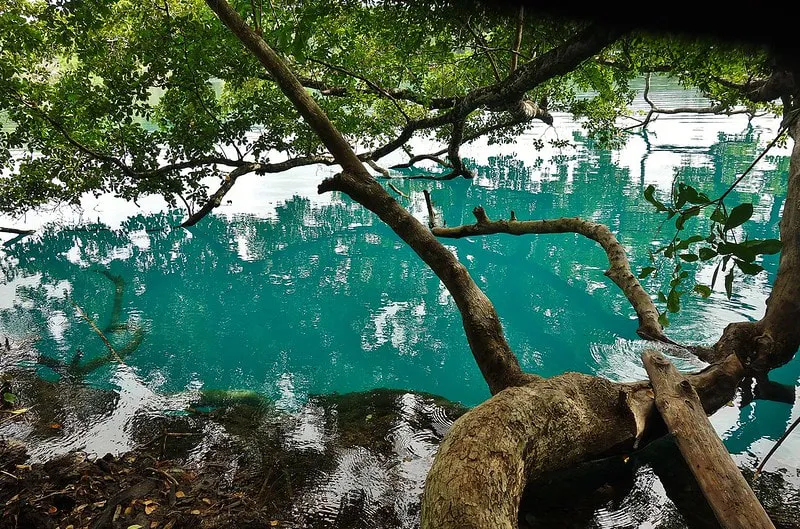
The water itself is extraordinary: crystal-clear, around 24°C year-round regardless of outside temperature, and filtered through limestone for thousands of years before it arrives in the cenote.
Why Does the Yucatan Have 6,000+ Cenotes?
Two reasons: geology and a meteor.
The geology: The Yucatan Peninsula is almost entirely flat limestone. Unlike most of Mexico, it has no rivers. All the freshwater that falls as rain goes underground, creating a vast network of underground rivers and caves instead of surface drainage. This system is the perfect environment for cenote formation at massive scale.
The Chicxulub meteor: 66 million years ago, the asteroid that ended the dinosaurs struck the Yucatan Peninsula, at what is now Chicxulub near Mérida. The impact created a massive crater roughly 180km in diameter. The ring of the crater is still visible today as a slight arc in the landscape — and the highest concentration of cenotes in the Yucatan follows that arc almost perfectly. The impact shattered and fractured the limestone bedrock in a ring pattern, creating the ideal conditions for cenote formation along the crater’s edge.
You can see this from satellite imagery: the “Ring of Cenotes” traces the Chicxulub crater edge.
The Sac Actun System: What’s Below You
The Sac Actun system is the world’s longest underwater cave. As of the most recent mapping, it extends at least 347 kilometers — and possibly much further, since exploration is ongoing. It connects to other cave systems (Sistema Dos Ojos, Sistema Ox Bel Ha) in a network that’s the largest underwater cave system on Earth.
When you swim in a cenote, you are entering the Sac Actun system. The “hole” in the surface connects to passages, caves, and tunnels that extend hundreds of kilometers in every direction underground.
At least 10 cenotes accessible to the public are officially entries into the Sac Actun system. Dos Ojos near Tulum is one of the most famous.
Types of Cenotes
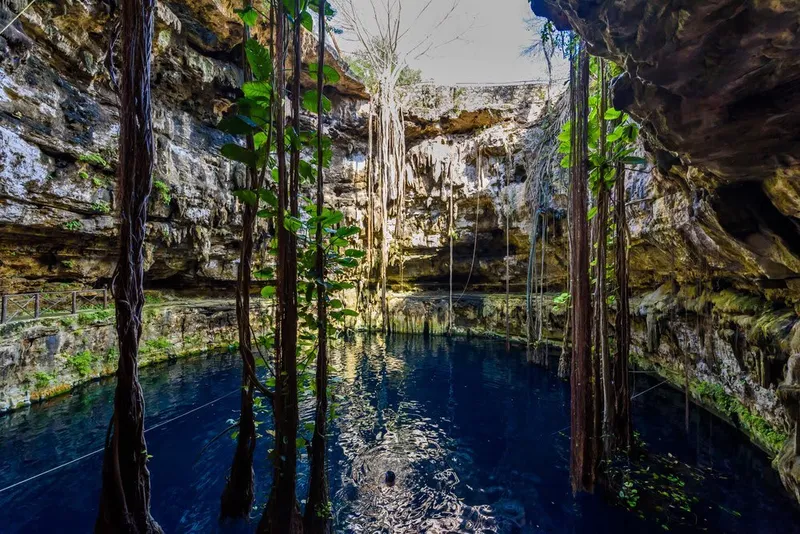
Open Cenotes (Type 1)
The limestone ceiling has fully collapsed, leaving an open-air pool. Sunlight enters directly, making these the most photogenic and easiest to access. Most popular tourist cenotes are open type.
Experience required: None. Suitable for all ages and swimming levels. Life jackets available.
Examples: Gran Cenote (near Tulum), Ik Kil (near Chichen Itza), Suytun (near Valladolid), Balankanche
Semi-Open Cenotes (Type 2)
The ceiling has partially collapsed — there’s some open sky but also cave sections. These offer a mix of sunlit and cave zones, often with dramatic light shafts cutting through the darkness.
Experience required: Moderate swimming ability. Cave sections require a guide.
Examples: Cenote Dos Ojos (cave and open sections), Cenote Azul (Bacalar area), Aktun Chen
Cave Cenotes (Type 3)
The ceiling is intact — you enter through an opening and swim in total darkness (except your lights). These are the most dramatic and the most dangerous. Proper cave diving requires specialized training and equipment; snorkeling in guided cave sections is possible at some.
Experience required: Open water certified for diving sections; guided snorkel for accessible sections; do not enter unguided.
Examples: Cenote Angelita (dive only, 60m), Dzitnup and Samula (guided snorkel possible), Chaak-Tun
Safety Rules
These aren’t suggestions. Cave systems kill people who ignore them.
- Never dive solo. This is the absolute rule for cave cenotes. Divers die in cave systems every year, usually because they went in alone, ran low on air, and had no one to help.
- Always use a guide for cave sections. Cave diving requires specific training (PADI or TDI cave certification). For snorkeling in cave sections, a certified guide who knows the system is required.
- Buddy system for open cenotes. Even in open cenotes, swim with someone. Some are very deep (30–50m). The cold thermocline can cause cramps.
- No alcohol before swimming. This seems obvious, but cenote towns are full of bars. Alcohol impairs judgment in cave systems in ways that can be fatal.
- Respect depth. Many cenotes that look like a 5m pool are actually 30–60m deep. The water clarity makes depth deceptive.
- Tell someone your plans. If visiting a remote cenote, tell your accommodation where you’re going.
- Wear a life jacket if offered. Most cenote operators offer them free or for a small fee. There’s no reason to refuse.
Sunscreen and Skin-Product Rules
There is no single visitor policy shared by every cenote. Rules range from biodegradable-only products to a complete ban on sunscreen, repellent, makeup, and lotion before swimming. Cenote Azul’s official rules, for example, explicitly ban even biodegradable sunscreen and require visitors to shower.
The safest universal plan is simple: arrive without skin products on, shower as directed, wear a rash guard or hat between swims, and apply sunscreen after your final cenote visit. Always follow the operator’s posted rules.
Cenotes by Type Table
| Cenote | Type | Entry Fee | Skill Level | Notes |
|---|---|---|---|---|
| Gran Cenote | Open/semi | 500 MXN | Beginner | Open and cave-like swim areas |
| Dos Ojos | Cave/open | From ~400 MXN | Moderate | Sac Actun entry point |
| Angelita | Cave | Dive only | Expert diver | 60m, H₂S cloud at 30m |
| Suytun | Open | 200 MXN | Beginner | Instagram platform |
| Ik Kil | Open | 180 MXN | Beginner | Cliff jump 28m |
| Dzitnup | Cave | 80 MXN | Beginner (guided) | Underground, blue hole |
| Samula | Cave | 80 MXN | Beginner (guided) | Twin to Dzitnup |
| Zaci | Open | 50 MXN | Beginner | In Valladolid town |
| Chaak Tun | Cave | Check official booking | Moderate | ~4.7km inland from Playa del Carmen |
| Yokdzonot | Open | 80 MXN | Beginner | Local community-run |
Best Cenotes by Region
Near Tulum
Gran Cenote — About 4km from Tulum town, this is an accessible option for non-divers. It combines open swimming with cave-like areas, and current admission is 500 MXN. Typical hours are 8am–4:45pm, with last entry around 4:15pm; confirm before travel and arrive early for lighter crowds.
Cenote Angelita — One of the most extraordinary dives in Mexico. At roughly 27–30m, a hydrogen-sulfide cloud creates what looks like an underwater river. This is an advanced dive, not a snorkeling stop; operators normally require Advanced Open Water certification.
Dos Ojos — The name means “Two Eyes.” The site is about 22km north of Tulum and is part of Parque Dos Ojos, with swimming, snorkeling, and dive options sold at different prices. Admission starts around 400 MXN; guided packages cost more.
Aktun Chen — A cave cenote within a nature park, guided tours only. Less crowded than the Tulum cenotes, includes cave walks above water as well as swimming.
Near Valladolid
Cenote Suytun — The most Instagram-famous cenote in Mexico. A stone platform surrounded by water with a circular skylight above creates a perfect natural spotlight. It’s beautiful in person, but it’s also crowded — the platform holds about 10 people at a time and the cenote is small. Entry around 200 MXN. Worth it for the experience; don’t expect to have it to yourself.
Samula and Dzitnup — Two cave cenotes 500 meters apart, 6km west of Valladolid. Both are underground — you descend stairs into a cave and find a luminous blue hole illuminated by a shaft of sunlight through the ceiling. Tree roots hang 50–60 meters down from the ceiling to reach the water. Guided tours take small groups through. Entry approximately 80 MXN each.
Cenote Zaci — Right in the center of Valladolid town, this cenote requires no transport and costs only about 50 MXN to enter. It’s a large open cenote with a viewing platform and swimming area. Note: There are crocodiles in Zaci — small ones, rarely seen, but the sign at the entrance acknowledges their presence. No attacks on record, but worth knowing.
Near Chichen Itza
Ik Kil — The most visited cenote in Mexico, directly on the route between Mérida and Chichen Itza. It’s also genuinely spectacular: a perfectly circular open cenote with waterfalls of hanging vines, cliff jump platforms at heights of 7 and 28 meters, and crystal water despite the crowds. Entry around 180 MXN. Expect tour groups; arrive early.
Yokdzonot — A community-run cenote a few kilometers off the main highway near Chichen Itza. Far fewer tourists, lower entry fee, and the income directly supports the local Maya community. A good alternative to Ik Kil if you want a calmer experience.
Near Playa del Carmen
Chaak Tun — About 4.7km inland on Avenida Juárez, Chaak Tun is a guided cave experience rather than an independent swimming stop. Use a taxi or the operator’s transport option and check the current booking price directly.
Río Secreto — A guided underground-river experience rather than a traditional cenote. You walk, wade, and swim through cave passages with safety equipment provided. The official basic tour starts at US$89, with higher-priced packages available.
Bacalar Area
Cenote Esmeralda — Free access, no facilities, just a beautiful freshwater pool in the jungle south of Bacalar. Worth combining with a visit to the Bacalar lagoon.
Cenote Azul (Bacalar) — Different from the Valladolid Cenote Azul — this one sits directly adjacent to the Laguna de Bacalar in the town itself. One of the deepest cenotes in the Yucatan (over 90 meters), with a restaurant and bar on the edge. Free or low entry on the public side; restaurant side charges more.
How to Get to Cenotes Without a Car
Tulum cenotes: Gran Cenote is about 4km west on the Cobá road and practical by bike or taxi. Dos Ojos is about 22km north; use a northbound colectivo plus a local transfer, a car, or a tour rather than treating it as a bike ride from town.
Valladolid cenotes: Colectivos from Valladolid’s main terminal pass near Dzitnup and Samula. For Suytun, a taxi from town is about 100 MXN round trip.
Ik Kil: It’s on the main highway between Mérida and Cancún. Every tour to Chichen Itza stops here, or ADO buses will drop you at the entrance.
Playa del Carmen: Most tour operators run full-day cenote tours from PDC for around 800–1,200 MXN including transport, lunch, and two or three cenotes.
General tip: Mexican colectivos (shared vans) are the backbone of local transport in the Yucatan. They’re cheap (10–50 MXN for most local routes) and run frequently between towns. Ask your accommodation which colectivo route passes nearest your target cenote.
What to Bring
- A rash guard — reliable sun protection without putting sunscreen into the water.
- Reef shoes or water shoes — the rocks entering cenotes can be sharp and slippery.
- Underwater camera — the GoPro-style waterproof cameras are worth it here. Visibility in cenotes is 30–100 meters.
- Change of clothes — you will be wet.
- Cash — many cenotes do not accept cards. Bring enough for entry, lockers, food, and transport.
- Snorkel set — equipment rules and rental fees vary; bring your own only if the operator permits it.
- Sunscreen for after the swim — do not apply it until you know the site’s policy; some operators require visitors to enter product-free.
Life-jacket rules vary by operator; some include one and require it, while others rent equipment separately. Follow the site rule even if you are a strong swimmer because many cenotes are deceptively deep.
Book Cenote Tours
Viator has a strong selection of guided cenote tours — cave snorkeling, whale shark combination days from Cancún, and full-day multi-cenote routes from Playa del Carmen and Tulum. Guided tours often get you into cave sections that you can’t access independently.
Browse Mexico cenote tours on Viator →
Travel Insurance
Some cenote activities — cave diving, cliff jumping, deep snorkeling — are classified as adventure activities. Standard travel insurance may not cover these. Check your policy before you go, especially if it needs to include water sports or cave-related activities.
Related Guides
- Best Cenotes in Mexico: The Listicle — ranked list of the top 20 cenotes across Mexico
- Tulum Travel Guide — cenotes, ruins, beach, and where to stay
- Valladolid Travel Guide — colonial town with excellent nearby cenotes
- Day Trips from Tulum — Dos Ojos, Sian Ka’an, and beyond
- Yucatan 7-Day Itinerary — how to combine cenotes with Chichen Itza, Mérida, and the coast