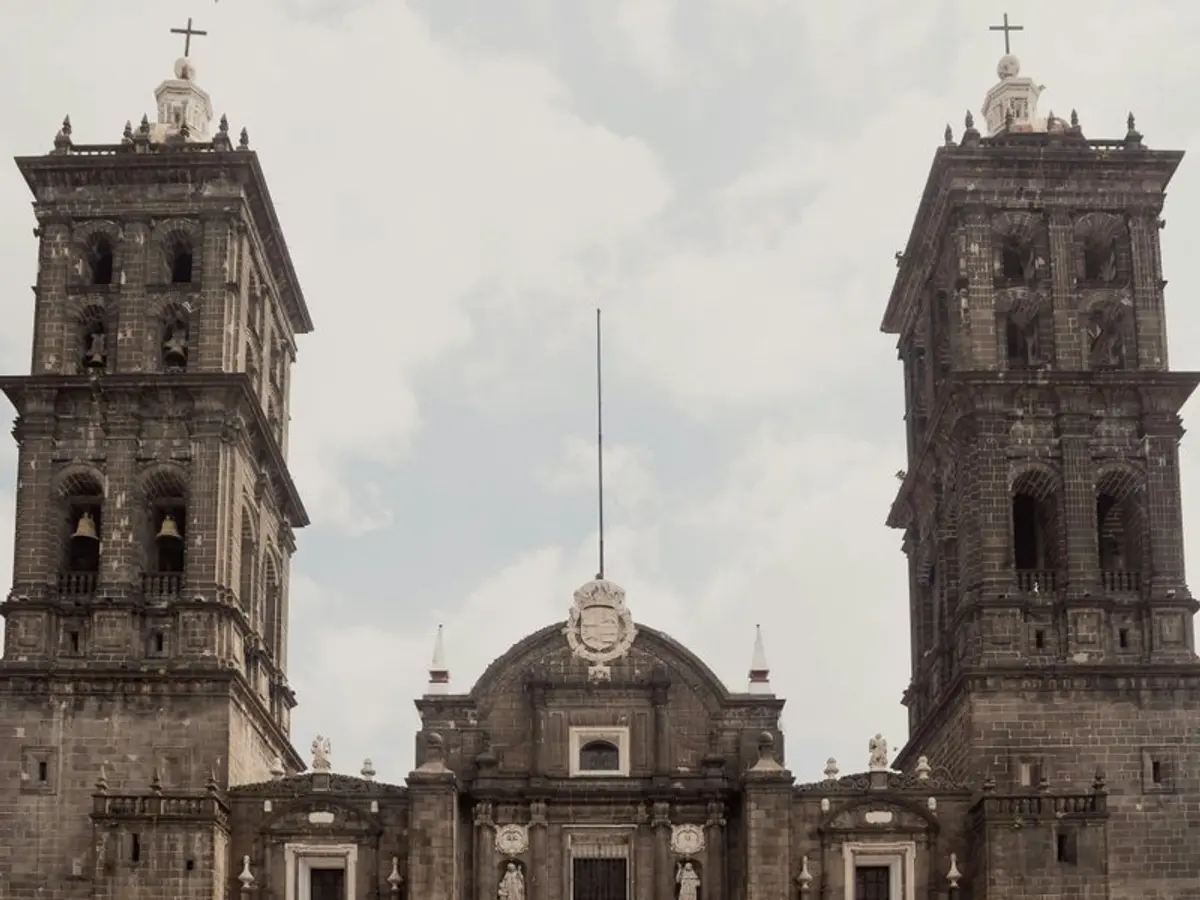
Puebla State Guide 2026: UNESCO City, Volcanoes & Cuisine
Puebla state sits two hours southeast of Mexico City, and that proximity explains both its historical importance and its current underestimation. It’s close enough that weekend visitors have been treating it as a day trip for decades — which means many travelers have seen Puebla City’s cathedral and eaten a cemita, checked the box, and gone home without realizing the state extends into cloud forests, volcano trails, indigenous ceremonial grounds, and the birthplace of corn itself.
This guide covers the whole state. For the city in full detail — neighborhoods, restaurants, markets, mezcal — see the Puebla City guide and things to do in Puebla.
Why Puebla State Matters
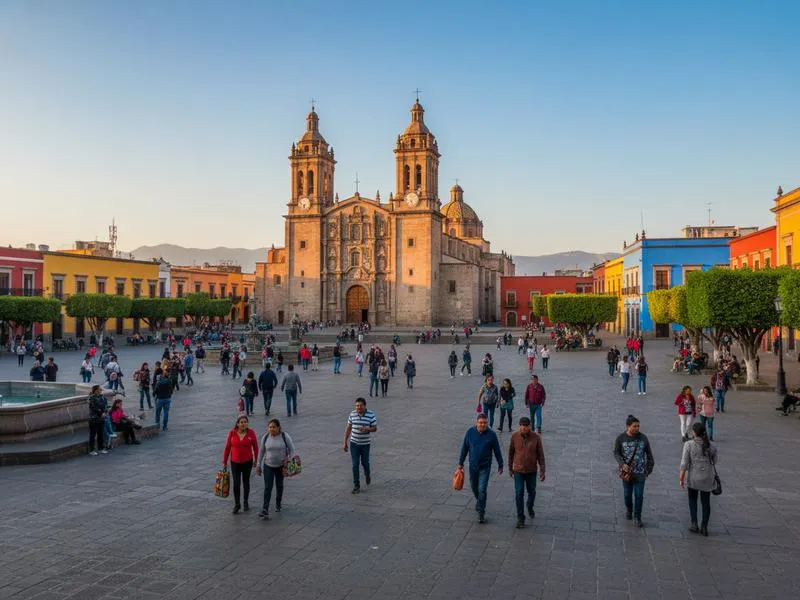
After Mexico City, Puebla is the most historically significant colonial city in Mexico — and this isn’t hyperbole. Mexico City was built on the ruins of Tenochtitlán (the Aztec capital), which gives it pre-Hispanic precedence. Puebla was founded from scratch by the Spanish in 1531 specifically as a strategic point on the route from Veracruz to Mexico City. It became the second wealthiest city in New Spain, the production center of talavera pottery, and the location of what became Mexico’s most famous military victory.
The Cinco de Mayo story that gets misrepresented abroad: it’s not Mexican Independence Day (that’s September 16) and it’s not even a major national holiday in Mexico. It commemorates a specific battle — the Battle of Puebla, May 5, 1862 — in which a Mexican army of 4,000 under General Ignacio Zaragoza defeated a French force of 6,000 considered invincible at the time. The French were marching toward Mexico City to collect debt and extend Napoleon III’s empire. The victory at the Forts of Loreto on the hill above the city delayed the French advance and became a symbol of Mexican resistance. You can visit the actual Forts of Loreto — now a museum — overlooking the city.
Beyond the city: the state borders Veracruz at Pico de Orizaba (North America’s third highest peak, 5,636 meters), Oaxaca at its southern edge, and contains Tlaxcala — the smallest state in Mexico, worth a half-day detour for its extraordinary 16th-century frescoed church and the pre-Hispanic site of Cacaxtla.
Puebla City: UNESCO Colonial Center
Puebla City’s historic center is one of the most intact colonial urban spaces in the Americas. Nearly 70 buildings in the center are baroque monuments of architectural significance — the density of ornate 17th and 18th century churches, convents, and civil buildings is extraordinary. UNESCO listed it in 1987.
The city sits at 2,135 meters elevation, which keeps temperatures cooler than coastal Mexico: 15-25°C year-round. On clear days (November-February), Popocatépetl volcano (5,426m) and the glacier-covered peak of Iztaccíhuatl (5,230m) dominate the skyline to the northwest — two active/dormant volcanoes visible from the city’s streets.
The Food Scene
Puebla’s cuisine is one of the primary reasons to visit the state. Quick navigation:
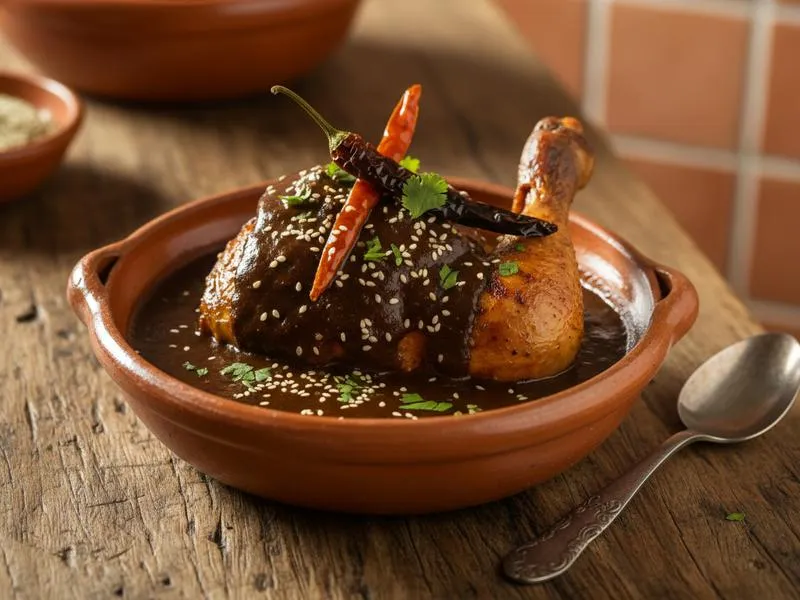
Mole poblano — the real version, not the jarred approximation — requires hours of preparation: toasting and grinding dried mulato, ancho, and chihuacle chiles, working in chocolate, plantain, almonds, sesame, and spices. The best versions in the city are at Mesón Sacristía de la Compañía (inside a 17th-century building) and the comedores on the south side of Mercado El Carmen.
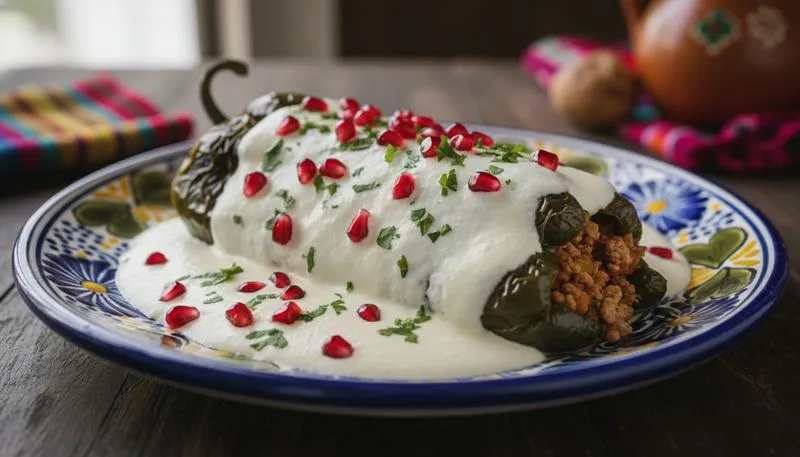
Chiles en nogada (late July-September): poblano chiles stuffed with picadillo — minced meat with peaches, pears, plantain, almonds, raisins — covered in walnut cream sauce, topped with pomegranate seeds and parsley. The three colors represent the Mexican flag. August and early September are the safest travel window; use the chiles en nogada season guide before booking around one meal.
Cemitas: Sesame-seed rolls filled with avocado, cheese, chipotle, and your choice of milanesa, chicken, or pork. The specific bread (the cemita roll itself) is unique to Puebla and cannot be replicated elsewhere. The market at 6 Oriente has the most-cited cemita stalls.
Tacos árabes: Vertical-spit pork wrapped in a flour tortilla, local Lebanese immigrant influence from the early 20th century. Taquería El Árabe and Chilis are the institution.
Talavera Pottery
Puebla is the only city in Mexico authorized to produce certified talavera — the tin-glazed earthenware with distinctive blue, yellow, and white geometric patterns. The certification process (protected denomination of origin) requires specific materials, techniques, and production location. You can visit active workshops in the Barrio de Analco and buy directly at significantly lower prices than tourist shops.
Cholula: The Pyramid Under the Church
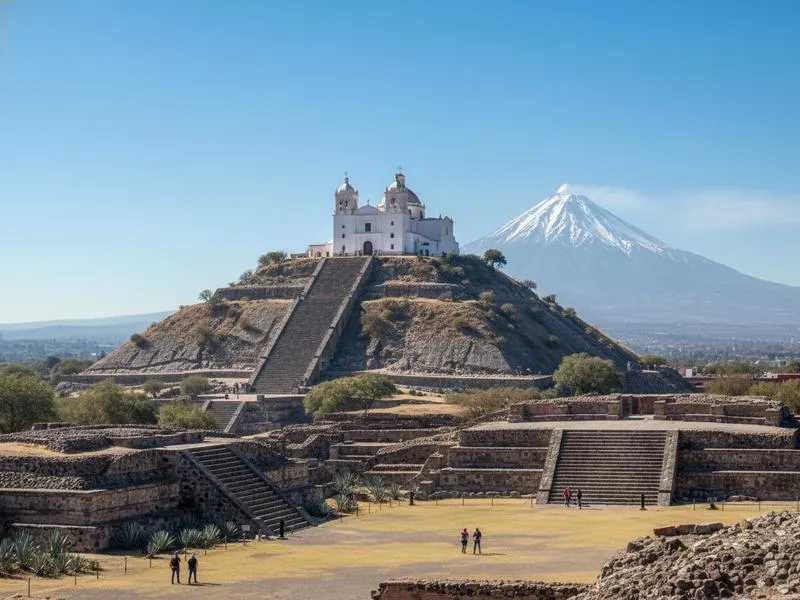
Cholula is 12 kilometers west of Puebla City — a 20-minute colectivo ride. It looks like a small city with a church on a hill. The hill is actually the Tlachihualtepetl (Great Pyramid of Cholula), the largest pyramid on earth by volume.
The pyramid was built in stages by successive civilizations over roughly 1,000 years (300 BCE to 900 CE). When the Spanish arrived, it had been abandoned and covered in vegetation for centuries — they didn’t realize it was man-made. In 1594, they built the Virgen de los Remedios church on top of what they thought was a natural hill. That colonial irony — the Catholic church literally built on top of the indigenous sacred site — is visible from anywhere in Cholula.
You can walk 8 kilometers of archaeological tunnels through the pyramid’s interior (admission included with entry). The tunnels reveal the sequential construction layers — each new civilization built over the previous structure. Outside, the exposed northeast corner shows the pyramid’s stepped profile rising 55 meters.
The church on top is still an active place of worship. The view from the church level — pyramid edges in the foreground, the city of Cholula spreading in every direction, Popocatépetl (usually smoking gently) filling the western sky — is one of the iconic panoramas of Mexican travel.
The 365 churches claim: Cholula is often cited as having 365 churches — one for each day of the year. The number is a myth; the actual count of standing, identifiable churches is 37-40. Still impressive for a city of 100,000, but the “365” is colonial folklore rather than fact.
Cholula’s main square and the Zona Arqueológica grounds make for an easy half-day from Puebla City.
Cuetzalán: Cloud Forest Pueblo Mágico
Two and a half hours north of Puebla City, the road climbs from the dry plains into cloud forest. At 1,000 meters elevation, Cuetzalán (population 15,000) is the state’s most dramatic Pueblo Mágico — a colonial town of white-washed buildings and tile roofs where Nahuatl is spoken alongside Spanish and weekend markets bring indigenous Totonac communities down from the surrounding villages.
The cloud forest at and above Cuetzalán is extraordinary. The Sierra Norte de Puebla receives significant rainfall from Gulf moisture — the result is dense, mossy forest with waterfalls, orchids, and a micro-climate that makes Cuetzalán consistently cooler and wetter than the plains. The waterfalls at Cascada de la Gloria and Las Brisas are within hiking distance of the town. A local guide is worth hiring for the forest trails — the paths are not always marked and the botanical knowledge adds context.
The Voladores de Papantla: Cuetzalán has its own group of Totonac Voladores — the pre-Columbian ceremony in which five men climb a 30-meter pole, four then launch themselves on ropes and spin down as the fifth plays flute and drum at the top. It’s a UNESCO Intangible Cultural Heritage. Performances happen at the main plaza on weekends and market days.
Market days (Sundays and Thursdays): The weekly market brings communities from surrounding villages for a market that sells dried chile varieties, fresh mushrooms (the cloud forest produces exceptional edible fungi), regional textiles, and traditional dress including the elaborate Totonac embroidery.
Mushroom tourism: The cloud forest surrounding Cuetzalán produces dozens of edible mushroom species during the rainy season (June-October). Local guides offer mushroom identification walks — you collect edibles and they get cooked into your dinner. It’s a uniquely specific experience that draws food-focused travelers from Mexico City.
Coffee: The Sierra Norte de Puebla is a significant coffee-producing region. You can visit fincas (farms) during harvest (November-February) and buy directly from producers.
Huamantla: Night of the Flower Carpets
Three hours east of Puebla City, Huamantla (population 80,000) is one of Mexico’s most intense single-event destinations. The Noche de Huamantla — Night of Huamantla — happens annually on the night of August 14-15, when the streets of the entire historic center are covered in elaborately designed alfombras (carpets) made from flowers, colored sawdust, seeds, and fruit, for the procession of the Virgen de la Caridad.
The preparation takes days. Community groups spend weeks in advance preparing their section of street. On the night itself, the procession walks over the carpets — destroying them. The beauty is entirely temporary. By dawn on August 15, what was an extraordinary work of collective art is a crushed path.
Huamantla also has a bullfighting tradition that extends through August — the town’s annual festival (Feria de la Huamantlada) includes running with bulls through the streets in a tradition similar to Pamplona but with significantly lower media attention.
Tehuacán: Cradle of Corn
Ninety minutes southeast of Puebla City, Tehuacán (population 280,000) is the industrial center of the Tehuacán-Cuicatlán Valley — a UNESCO World Heritage site (2018) that spans Puebla and Oaxaca states. The valley contains the world’s most significant evidence for the domestication of corn.
Coxcatlan Cave in the Tehuacán Valley is where archaeobotanist Richard MacNeish found the earliest known maize cobs in 1960 — evidence of corn cultivation beginning around 5,000-7,000 years ago. The valley contains thousands of years of documented human agricultural history.
Tehuacán is also Mexico’s mineral water capital — several major brands (Peñafiel, Tehuacán Garci Crespo) produce sparkling water from the valley’s natural mineral springs. The specific mineral content of Tehuacán water — calcium, magnesium, bicarbonate — gives it the flavor profile that made it Mexico’s preferred sparkling table water for a century.
Day trips from Puebla City combine Tehuacán with the nearby Valle de Zapotitlán de las Salinas — a surreal cactus desert landscape of giant cardon and tetecho cacti, one of the largest cacti concentrations in the Americas.
Atlixco: Flower Festival
One hour southwest of Puebla City, Atlixco (population 85,000) sits in the Atlixco Valley — one of Mexico’s most important flower-producing regions. The Feria Atlixcayotl flower festival, held the last Saturday of September, is the state’s second most important cultural event after Chiles en Nogada season.
The festival combines flower displays, traditional regional dance performances from different indigenous groups, and market activities. It’s less internationally known than similar events but draws visitors from across central Mexico.
Pico de Orizaba
On the border between Puebla and Veracruz states, Pico de Orizaba (Citlaltépetl — Star Mountain in Nahuatl) stands at 5,636 meters — the highest peak in Mexico and third highest in North America after Denali and Logan. The permanent glacier that caps it is one of the last surviving tropical glaciers in the Americas (retreating significantly due to climate change).
Summit climbs are attempted from the Veracruz side (from the town of Tlachichuca, accessible via Puebla City or Orizaba). No technical rock climbing is required but experience with crampons, ice axe, and high-altitude hiking is essential. The ascent typically requires 1-2 days from a base hut (refugio) at 4,260 meters. Guided ascents are available through Tlachichuca operators.
For non-summit visitors: The view of Pico de Orizaba from Puebla City and the highway east is spectacular on clear winter mornings. The Parque Nacional Pico de Orizaba on the Puebla side offers hiking in the forest zone below the glacier line.
Day trips from Puebla covers the logistics of reaching both Pico de Orizaba and Cuetzalán.
Getting Around Puebla State
Puebla City from Mexico City: ADO and EADO buses from TAPO terminal every 15-30 minutes. Two hours. 250-380 MXN first class. One of the easiest inter-city connections in Mexico. By car: Highway 150D or Arco Norte, 2 hours without traffic.
Within Puebla City: Walkable historic center. Taxis for longer distances (50-100 MXN across center). Uber operates in Puebla City.
To Cholula: Colectivos from the city’s Centro Histórico every few minutes (10-15 MXN, 20 minutes). Easy and cheap.
To Cuetzalán: ADO bus from Puebla City CAPU terminal (3.5 hours, 180-250 MXN) or car via Highway 129. The mountain road into Cuetzalán itself is winding — rental cars are manageable but expect a slow final approach.
To Tehuacán: ADO bus from CAPU (1.5 hours, 120-180 MXN) or car.
To Huamantla: ADO bus (2.5 hours) or car. During the August festival, buses fill weeks in advance — book early.
Car rental: For the state’s full circuit (Cuetzalán, Atlixco, Tehuacán, Huamantla), a rental car from Puebla City makes the most sense. See Mexico City to Puebla guide for transportation options from CDMX.
Budget Guide
| Destination | Budget/day | Notes |
|---|---|---|
| Puebla City | 600-1,400 MXN | Very affordable; excellent food value |
| Cholula | Day trip from Puebla | under 100 MXN admission |
| Cuetzalán | 600-1,200 MXN | Budget-friendly mountain town |
| Huamantla | Day trip or overnight | Festival week: book months ahead |
| Tehuacán | Day trip | Industrial city, limited tourist accommodation |
City specifics:
- Hostel dorm: 180-300 MXN
- Mid-range hotel: 700-1,400 MXN
- Cemita at the market: 50-80 MXN
- Mole dinner at a good restaurant: 150-250 MXN
- Tacos árabes: 30-50 MXN each
Travel insurance: travel insurance should include emergency medical treatment and hiking activities including high-altitude trekking near Pico de Orizaba.
Best Time to Visit Puebla State
Late July–September: Chiles en nogada season — the primary culinary reason to visit. August and early September are the most reliable weeks. The Huamantla flower carpets happen August 14-15, and Huey Atlixcáyotl closes out September.
November–February: Dry season peak. Best views of Popocatépetl and Iztaccíhuatl from the city. Cuetzalán is in coffee harvest. Clear skies over the volcanoes make this the photography window.
October–November: Day of the Dead traditions in Puebla are celebrated distinctly from the Oaxaca version but worth experiencing. Post-rainy season greenery in Cuetzalán. Cooler temperatures across the state.
June–October: Rainy season in Cuetzalán (mushroom tourism peak). The city gets afternoon rain but mornings are clear. Avoid if volcano views are a priority.
Plan Your Puebla State Trip
Internal Links
- Puebla City Guide — full city coverage: neighborhoods, churches, markets, food, talavera
- Things to Do in Puebla — curated activities and experiences in the city
- Day Trips from Puebla — Cholula, Cuetzalán, Tehuacán, Tlaxcala logistics
- Chiles en Nogada Season — the reliable ingredient window and when restaurant confirmation matters
- Puebla Chiles en Nogada Weekend — a practical two-night food itinerary built around one reserved lunch
- Cinco de Mayo in Mexico — the real history and where it’s actually celebrated
- Mexico City to Puebla — all transport options, driving tips, recommended stops
Book Tours
Cooking classes for mole poblano and chiles en nogada, Cholula archaeological guided tours, and Cuetzalán cloud forest excursions: Viator’s Puebla collection has vetted operators.
Frequently Asked Questions
What is Puebla state known for?
Puebla state is Mexico’s culinary and colonial heartland. Puebla City is a UNESCO World Heritage site and the birthplace of mole poblano and chiles en nogada. The state contains Cholula (the world’s largest pyramid by volume), Cuetzalán (a cloud forest Pueblo Mágico), and borders Pico de Orizaba — North America’s third highest peak. It’s 2 hours from Mexico City, making it one of the most accessible major destinations in the country.
Is the Cholula pyramid really the world’s largest?
By volume, yes — the Great Pyramid of Cholula is estimated at 4.45 million cubic meters, larger than Giza’s 2.6 million. It doesn’t look like a pyramid because it’s covered in vegetation after centuries of abandonment. The Spanish built the Virgen de los Remedios church on top in 1594 — the image of church plus volcano in the background is one of Mexico’s most iconic photographs. The “365 churches” claim is exaggerated; the real count is around 37-40.
What food is Puebla most famous for?
Mole poblano (complex dark chile-chocolate sauce), chiles en nogada (seasonal from late July through September, with August and early September most reliable), cemitas (sesame-seed sandwiches with papalo herb and avocado), and tacos árabes (vertical-spit pork from Lebanese immigrant tradition). Puebla competes with Oaxaca for the title of Mexico’s most important culinary state.
How do I get from Mexico City to Puebla?
ADO and EADO buses from TAPO terminal run every 15-30 minutes, 24 hours. Journey time is 2 hours. Cost is 250-380 MXN first class. By car on Highway 150D, 2 hours without traffic. One of the easiest inter-city connections in Mexico.
When is the best time to visit Puebla for food festivals?
Chiles en nogada season usually runs from late July through September, with August and early September the most reliable window. Confirm restaurant availability if the dish is the reason for your trip. Huamantla’s Night of the Flower Carpets is August 14-15, and Huey Atlixcáyotl closes out September. November-February is best for volcano views and dry weather.