Isla Mujeres: Best Things to Do, Ferry & Stay Tips
Isla Mujeres is worth visiting for Playa Norte’s calm Caribbean water, the Punta Sur coastal loop, fresh seafood, and June-to-September whale shark trips. For a first visit, take an early ferry from Cancun, reach Playa Norte before 10 AM, explore Centro on foot, and use a golf cart only for the south-end sights.
The island works as a day trip, but one or two nights are better: you get the beach before the Cancun crowds arrive and after they leave. This guide covers the best things to do, ferry choices, where to stay, costs, and the timing mistakes that can make Isla Mujeres feel overrated.
| Isla Mujeres decision | Best answer for most travelers |
|---|---|
| Day trip or overnight? | Overnight is better; day trip works if you take an early ferry and leave before dinner. |
| Best ferry choice | Puerto Juárez for frequency and price; Hotel Zone piers for resort convenience. |
| Best beach timing | Playa Norte before 10 AM or near sunset, especially in peak season. |
| Best reason to visit | Calm swimmable water, easy Cancún access, golf carts, seafood, and June-September whale sharks. |
Isla Mujeres 30-Second Answer
- Best for: calm beach water, easy ferry access, short stays, whale shark season, and travelers who want a softer alternative to Cancún’s Hotel Zone
- Best stay length: 1 to 2 nights if you want the island at its best, 1 day only if your base is Cancún and time is tight
- Best ferry terminal: Puerto Juárez for the cheapest and most frequent service, Hotel Zone piers only for convenience
- Best area to stay: Playa Norte / Centro for first-timers, south end only if you want quiet and do not mind taxis or a golf cart
- Best months overall: December to April for dry weather, June to September for whale sharks
- Skip or rethink Isla Mujeres if: you want serious diving, a car-based road trip base, or an uncrowded midday beach in peak season
Quick Facts
| Location | Quintana Roo, 13 km from Cancún |
| Size | 7.7 km long × 0.4-1.1 km wide |
| Population | ~13,000 |
| Transport | Golf carts, bikes, taxis, and scooters only |
| Ferry from Cancún | 15-25 minutes |
| Best beach | Playa Norte (consistently top-rated in Mexico) |
| Whale shark season | June–September |
| Best time | December–April (dry) or June–Sept (whale sharks) |
| Currency | Mexican Peso (MXN) |
| Safety | Quintana Roo: US Level 2 — generally safe for tourists |
Why Isla Mujeres Over Cancún’s Hotel Zone
Cancún’s Hotel Zone is 23 km of resort corridor: all-inclusives, chain restaurants, and cruise ship crowds. Isla Mujeres is 20 minutes by ferry and a different world.
The island’s streets are too narrow for cars. Instead, golf carts buzz past painted wooden houses in shades of turquoise, yellow, and coral. Fishing boats are still part of the economy — lobster season (July–February) fills local restaurants with freshly caught Caribbean spiny lobster at prices that feel improbable next to what you’d pay at an all-inclusive.
The island’s vibe skews toward independent travelers who want Caribbean water and fresh seafood without the resort machinery. Day-trippers come from Cancún — arriving around 10 AM, hitting Playa Norte, eating on Calle Hidalgo, and heading back by 4 PM. Stay overnight and the island belongs to the people who actually chose to be here.
For broader context on the region, see our Cancún travel guide and Cozumel vs Isla Mujeres comparison.
Book Isla Mujeres tours and activities on Viator.
Playa Norte
Playa Norte (North Beach) consistently appears on “best beaches in Mexico” lists and regularly on “best beaches in the world” lists. The distinction is the water: the Caribbean on Isla Mujeres’ north end is calm, shallow (you can walk 50 meters out and still be waist-deep), and a particular shade of turquoise that shifts green-blue with the angle of the sun.
What makes it special:
- No waves: The north tip faces the protected bay between the island and the mainland — completely flat water
- Gradual depth: Perfect for children and non-swimmers, though the sand drops sharply after 80-100 meters
- Soft sand: Ground fine by centuries of wave action — no rocks, no coral at the shoreline
- Manageable crowds: Even at peak season, Playa Norte doesn’t reach the sardine density of Cancún’s public beaches
Practical Playa Norte:
- Beach chairs: 100-150 MXN/day at bars and restaurants (often waived with two-drink minimum)
- Best early morning slot: 7-9 AM — glass-flat water, no crowds, perfect light for photos
- Sunset: The west-facing strip at the end of Calle Zazil-Ha catches direct sunset over the mainland
- Vendors: present but not aggressive — easy to browse and decline
See our dedicated Isla Mujeres Playa Norte guide for the full beach breakdown.
Getting There From Cancún
Ferry Option 1 — Puerto Juárez (from downtown Cancún area):
- Terminal: Puerto Juárez, about 3 km north of downtown Cancún (R1 bus from the Hotel Zone, 12 MXN)
- Duration: 20-25 minutes
- Frequency: Every 30 minutes, 6 AM–midnight
- Price: ~90-100 MXN each way (cheapest option)
- Notes: Small boat, open deck — can get choppy in rough weather
Ferry Option 2 — Gran Puerto / Ultramar (from Hotel Zone):
- Terminal: Multiple piers along the Hotel Zone (Playa Linda, Playa Tortugas, etc.)
- Duration: 15-20 minutes
- Frequency: Every 30-60 minutes from each pier
- Price: ~170-200 MXN each way
- Notes: Larger, faster catamarans — smoother ride, more convenient for resort-zone hotels
Key facts:
- No car ferries to the tourist center — passenger only
- A separate car ferry exists (Punta Sam terminal) for residents; tourists don’t need it
- Ferries run until roughly midnight; the last return from the island is around 11:30 PM
- Book a day trip or ferry package from Cancún on Viator — packages often include round-trip ferry + activities
- Full breakdown: Cancun to Isla Mujeres: Ferry Prices, Times & Which Pier to Use (2026)
Getting Around the Island
Golf carts: The island’s primary transport. Rentals run 500-800 MXN for a full day (8 AM–6 PM). Electric carts are increasingly available and quieter. You’ll cover the entire island in one direction (north to south) in about 20-25 minutes. All major rental shops cluster near the ferry pier.
Bikes: 150-250 MXN/day — fun for flat terrain around town and Playa Norte, harder on the hilly south end toward Punta Sur.
Taxis: Collectivo taxis run fixed routes from the ferry pier to Playa Norte (20-25 MXN) and to Garrafón (80-100 MXN). Private taxis: 80-150 MXN for most trips.
Walking: The town center (roughly 8-10 blocks) is entirely walkable. Playa Norte is a 15-minute walk from the ferry pier.
Punta Sur and the Lighthouse
The island’s southern tip — Punta Sur — is the first point of land to receive the Caribbean sunrise in Mexico. It’s a rocky promontory with a sculpture garden (somewhat kitschy but popular) and a small lighthouse with views of the open Caribbean to the east and the protected bay to the west.
Getting there: Golf cart or taxi from town — 3 km south, about 5 minutes by cart. Entrance to the sculpture garden: 30 MXN.
The restaurant El Mirador sits on the cliff edge at Punta Sur, built on a platform over the Caribbean. It’s expensive (entrees 250-500 MXN) and frankly not the island’s best food, but the view — open Caribbean below you, wave-carved limestone under the tables — justifies a drink and a sunset.
Garrafón Natural Reef Park
Garrafón is a protected natural reef on the island’s southwestern shore, 3 km from town. The reef supports a significant population of fish and sea turtles, and snorkeling here puts you in the water with parrotfish, angelfish, grouper, and green turtles in water shallow enough to stand up in most sections.
Visiting options:
- Garrafón Natural Reef Park (paid admission): All-inclusive entry runs 1,200-2,000 MXN and includes snorkeling gear, kayaks, hammocks in the water, zip-line, and a buffet meal. Excellent for families.
- Independent snorkel tours: Various local operators run 2-3 hour snorkel trips past Garrafón reef for 400-700 MXN — you get the reef without the park infrastructure.
- Book Garrafón snorkel tours on Viator
Best visibility: December–April, when Caribbean winds are minimal and the water is clearest (10-15 meter visibility common).
Also nearby, the MUSA (Museo Subacuático de Arte) — an underwater sculpture park with 500+ sculptures by Jason deCaires Taylor — is accessible via snorkel and dive tours from Isla Mujeres. Some sculptures are as shallow as 4 meters, accessible without scuba certification. See our snorkeling and diving guide for tour options.
Whale Shark Tours
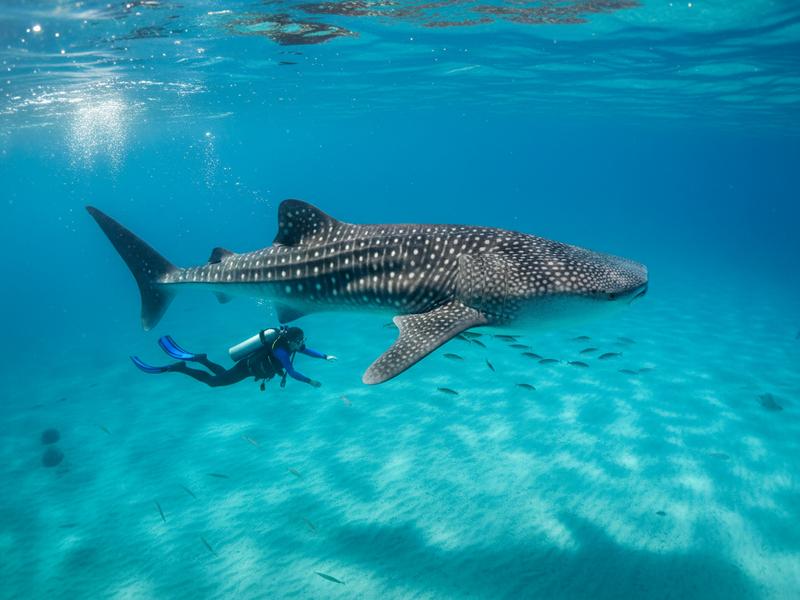
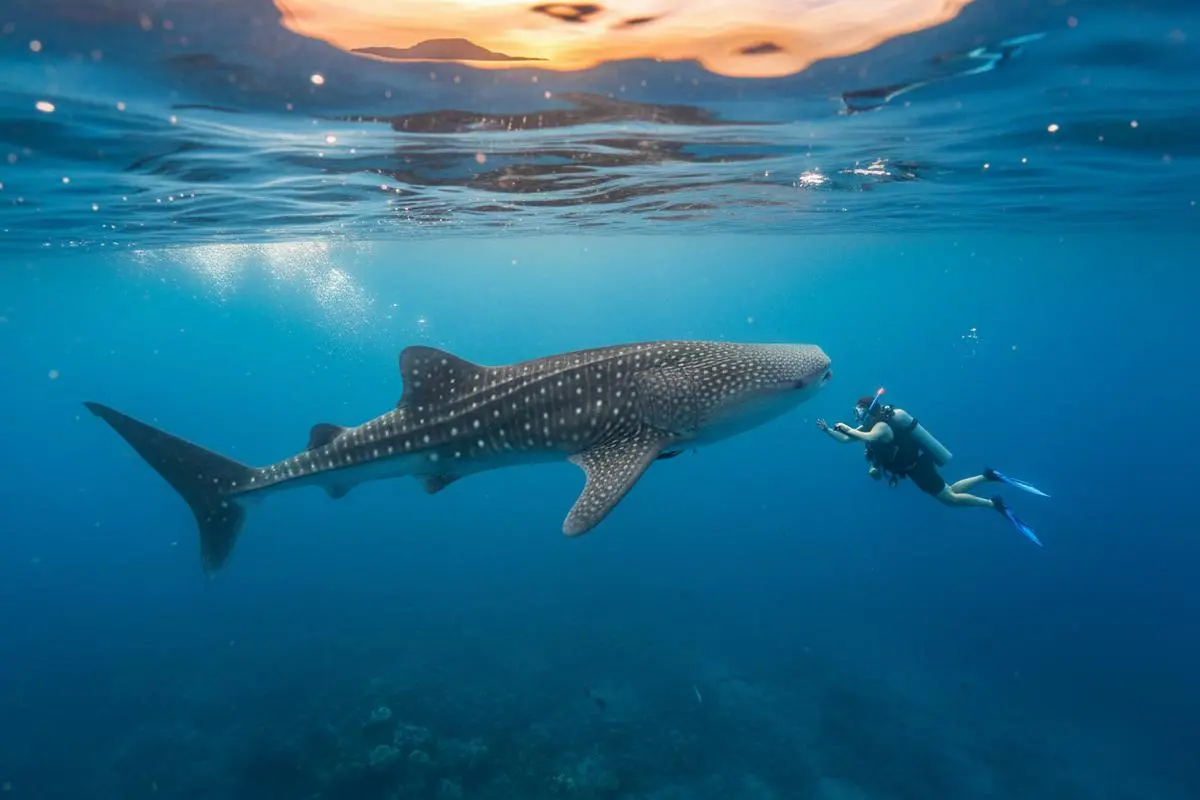
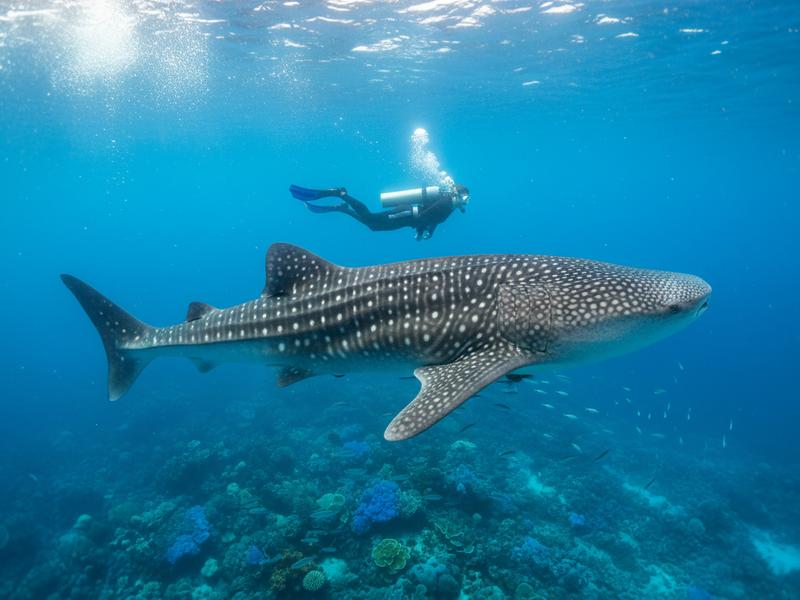
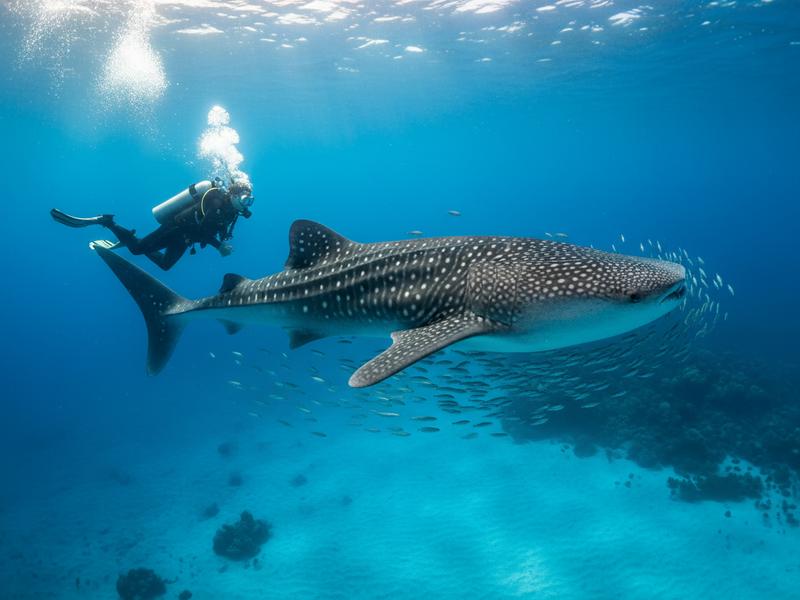
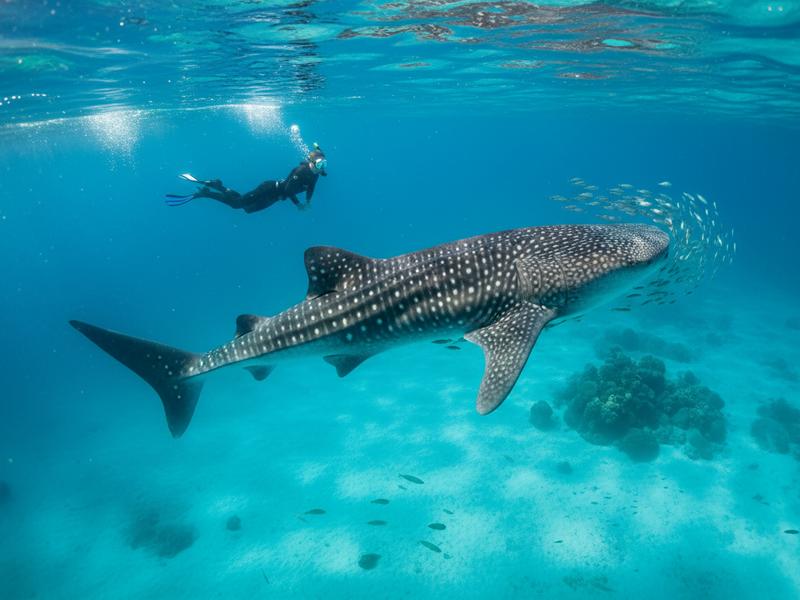
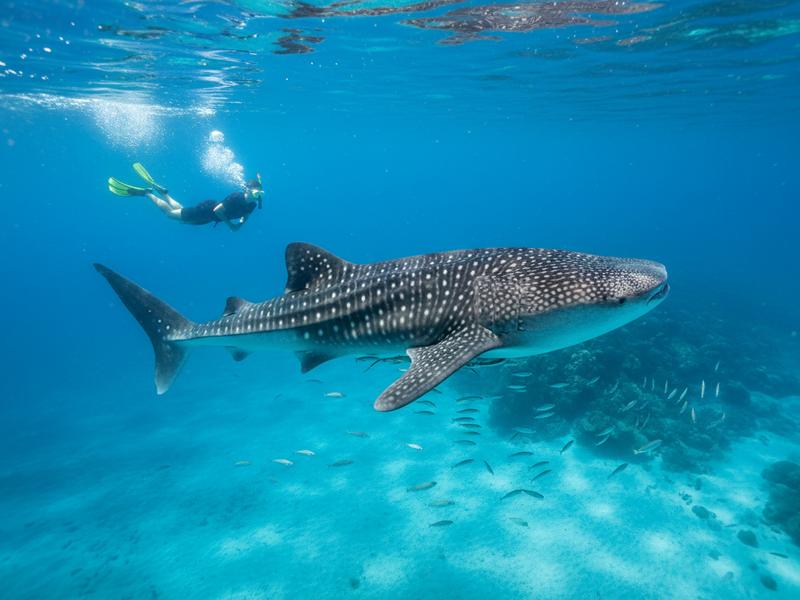
From June through mid-September, the waters roughly 15 km north of Isla Mujeres host the world’s largest documented aggregation of whale sharks. These are open-water feeding events — the sharks are there eating fish spawn, not following a feeding schedule organized by tour operators.
What to know before booking:
- Whale sharks are the world’s largest fish (up to 12 meters / 40 feet) — not whales, not aggressive, filter feeders only
- Swimming is in open water, roughly 20-30 meters deep — not a shallow calm reef
- You enter the water in groups of two with a guide; no touching, 2-meter distance rule enforced
- Sighting rates in season: 90%+ on well-operated tours
- Motion sickness risk is real on the boat ride out — bring Dramamine if you’re prone to seasickness
Tours from Isla Mujeres:
- Price: 1,500-2,500 MXN per person
- Duration: 6-8 hours including transit, snorkeling time, and usually a cenote or Isla Contoy stop
- Depart: 7-8 AM from the Ultramar pier
- Book whale shark tours from Isla Mujeres on Viator
For more on whale shark experiences across Mexico, see our whale watching Mexico guide.
The Cat Sanctuary
On the north side of the island, adjacent to the Hacienda Mundaca ruins, a volunteer-run cat sanctuary houses roughly 500 cats. It’s free to visit, entirely funded by donations and volunteer work, and wildly popular with a certain type of traveler.
The cats were originally feral island cats adopted and socialized over years. The sanctuary does basic veterinary care and runs an adoption program. You can bring donated food (dry cat food, canned tuna) — locals and staff will point you toward the needs.
It’s not for everyone. If you have 30 minutes and appreciate a functioning bit of grassroots community organizing, it’s worth the visit. Isla Mujeres Cat Sanctuary information.
The Turtle Farm (CIQRO)
The Tortugranja (turtle farm), run by the government research center CIQRO, sits on the island’s Caribbean coast about 3 km from town. The facility incubates sea turtle eggs (green, loggerhead, and hawksbill turtles), raises juveniles in tanks, and releases them into the Caribbean.
Visiting:
- Hours: 9 AM–5 PM daily
- Entrance: 30 MXN
- What you see: Tanks of juveniles ranging from newly hatched to 3-4 years old; outdoor pens with larger turtles; information panels on turtle biology and conservation
The release events (typically June–September when eggs are incubated) are sometimes open to visitors who arrange in advance — contact the facility directly if this is a priority.
Hacienda Mundaca Ruins
A 10-minute golf cart ride south of town, the Hacienda Mundaca was built in the 1850s by a former slave trader, Fermín Mundaca de Marechaja, who retired to Isla Mujeres and built a hacienda to impress a local woman who, famously, married someone else. Mundaca is buried nearby, under a tombstone he had carved himself.
Today the hacienda is a modest ruin — crumbling stone archways, overgrown gardens, an old fountain — with a small fee (30 MXN) and interpretation panels. Interesting for its story more than its physical condition.
Where to Eat
Avoid: Most restaurants on Calle Hidalgo (the pedestrian tourist strip) are overpriced relative to quality. Prices are 2-3x what you’d pay a block away for similar food.
Seek out:
- North end of Playa Norte: Several smaller palapa restaurants serve fresh fish fillets, ceviche, and shrimp tacos. Expect 200-350 MXN for a full meal.
- Mercado Municipal: Behind the pedestrian zone — local market stalls, full lunch plates at 80-120 MXN
- Mango Café: Popular for breakfast, strong coffee, and smoothies near Playa Norte
- Restaurant Sunset Grill: Mid-tier prices but a genuinely good sunset view from Playa Norte’s western edge
- Olivia: The island’s best upscale option — Mediterranean-influenced fish and seafood, book in advance for dinner
Fresh seafood: Lobster season runs July–February; during this period, every local restaurant serves whole Caribbean spiny lobster at 350-650 MXN — less than you’d pay for a mediocre lobster roll in New England.
Day Trip vs Overnight: The Real Answer
Come for the day if:
- You’re staying at a Cancún all-inclusive and want one beach day
- You have very limited time in the region
- You specifically want the Garrafón park experience as a packaged tour
Stay overnight (1-2 nights) if:
- You want Playa Norte at sunrise and sunset without day-tripper crowds
- You want whale shark access (tours depart too early for day-trippers)
- You want to eat at local spots rather than tourist-strip restaurants
- You want the island to feel like a place you visited rather than a box you checked
The morning window (7–9 AM) and evening window (5–8 PM) on Isla Mujeres are genuinely different from the 10 AM–4 PM day-tripper rush. The island’s character changes completely once the last ferry from Cancún arrives and the streets thin out.
Where to Stay
The biggest lodging mistake on Isla Mujeres is choosing by price alone instead of by walking distance to Playa Norte and the ferry.
Playa Norte / Centro, best for most first-timers:
- Best if you want to walk to the beach, restaurants, and the ferry without needing a golf cart all day
- Best match for couples, short stays, and travelers arriving without a rental car on the mainland
- Expect the highest prices, especially in winter and on Mexican holiday weekends
Mid-island, best for value:
- Better hotel value and more local-feeling streets
- Works well if you are renting a golf cart or do not mind short taxi hops
- Less atmospheric at night than staying near Playa Norte
South end, best for quiet:
- Better for repeat visitors, longer stays, sunrise views, and easy access to Punta Sur and Garrafón
- Not ideal if your dream trip is multiple beach walks per day to Playa Norte
Price guide:
- Budget (600-1,200 MXN/night): simple posadas and guesthouses, often east side or farther from Playa Norte
- Mid-range (1,500-3,000 MXN/night): boutique hotels and polished guesthouses in Centro or near Playa Norte
- Boutique (3,000-6,000+ MXN/night): small beachfront or near-beach properties with better design, pools, or ocean-facing terraces
If lodging is your main decision point, see our dedicated best hotels in Isla Mujeres guide.
Note: Booking in advance is essential December to April and during whale shark season. The island has limited inventory and good-value rooms disappear quickly.
Budget Table
| Expense | Budget | Mid | Comfort |
|---|---|---|---|
| Hotel (per night) | 600-1,000 MXN | 1,500-2,500 MXN | 3,000+ MXN |
| Golf cart rental (per day) | 500-650 MXN | 650-800 MXN | 800+ MXN |
| Meals (per day) | 250-400 MXN | 400-700 MXN | 800+ MXN |
| Activities (per day avg.) | 300-600 MXN | 600-1,500 MXN | 2,500+ MXN |
| Ferry round-trip | 180-400 MXN | 180-400 MXN | 180-400 MXN |
| Daily total | ~1,500-2,500 MXN | ~3,000-5,000 MXN | 7,000+ MXN |
Rates as of Feb 2026; USD rate ~17-18 MXN
Common First-Timer Mistakes
- Taking the most convenient ferry instead of the best one: Puerto Juárez is usually the better default unless you are staying right by a Hotel Zone pier.
- Treating the island like a noon-to-4 PM beach stop: that is the busiest, least charming window.
- Renting a golf cart before deciding whether you actually need one: if you stay near Playa Norte or Centro, you may only need it for half a day.
- Eating every meal on Calle Hidalgo: it is useful, but not where the best value usually is.
- Booking the far south end for a one-night stay without realizing how often you will want to be near Playa Norte.
Practical Tips
- Cash: Many smaller restaurants and some golf cart rentals prefer cash. ATMs exist near the ferry pier but can run low on busy weekends.
- Sunscreen: Reef-safe is the safer choice for marine activities and protected areas. Buy it before arriving if you want more options.
- Golf cart driving: You need a driver’s license. Drive slowly, especially around pedestrians and narrow town-center corners.
- Bugs: Mosquitoes are worst near mangroves and after rain, especially on the south end. Pack repellent.
- Safety: Isla Mujeres is one of the safest places in Mexico for tourists, though petty theft still happens. For broader state context, see our Mexico travel advisory guide and Cancún travel guide.
- Internet: Strong 4G signal across the island; most hotels have WiFi.
Nearby Islands Worth Adding
Isla Contoy: A protected national park 25 km north of Isla Mujeres — no accommodation, day-trip only, strictly limited visitor numbers (200 per day). Home to 150+ bird species, a turtle nesting beach, and snorkeling at pristine reefs. See our Isla Contoy guide. Day tours from Isla Mujeres run 900-1,400 MXN and combine Contoy with whale shark or snorkel stops.
Holbox: 2 hours northwest by road and ferry — shallower, murkier water but a more rustic vibe, flamingo lagoons, and bioluminescence. See our Holbox Island travel guide.
Cozumel: 2.5 hours south by ferry — diving capital of Mexico’s Caribbean coast, serious reef systems, 30-meter visibility. Cozumel is the better choice if diving or snorkeling is the primary goal; Isla Mujeres wins for beach atmosphere and walkability. See our complete Cozumel travel guide and Cozumel vs Isla Mujeres comparison.
For the full Caribbean Mexico overview, see our Caribbean Beaches Mexico guide.
Final Thoughts
Isla Mujeres works because it’s small enough to feel like you’re somewhere specific. The 7.7 km of island is entirely comprehensible in a day — you can see Punta Sur’s lighthouse, the Tortugranja, and Playa Norte in a single golf cart loop before lunch. That completeness is rare.
The Cancún Hotel Zone is a machine that processes tourists efficiently. Isla Mujeres is 20 minutes away and operates on an entirely different logic — one where the ferry schedule matters, where the same fishing families have run the same restaurants for three generations, and where Playa Norte at 7 AM is one of the better beaches on Earth.
Book your Isla Mujeres tours and activities on Viator.
More Isla Mujeres Guides
- 25 Things to Do in Isla Mujeres — activities, beaches, wildlife & day trips
- Playa Norte complete guide — tips, best spots, beach clubs