Bacalar Travel Guide 2026: What to Do, Where to Stay, and Is It Worth It?
Bacalar is worth visiting if you want calm freshwater swimming, sailboat tours, and a slower alternative to Tulum. Most travelers come for the Lagoon of Seven Colors, but the real appeal is that Bacalar still works well as a 2 to 4 day trip: you can swim straight off public docks, kayak through shallow turquoise water, visit Fort San Felipe, and stay in lakefront hotels that are usually cheaper than Riviera Maya beach towns.
Bacalar is a town of about 12,000 people in southern Quintana Roo, Mexico, on the western shore of Laguna Bacalar, a 42-km-long freshwater lagoon known for its intense blue color bands. It sits about 40 km north of the Belize border, roughly 3.5 to 4 hours from Cancun by ADO bus or Tren Maya.
This guide covers what to do in Bacalar, where to stay, how to get there, what it costs, the best time to go, and whether it still feels special now that it is firmly on the Yucatán travel circuit.
The short answer: yes, Bacalar is still worth it, especially if you want water-focused downtime rather than beach clubs or nightlife. But the best lakefront stays now book up early.
30-Second Answer
| Question | Quick answer |
|---|---|
| Is Bacalar worth visiting? | Yes, especially for couples, slower trips, and freshwater swimming. |
| How long do you need? | 2 to 4 days is ideal. |
| Best things to do | Sailboat tour, kayak, Fort San Felipe, Cenote Azul, dock swimming at sunset. |
| Best area to stay | Waterfront if you want dock access, centro if you want lower prices. |
| Best time to go | November to April for dry weather and calmer lagoon conditions. |
| Biggest mistake | Treating it like Tulum and booking too late for the better lakefront hotels. |
Bacalar Quick Facts
| State | Quintana Roo |
| Distance from Cancun | 360 km south (3.5 hours by ADO bus) |
| Distance from Tulum | 170 km south (1.5-2 hours by car) |
| Distance from Belize border | 40 km south |
| Lagoon length | 42 km (longest lake in Quintana Roo) |
| Population | ~12,000 (town of Bacalar) |
| Airport | Chetumal (CTM) — 40 km south. Cancun (CUN) — 360 km. |
| Best time | November–April (dry season) |
| Water type | Freshwater (not saltwater) |
| Uber | ❌ Not available — taxis and colectivos |
| Electricity/Infrastructure | Reliable in town; patchy at some remote lakefront hotels |
Why Seven Colors? The Science Behind the Lagoon
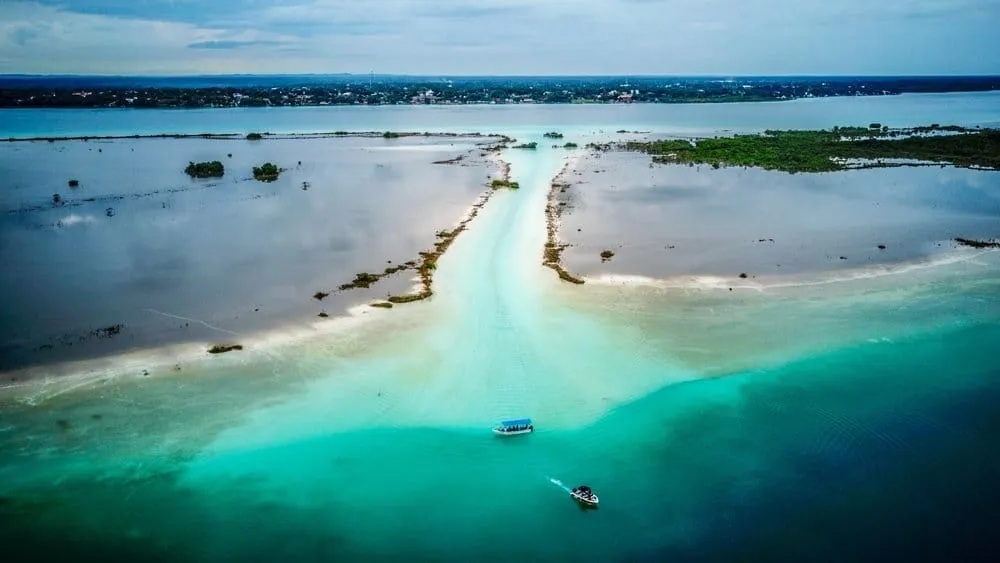
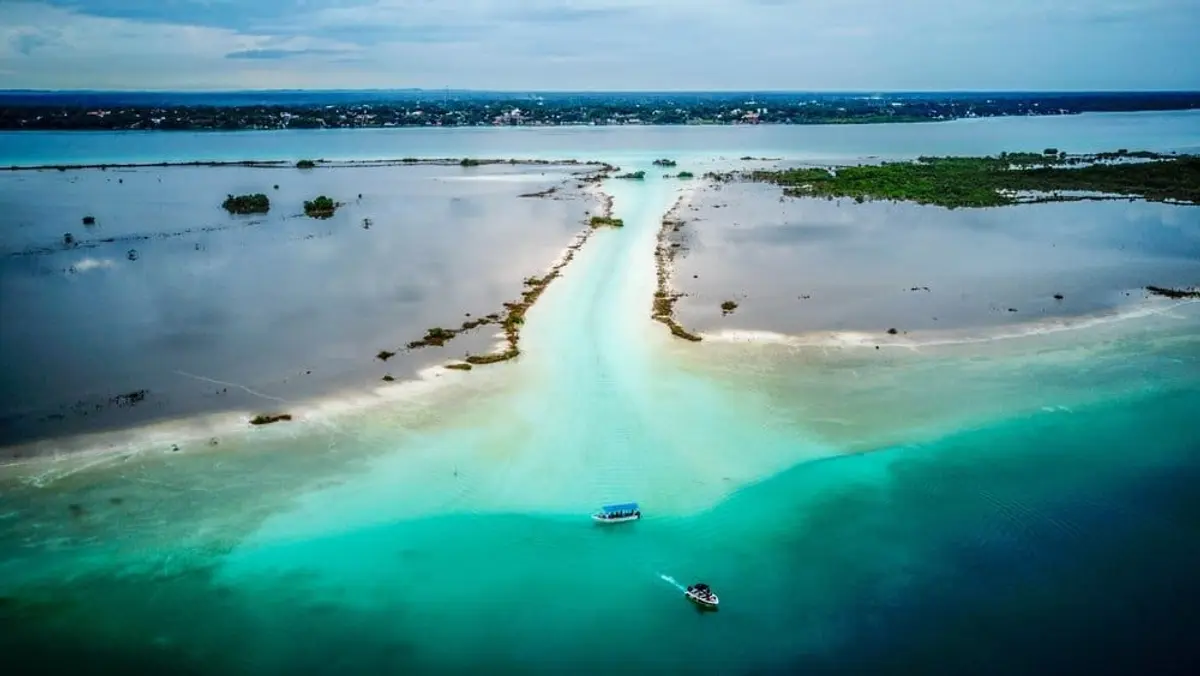
The Lagoon of Seven Colors (La Laguna de los Siete Colores) earns its name from the remarkable chromatic gradient visible from the shore and especially from above. The mechanism is simple physics:
Shallow water (0-1 meter): White calcium carbonate sediment on the lagoon floor reflects sunlight back through the water column. The result is a brilliant, almost luminescent turquoise — similar to the color of the Caribbean, but in fresh water.
Medium depth (2-5 meters): As depth increases, the reflected light intensity decreases. The apparent color shifts through pale cyan to a more saturated blue-green.
Channel depth (8-15 meters): In the central channel (the deepest section), the water column absorbs most of the light wavelengths except deep blue. The water appears midnight blue or dark navy.
These color transitions happen over meters, not kilometers — you can paddle a kayak from turquoise to navy in a few minutes. On a clear day, looking down the lagoon axis, the color gradient is literally visible as distinct bands.
Why is the water so clear? Bacalar’s lagoon has no river inputs. Water enters entirely through karst filtration — percolating through the Yucatan Peninsula’s limestone bedrock, which acts as a natural filter removing sediment and most impurities. The result is water with exceptional clarity and a very specific mineral chemistry (high calcium, neutral pH) — the exact conditions that also support the lagoon’s stromatolite colonies.
Top Things to Do in Bacalar
Sailboat and Catamaran Tours
The quintessential Bacalar activity. Dozens of operators run day trips on the lagoon: either intimate 8-10 person catamarans or larger “pirate ships” (wooden motorized boats). A standard day tour includes:
- Navegación through the canal (the channel between mainland and the central part of the lagoon)
- Stop at the Cenote Azul for swimming
- Snorkel at the Pirates’ channel
- Lunch on board (fresh fish, ceviche)
- Sunset return
Cost: $800-1,500 MXN/person ($40-75 USD) for full-day tours. Private catamaran hire: $4,000-8,000 MXN for up to 10 people. Book the night before or morning of at the town docks (Muelle Municipal) — several operators compete for passengers and prices are negotiable.
Kayaking the Canal de los Piratas
The narrow channel connecting the lagoon’s different sections has historically been used by pirates (British buccaneers raided from Belize throughout the 17th-18th centuries). Today kayakers paddle through overhanging jungle where the water shifts colors under the canopy. Several rental operators near the town center: 100-150 MXN/hour for a single kayak.
Stromatolites: Swimming With 3.5 Billion-Year-Old Life
One of Bacalar’s strangest and most extraordinary features sits in the southern lagoon near the Puerto Pequeño channel: an active colony of stromatolites — rock-like structures built by cyanobacteria (blue-green algae), the same microorganism that created Earth’s oxygen atmosphere 3.5 billion years ago.
Modern living stromatolites exist in fewer than a dozen locations worldwide. Bacalar’s colony is one of them.
How to visit: Kayak or take a boat tour south to the stromatolite zone. You can look and photograph but do not touch — they’re protected, and a single handprint can damage years of microbial growth. The best viewing is from a kayak in the shallow water where you can see the grey-brown layered structures just below the surface.
This is genuinely one of the weirder things you can do in Mexico. The cyanobacteria in those structures are the evolutionary ancestors of every plant and animal that ever lived. Most visitors walk past them on their way to the swimming area.
Fort San Felipe de Bacalar
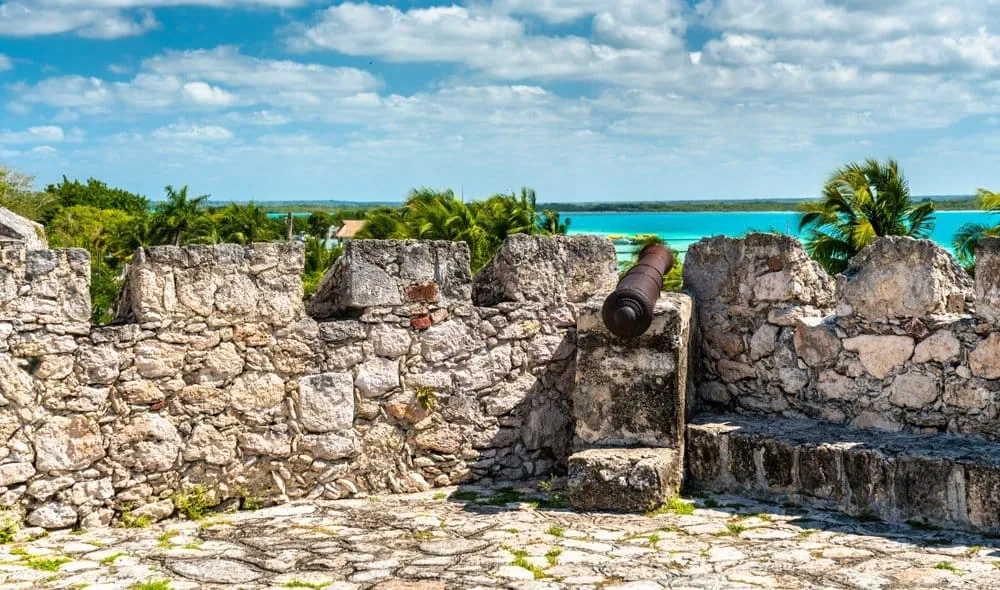
The town’s most historical landmark — a Spanish colonial fort built in 1733 to defend against British buccaneers raiding from what is now Belize. The fort withstood attacks through the 18th century, was captured by Maya rebels during the Caste War of Yucatán (1848), and held by indigenous fighters for 40 years before Mexican federal forces recaptured it.
The fort is well-preserved, sits on a promontory overlooking the lagoon, and has a small museum covering the pirate history and Caste War. Entry: 65 MXN. Open Tuesday-Sunday. The views of the lagoon from the battlements are among the best in Bacalar.
Cenote Azul
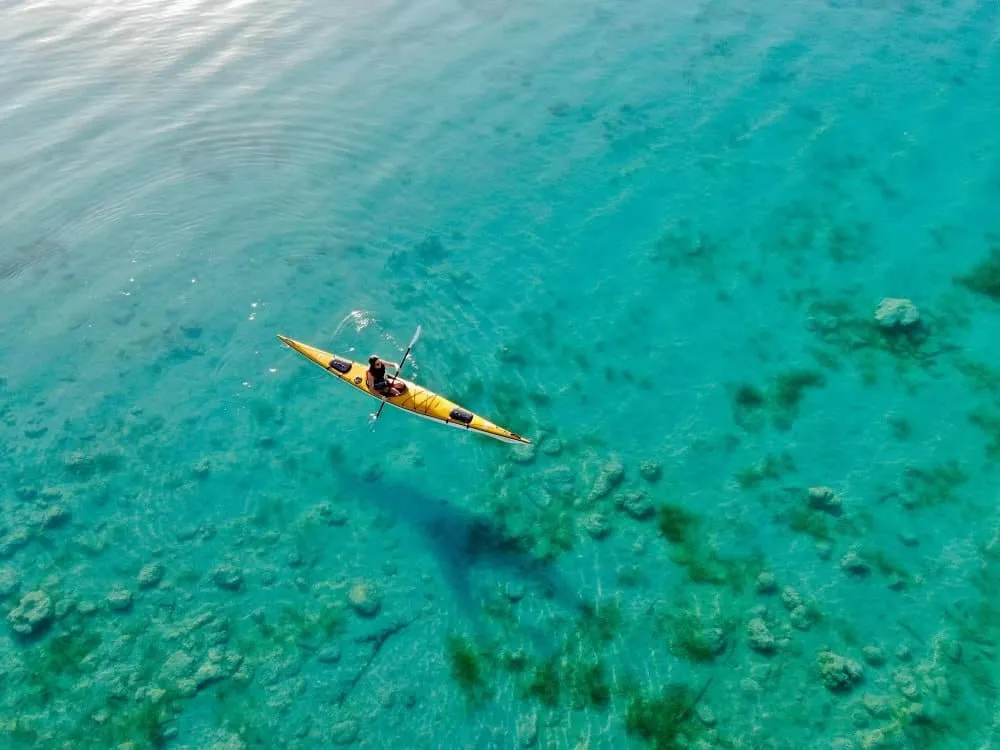
Located 5 km south of Bacalar town, Cenote Azul is one of Mexico’s largest open-air cenotes — roughly 70 meters in diameter and up to 90 meters deep. Unlike the cave cenotes near Tulum, this is a sky-facing swimming hole: turquoise water, limestone cliffs to jump from, and a restaurant on the rim where you can eat fresh fish and watch swimmers.
Entry: 50-100 MXN (varies). Restaurant meals: 150-250 MXN/plate. Taxi from Bacalar town: 80-120 MXN one-way. Most boat tours stop here for swimming.
Swimming Off Bacalar’s Public Docks
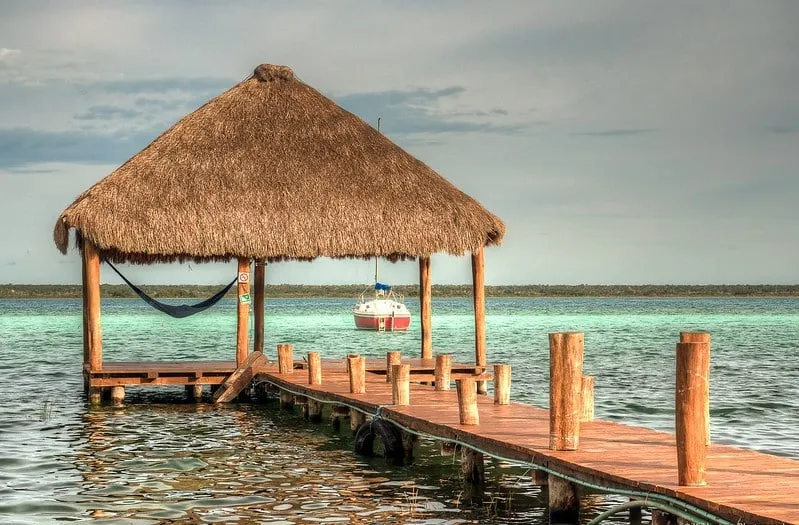
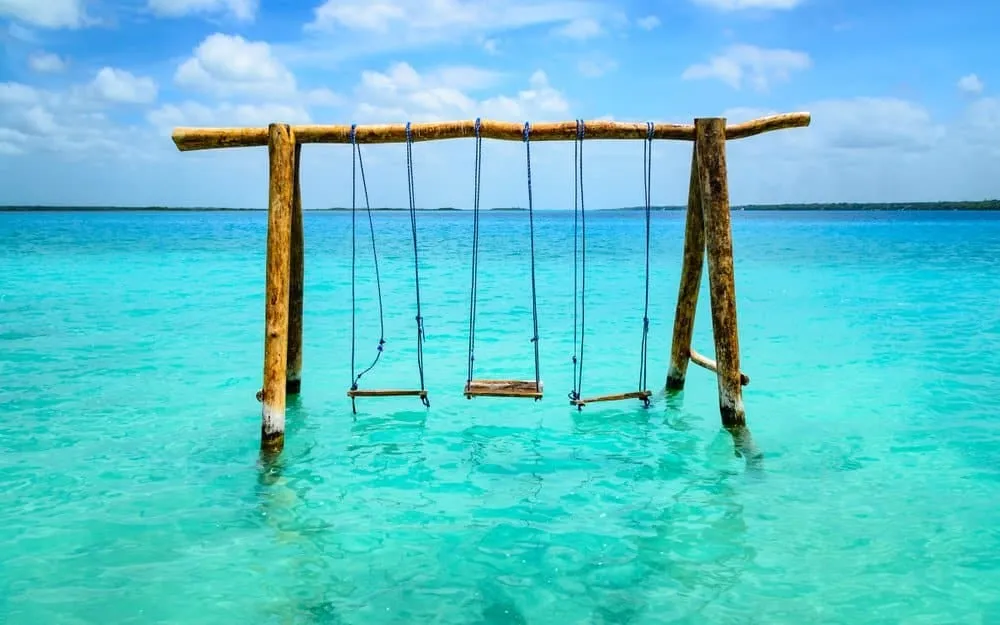
The town of Bacalar has several public docks (malecones) where you can simply walk in and swim for free. The water at the town docks is 1-3 meters deep over white sand — luminescent turquoise. Many travelers spend entire days doing nothing but swimming off the docks and eating at nearby restaurants. This is valid.
The most popular dock areas are near the centro histórico, along the waterfront street (Avenida 7). The docks face west — sunset from the docks is one of the genuinely spectacular daily events in Mexico.
Bacalar vs. Tulum: The Comparison
Bacalar is frequently marketed as “the alternative to Tulum” — which is partly true and partly a reductive comparison. They’re different experiences:
| Bacalar | Tulum | |
|---|---|---|
| Water type | Freshwater lagoon (42 km long) | Caribbean Sea (saltwater) |
| Beach? | No ocean beach — docks and lagoon shore | Caribbean beaches |
| Vibe | Slow, sailing, hammock-focused | Boutique eco-chic, beach clubs |
| Price level | Still affordable; gentrifying | Expensive ($250-500+/night beach zone) |
| Sargassum | None — freshwater lagoon | Yes, seasonal (June-October) |
| Distance from Cancun | 360 km (3.5 hrs bus) | 130 km (2 hrs bus) |
| Things to do | Sailing, kayaking, fort, stromatolites | Ruins, cenotes, beach, Sian Ka’an |
| Nightlife | Very limited | Boutique beach parties |
| Best for | Couples, relaxation seekers, nature | Beach + cenotes + bohemian scene |
Choose Bacalar if: You want a slower pace, freshwater swimming, sailing sunsets, and you’re happy without ocean waves or cenote diving infrastructure.
Choose Tulum if: You want Maya ruins, easy cenote access, the Caribbean sea, and the classic Riviera Maya experience (at higher cost). Full Tulum guide →
What Bacalar Is Best For
Bacalar works best for travelers who want a scenic, low-pressure stop rather than a packed activity destination.
Bacalar is a strong fit if you want:
- calm water instead of surf
- a romantic or quiet 2 to 4 day stop
- easy dock swimming and sunset boat time
- a more affordable alternative to Tulum beach hotels
- a base near Chetumal, southern Quintana Roo, or the Belize border
Bacalar is a weaker fit if you want:
- nightlife or beach clubs
- white-sand Caribbean beaches
- lots of museums or urban food neighborhoods
- a destination with nonstop rainy-season reliability
Getting to Bacalar
From Cancun (360 km south)
ADO bus is the standard: 330-380 MXN, approximately 3.5-4 hours, buses every 1-2 hours from Cancun downtown terminal and approximately every 2-3 hours from the airport terminal. The Bacalar ADO stop is a few blocks from the town center. Book online for guaranteed seats. The Maya Train (Tren Maya) departs direct from CUN Airport station, taking ~3.5–4 hours (600–900 MXN). For full details on all options and the important day-trip warning: Cancun to Bacalar: All 4 Ways to Get There. Returning to Cancun? See Bacalar to Cancun.
From Playa del Carmen (250 km south)
ADO bus: 250-280 MXN, 2.5-3 hours.
From Tulum (200 km south)
ADO bus: 180-260 MXN, 2 to 2.5 hours direct. Also accessible by colectivo (shared van) via Felipe Carrillo Puerto — slower but cheaper. Rental car option great for stopping at Muyil ruins. Full guide: Tulum to Bacalar: All 4 Ways to Get There. Returning to Tulum? See Bacalar to Tulum.
From Chetumal (40 km north)
Chetumal is the closest city with an airport (CTM — daily flights from Mexico City). From Chetumal to Bacalar: colectivo (shared van) from the central market, 30-40 MXN, 40 minutes. Taxi: 200-250 MXN.
From Belize
Many travelers cross the Belize border at Subteniente López (40 km south of Bacalar) and take a taxi or colectivo north to Bacalar. The border crossing is functional but can have queues. Mexico issues tourist cards (FMM) which you’ll need to obtain before crossing back.
Getting Around Bacalar
Bacalar town is small and walkable — the centro histórico, the fort, the main docks, and the market are all within 15 minutes on foot.
Taxis: Available in the town center. Fixed rates for most routes. Centro to Cenote Azul: 80-120 MXN.
Bicycles: Several rental shops in the centro, 80-150 MXN/day. The lakefront road south toward Cenote Azul is flat and scenic.
Colectivos: Shared vans run the road between Bacalar and Chetumal, stopping at Cenote Azul (flag them down on the main highway).
No Uber — taxis and colectivos only.
Where to Stay in Bacalar
If this is your first trip, the main decision is simple: stay on the waterfront if lagoon access is the point of the trip, stay in centro if budget matters more than the view. Bacalar is compact enough that you are never terribly far from the water, but waking up with a dock outside your room is still the premium version of the experience.
Bacalar’s accommodation divides into the town center (cheaper, local atmosphere) and the lakefront (more expensive, dock access).
Budget — Town Center ($25-60/night)
Guesthouses and small hotels within walking distance of the fort and market. No lake view from the room, but 10-minute walk to the docks. Still available for under $50 USD at small family-run places.
Mid-Range — Town Waterfront ($80-180/night)
Small boutique hotels and posadas directly on the lagoon. Many have private docks. This is the sweet spot — lake access without boutique villa pricing. Book 4-8 weeks ahead for December-March.
Upscale — Lakefront Boutique ($180-400+/night)
Bacalar’s answer to Tulum’s eco-chic: boutique hotels with overwater platforms, infinity pools, kayak fleets, and farm-to-table menus. Prices have risen 40-60% since 2020. Still significantly cheaper than Tulum’s equivalent, but no longer budget. Hotels in Bacalar full guide →
Food in Bacalar
The food scene is anchored by fresh fish (from the lagoon and nearby Gulf of Mexico), Yucatecan staples, and the colmados (small restaurants) along the waterfront.
Best cheap eats: The taco stands and small restaurants on the block behind the main plaza. Cochinita pibil tacos (Yucatecan), fresh fish ceviches, and aguas frescas — full lunch for 80-150 MXN.
Waterfront restaurants: Quality has improved dramatically since 2020. Expect fresh fish, ceviche, and seafood prepared well at 200-400 MXN/plate. The price has risen with the clientele.
The Bacalar signature dish: Fresh mojarra (cichlid fish from the lagoon, now mostly farmed locally), grilled or fried, served with rice, beans, and salsa. Simple and excellent when done right.
Tip: Avoid the most prominently advertised waterfront restaurants and walk one block inland — prices drop 30-40% and quality is often better.
Bacalar Budget Guide
| Category | Budget | Mid-Range | Comfort |
|---|---|---|---|
| Accommodation | $25-50/night | $80-150/night | $180-400/night |
| Meals | $8-20/day | $25-50/day | $50-100/day |
| Transport | $5-15/day | $10-25/day | $20-40/day |
| Activities (boat tour, kayak, cenote) | $15-30/day | $40-80/day | $80-150/day |
| Daily total | $53-115 | $155-305 | $330-690 |
The trajectory: These numbers will be higher in 12 months. Bacalar is gentrifying at pace. The gap with Tulum is closing. If budget is important, visit sooner rather than later.
Safety in Bacalar
Bacalar is safe for tourists. Violent crime directed at tourists is essentially unheard of in this small lakeside town. The main concerns:
Boat/water safety: The lagoon looks calm but afternoon winds can develop quickly. If renting kayaks independently, stay close to shore. Tour operators on legitimate boats are the safer option.
Petty theft: Normal urban caution — don’t leave bags unattended at the docks.
Sun and heat: The lagoon reflects UV rays intensely. Bring high-SPF reef-safe sunscreen (biodegradable — same rule as cenotes). Many travelers underestimate the burn risk on open water.
Common First-Timer Mistakes in Bacalar
Booking a lakefront hotel too late
The best-value waterfront hotels are usually the first to disappear for December through April. If a dock and direct lagoon access matter to you, book earlier than you would for a normal inland town stay.
Expecting an ocean beach destination
Bacalar is a lagoon town, not a Caribbean beach town. You come here for docks, calm water, sailboats, and low-key days, not for surf or long sandy beaches.
Underestimating sun exposure on the lagoon
Hours on a boat or kayak feel deceptively gentle because of the breeze, but the reflected UV is intense. Bring sun protection and drink more water than you think you need.
Trying to rush Bacalar as a same-day add-on
Bacalar can technically be done fast from other Yucatán destinations, but it is better when you stay at least one night and get both an early-morning lagoon window and sunset.
Best Time to Visit Bacalar
November–April: The clear winner. Dry season, daily highs of 25-30°C, low humidity, calm lagoon for sailing. November and February/March offer best value within this window.
December–January: Peak season — most crowded, most expensive, most vibrant. The lagoon is at its most spectacular in clear winter light.
May: Shoulder season beginning — crowds thin, prices drop, weather is still manageable (though heating up). Good value.
June–September: Hot (32-35°C), humid, afternoon showers. Hurricane risk exists but Bacalar is far enough south that direct hits are relatively rare. Sailboat tours still operate but conditions are less predictable. Not the ideal time but workable.
October: Beginning of dry season, very low crowds, good value, tolerable temperatures.
Useful Links for Planning
- Things to Do in Bacalar →
- Hotels in Bacalar →
- Tulum vs Bacalar 2026 → — which should you choose? Caribbean beach vs seven-color lagoon: complete comparison
- Tulum Travel Guide → — the northern Riviera Maya alternative
- Cancun Travel Guide → — most likely arrival point from international flights
- Isla Mujeres Travel Guide → — a useful contrast if you are choosing lagoon vs island time
- 7 Days in Yucatan Itinerary →
- Mexico Entry Requirements →
- Is Mexico Safe? →
- Mexico Travel Budget →
- Best Time to Visit Bacalar → — month-by-month guide with sailing season and pricing
- Best Time to Visit Mexico →
- Car Rental in Mexico →
Ready to book? Browse Bacalar day trips from Cancun on Viator — combined Bacalar + Chetumal tours and private transfers. Need a car? Compare Cancun rental car prices on RentCars for the drive south via Tulum.