
7 Days in Oaxaca 2026: Day-by-Day Itinerary, Monte Albán, Hierve el Agua, and Mezcal
Seven days in Oaxaca is enough time to do the trip properly, not just rush through the postcard stops.
If you only want the fast answer, here it is: base yourself in Oaxaca City for the full week, do Monte Albán on Day 2, the valley villages and ruins on Day 3, Hierve el Agua plus mezcal country on Day 4, keep Day 5 flexible for a city reset or coast extension, and use Day 6 for the Sierra Norte if you want something quieter than the usual first-timer circuit.
What makes a 7-day Oaxaca itinerary work is not squeezing in more stops. It is sequencing them well. The food is complex enough that you want repeat meals, not one rushed market stop. The mezcal makes more sense once you have seen the valleys first. And the Sierra Norte, which many visitors skip, gives the week a second texture beyond ruins, markets, and churches.
Oaxaca state covers 95,000 km² in southern Mexico, with 570+ indigenous communities speaking 16 distinct languages. Oaxaca City sits at 1,550 meters in the Central Valleys, so days are usually mild and nights can feel cool. That makes it an easy week-long base, especially if you pair this plan with our Oaxaca travel guide, things to do in Oaxaca City, and Oaxaca airport transportation guide.
This itinerary is built for travelers who want one clean week in Oaxaca, with honest timing, transport, and tradeoffs instead of a generic list of attractions.
7 Days in Oaxaca in 30 Seconds
| If you want… | Best move |
|---|---|
| The easiest first trip | Stay all 7 nights in Oaxaca City and do day trips to Monte Albán, the eastern valley, and Hierve el Agua |
| The best food-focused week | Keep Day 5 in the city for markets, a cooking class, and a slower meal crawl instead of forcing the coast |
| The most balanced 7-day itinerary | Use only 2 car days, then rely on city walking plus one guided Sierra Norte day |
| A coast add-on | Treat Puerto Escondido as an extension or swap, not something to cram into the middle of the week |
| The least stressful version | Book a central stay in Jalatlaco, Xochimilco, or near Santo Domingo and skip changing hotels |
Quick Overview: 7 Days in Oaxaca
| Day | Focus | Highlights |
|---|---|---|
| Day 1 | Arrive + city orientation | Zócalo, Andador Alcalá, Mercado 20 de Noviembre, mezcal bar |
| Day 2 | Monte Albán + afternoon craft | Monte Albán ruins, Templo de Santo Domingo, El Árbol del Tule |
| Day 3 | Valley East circuit (car day) | Mitla, Yagul, Lambityeco, Teotitlán del Valle weaving, Tlacolula |
| Day 4 | Hierve el Agua + mezcal | Hierve el Agua, Santiago Matatlán palenques, Benito Juárez market |
| Day 5 | Slow Oaxaca City day or coast extension | Museums, cooking class, markets, or Puerto Escondido only if you are extending the trip |
| Day 6 | Sierra Norte | Cuajimoloyas, Latuvi, Lachatao cloud forest hike |
| Day 7 | Mezcal deep dive or final city day | Mezcal villages, Corredor de Humo, final tlayuda |
Getting to Oaxaca
By air: Oaxaca International Airport (OAX) is 8 km south of the city. Direct flights from Mexico City take 1 hour (Aeromexico, Volaris, Vivaaerobus — typically $40–100 USD one-way). Connections from Guadalajara, Cancún, and US cities (Houston, Los Angeles, Dallas) are available. Taxis to the city center cost 180–220 MXN. Uber and DiDi are banned in Oaxaca — use official airport taxis or Aeropuerto shuttle vans.
By bus from Mexico City: ADO Platinum overnight from TAPO terminal (6 hours, 450–600 MXN, departures from 10 PM). You arrive at dawn having saved a hotel night. The bus station on Calzada Niños Héroes is 1.5 km from the historic center (15-minute walk or 50-MXN taxi). See our Mexico City to Oaxaca guide for full options.
From Puebla: ADO direct, 4.5 hours, 250–380 MXN.
Day 1: Arrive — City Orientation, Markets, and First Mole
Transport: On arrival, take an official airport taxi (180–220 MXN) or the Aeropuerto shuttle (135–210 MXN). No Uber/DiDi in Oaxaca.

Morning: Arrive, check in, walk the historic center. Start at the Zócalo — Oaxaca’s compact main plaza ringed by arcaded cafés. Order a tejate (pre-Hispanic cold drink made from cacao, cacao flower, and corn — earthy and strange) at one of the stalls on the plaza edge.
Walk north on Andador Macedonio Alcalá — the pedestrianized cultural spine of the city. Galleries, mezcal bars, chocolate cooperatives, and bookshops line both sides. At the top, the Templo de Santo Domingo de Guzmán stops you. The 17th-century interior is covered in nearly 2,000 carved figures, each one different — it’s obsessive in the best way.
Lunch: Mercado 20 de Noviembre (just south of the Zócalo). This is where Oaxacan residents eat. Find the Corredor de Humo (Smoke Corridor) — a row of women grilling tasajo, chorizo oaxaqueño, and cecina on charcoal. Order the combinado plate. Eat at the shared tables inside. The smoke itself is worth the trip.
Afternoon: Walk Jalatlaco neighborhood (10 minutes east of the center) — one of the most photogenic barrios in Mexico. Narrow cobblestone streets, painted walls, independent coffee shops. Then the Museo de las Culturas de Oaxaca inside the Ex-Convento de Santo Domingo (next to the temple) — the Tomb 7 Monte Albán treasure (Mixtec gold, jade, obsidian) is the main event.
Evening: Mezcal bar. The best introductory mezcal experience in the city is at In Situ on Macedonio Alcalá — wall-to-wall bottles, knowledgeable staff, no smoke machine. Order a joven mezcal (young, unaged) from the Valle de Oaxaca, then ask what’s interesting from Ejutla or Sola de Vega for contrast. Cost: 100–200 MXN per pour.
Dinner: Itanoni (half a kilometer from the Zócalo, Belisario Domínguez 513) — tortilla-focused restaurant using heritage corn varieties. Try the memela (oval masa cake with different fillings) and the tetela (triangular masa pocket). Low-key, genuinely good, inexpensive.
Day 2: Monte Albán and El Árbol del Tule

Morning (7:30 AM departure): Monte Albán is 9 km southwest of the city. Collective shuttles leave from the terminal behind the Mercado 20 de Noviembre — 70 MXN round-trip, departures from 8:30 AM. Taxis: 120–150 MXN one-way.
Arrive early. Tour buses from Huatulco and Puerto Escondido start arriving at 10 AM. From 7:30–10 AM, you may have the entire site nearly to yourself.
Monte Albán was the capital of the Zapotec civilization, founded around 500 BC on a flattened mountaintop overlooking three converging valleys. The great plaza stretches 300 meters north to south, flanked by temples and ball courts. Key stops:
- Los Danzantes wall: 140+ carved stone figures with deformed faces — long interpreted as dancers, now understood as defeated enemy captives or shamans. The open mouths and flexed limbs were the original style, not artistic convention.
- Building J (the arrowhead-shaped building): oriented 45 degrees off the site’s main axis to align with astronomical events — Venus rising and specific star transits. The tunnels inside still align with the sky.
- Tomb 104: painted Zapotec funerary art, one of the best-preserved in the region. Ask a guard to open it.
- Great Platform North: climb for the best panoramic view of all three valleys and Oaxaca City below.
The site takes 3 hours unhurried. Entrance: 100 MXN (federal) + 45 MXN (INAH lights) at some times.
Early afternoon: Return to city. El Árbol del Tule is 14 km east of Oaxaca City — a Montezuma cypress (Taxodium mucronatum) with the widest trunk of any tree on earth: 14.05 meters in diameter. It looks like it was carved. Colectivo from 2nd-class bus terminal: 15 MXN each way. The tree is 2 minutes from the highway stop.
Late afternoon: Afternoon in the historic center. Visit Museo Textil de Oaxaca (free) for an introduction to Oaxacan weaving traditions before you visit Teotitlán on Day 3. Pick up chocolate at Mayordomo or La Soledad — drinking chocolate made from cacao paste, cinnamon, and sugar. Different from Swiss chocolate; it’s coarser and less sweet.
Dinner: Casa Oaxaca Café (Calle García Vigil 407) — a cut above the market places without being precious. The enfrijoladas (tortillas bathed in black bean sauce with Oaxacan cheese) and the chichilo negro (a rarely-served mole made with dried chile chilhuacle, tomatillos, and avocado leaf) are both excellent.
Day 3: Valley East Circuit — Mitla, Teotitlán, Tlacolula
Rental car recommended. RentCars Oaxaca rates start around 600–900 MXN/day. Pick up the car at the airport or the city center.

This is the most productive car day of the itinerary — a 90 km circuit east of Oaxaca City that passes through the most interesting Valley sites.
8:00 AM: El Árbol del Tule — If you didn’t go yesterday, 15 minutes from the city, worth the stop.
9:00 AM: Teotitlán del Valle — The weaving village. Mexico’s rug-making capital has been producing hand-woven textiles since before the Spanish arrived. The best approach: walk directly to family workshops rather than the market stalls at the entrance. Ask to see the dye process — local weavers use cochineal insects (70,000 insects per kilogram of dye), wild marigolds, and indigo for the colors. The price difference between a genuine hand-woven rug and a machine piece is visible in the knots on the back.

11:00 AM: Lambityeco — 30 km east of Oaxaca, often skipped. Small but genuinely remarkable: two large stucco heads of the rain deity Pitao Cocijo flank the main altar, still showing original painted color. Entrance: 50 MXN. Takes 45 minutes. You’ll likely have the site entirely to yourself.
12:30 PM: Mitla — The most important Mixtec ceremonial site in Mexico, 45 km east of Oaxaca City. Unlike Monte Albán’s grand hilltop scale, Mitla is intimate — palaces surrounding enclosed patios, their facades covered entirely in geometric stone mosaics. No mortar was used; each piece of carved stone interlocks with the next. This technique appears nowhere else in pre-Columbian architecture in the same form. Entrance: 90 MXN. Takes 1.5–2 hours.
Lunch: Eat in Mitla town — simple comedores near the ruins, tasajo and memelas, 80–120 MXN.
2:30 PM: Tlacolula Sunday Market — If this is Sunday, Tlacolula’s weekly market (the oldest continuously running market in the Americas — 2,500+ years) is mandatory. Textiles, produce, ceramics, dried chiles, mezcal sold by the liter from plastic jugs. Busiest between 9 AM and 2 PM. If it’s not Sunday, skip and return to the city via Highway 190.
Optional stop: Yagul — 6 km off the main highway (signed). A compact Zapotec site with a fortress-palace and the largest ball court in Oaxaca, plus the UNESCO-listed Guilá Naquitz cave nearby (earliest evidence of domesticated squash and corn in the Americas). Good if you have time; skippable if you’re tired.
Evening return: Arrive Oaxaca City by 5 PM. The Mercado Benito Juárez (adjacent to the Zócalo) is good for a tlayuda (large crispy tortilla with asiento, black beans, Oaxacan cheese, and your choice of meat) before dinner or as a late snack.
Day 4: Hierve el Agua and the Mezcal Route
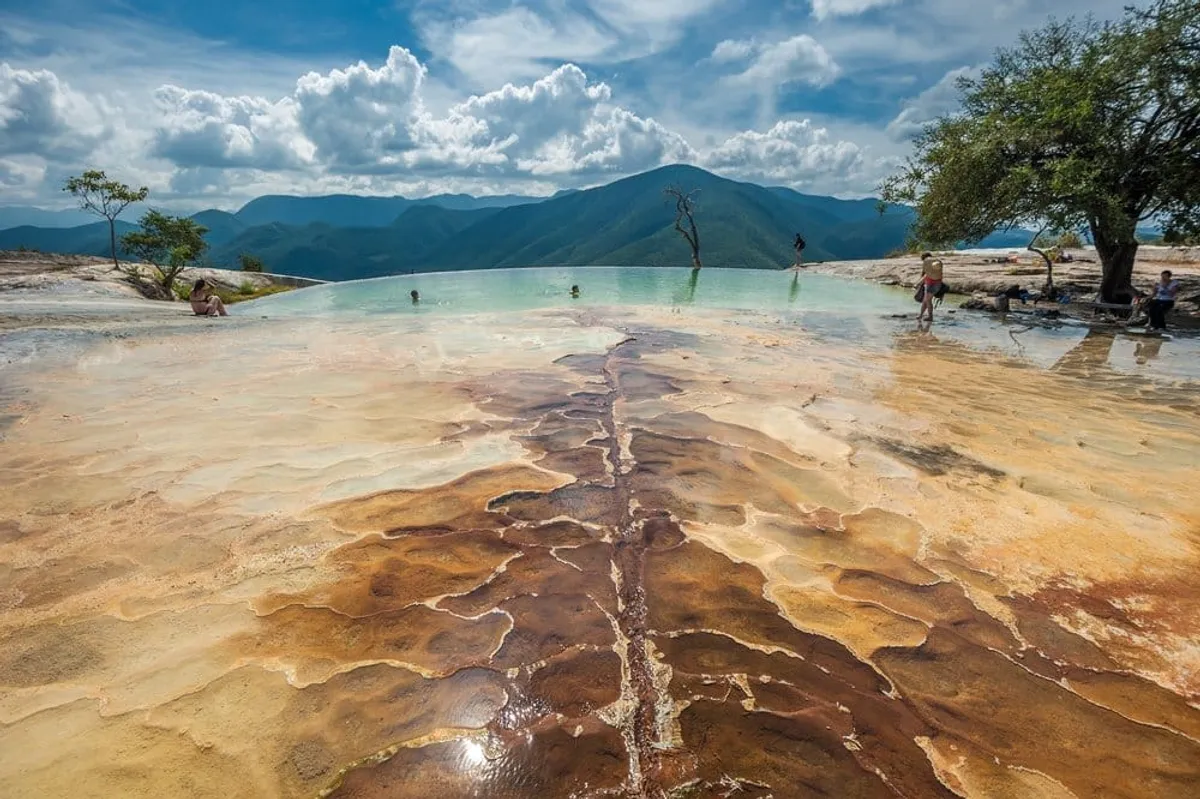
⚠️ Critical note: Hierve el Agua is CLOSED from approximately June through September each year due to flooding risk and recurring community access disputes. Check current status before booking. This day only works October–May.
8:00 AM: Depart by car. The route from Oaxaca City is 70 km east — drive through Mitla and then up a 12 km mountain road to the site. The road is passable in a standard car but requires care.
Hierve el Agua is a series of mineral springs at 1,800 meters elevation where mineral-rich water has petrified over millennia into formations that look like frozen waterfalls. The main “waterfall” drains into a swimming pool. The 40-minute trail circuit below the springs offers the best valley views in Oaxaca state. Entrance: 45 MXN. Crowds peak after 11 AM when tour buses arrive — arriving by 9 AM gives you 2 hours before it gets busy.
11:30 AM: Santiago Matatlán — Mezcal Capital of the World. The town 35 km east of Oaxaca City has 200+ registered palenques (mezcal distilleries), producing the majority of Oaxaca’s certified mezcal. Stop at any palenque with an “abierto” sign and ask for a tour. You’ll see: tahona-crushed agave hearts (some still horse-powered), clay or copper still fermentation, traditional distillation in clay pots. Tasting: free with the tour. Bottles: 150–600 MXN directly from the producer, versus 400–1,200 MXN at city shops.

Afternoon: Return to Oaxaca City. Visit the Mercado de Artesanías (just south of the Mercado Benito Juárez) for barro negro (black clay pottery), alebrijes (fantastical painted wooden figures from San Martín Tilcajete), and embroidered huipiles from San Antonino Castillo Velasco. Prices here are fixed — better for gifts than serious collecting.
Evening: Book ahead for Oaxacan food — this is your best dinner night. Casa Oaxaca El Restaurante (the upscale version, on Calle Constitución) offers tasting menus with all seven moles represented. Pitiona is another option for experimental Oaxacan cooking. Reserve by phone at least a day in advance.
Day 5: Sierra Norte or Pacific Coast
Option A: Sierra Norte Cloud Forest (recommended)
The Sierra Norte mountains 70 km north of Oaxaca City contain a community ecotourism network of 8 Zapotec villages — Cuajimoloyas, Latuvi, Lachatao, Benito Juárez, and others — at 2,700–3,000 meters. Dense pine-oak and cloud forest. Temperature 15–22°C (often cooler than the city). The villages operate cabins, mountain bike rentals, and guided hikes under the Expediciones Sierra Norte cooperative.
Getting there: Two-hour colectivo from Oaxaca City’s 2nd-class bus terminal to Cuajimoloyas (70 MXN, departures at 6 AM and 10 AM). Or rental car via Hwy 175 north. The road is paved but winding.
What to do: The best day option is the 6–8 km guided hike from Cuajimoloyas through cloud forest to a lookout with views of Oaxaca City far below. Local guides speak Spanish; some speak English. Hiking cost: 100–200 MXN/person guided. For a longer experience, mountain biking from Benito Juárez village downhill through the forest to the valley floor is one of the best cycling experiences in southern Mexico.
See our Cuajimoloyas guide for detailed logistics.
Option B: Puerto Escondido Day Extension
With the new Autopista Barranca Larga-Ventanilla (Highway 135D) — fully open since 2024 — the drive from Oaxaca City to Puerto Escondido is 3–3.5 hours (down from the old 7–8 hour mountain road route). This makes a day trip to the Pacific coast feasible for the first time.
Most visitors prefer to overnight in Puerto Escondido and return on Day 7, but if you only have one day: depart 7 AM, arrive 10:30 AM, spend the day at Carrizalillo or La Punta beaches, depart 4 PM, arrive Oaxaca City 7:30 PM.
⚠️ Zicatela is NOT for swimming. The open barrels and shore break have injured and killed swimmers. Swim at Carrizalillo (steps down to a sheltered cove) or La Punta (reef-protected, calmer).
See our Oaxaca to Puerto Escondido guide for the full route.
Day 6: Deep Mezcal or Crafts Circuit
For mezcal travelers: Do the full Ruta del Mezcal south of the city. Visit San Bartolo Coyotepec (black pottery — the technique invented by Doña Rosa Real Mateo using no potter’s wheel), then Ocotlán de Morelos (Friday market, Rodolfo Morales murals in the Convent), then Ejutla de Crespo (remote mezcal with distinct terroir from the valley varieties), then circle back through Zimatlán and Zaachila (Mixtec tombs with original jaguar reliefs).
For crafts travelers: Combine San Bartolo Coyotepec (black pottery direct from makers), San Martín Tilcajete (alebrije workshops — more elaborate and more expensive than market versions), and Arrazola (different alebrije style, rougher and cheaper). These three villages form a 25 km circuit west of Highway 175.
Sunday timing: If Day 6 falls on Sunday, Tlacolula market is the priority (if you missed it on Day 3). Drive east to Tlacolula (30 km), arrive by 9 AM, spend 3–4 hours, combine with Yagul or Mitla in the afternoon.
Evening: Walk the Andador Alcalá slowly — this is your last chance to browse cooperatives and pick up anything you missed. Chocolate at Mayordomo or La Soledad. Final mezcal at In Situ or the rooftop at Azul Cielo (Calle Berriozábal) for views over the Templo de Santo Domingo.
Day 7: Final Morning, Departure
Your final morning depends on flight timing.
For morning departures (before noon): The airport taxi takes 20 minutes from the city center. Arrive 90 minutes before domestic flights. The last useful thing you can do the night before: pick up tasajo (salt-cured beef) vacuum-packed from a butcher near Mercado Benito Juárez (150–200 MXN/kg) and mole paste from Mercado 20 de Noviembre (80–120 MXN per portion) — both pass airport security.
For afternoon/evening departures: Breakfast at Los Danzantes (Macedonio Alcalá, good huevos rancheros with house mole) or a final mezcal from the palenque bottles you bought in Santiago Matatlán. If you haven’t done Monte Albán yet (caught on other priorities), the 7:30 AM departure means you can be back by 11 AM for a noon airport taxi.
Final shopping: The Mercado de Artesanías opens at 8 AM. The Fonart government craft store near the Zócalo has fixed prices and quality control — useful for last-minute purchases where you don’t want to negotiate.
Budget: 7 Days in Oaxaca
| Category | Budget ($40–50/day) | Mid-Range ($60–90/day) | Upscale ($120–200/day) |
|---|---|---|---|
| Accommodation | Hostel dorm / guesthouse | Boutique hotel B&B | Design hotel suite |
| Daily room cost | 250–400 MXN | 600–1,200 MXN | 2,000–4,500 MXN |
| Meals | Market comidas, tlayudas | Mid-range restaurants + 1 upscale | Full restaurant dining |
| Daily food | 150–250 MXN | 350–600 MXN | 700–1,500 MXN |
| Transport | Colectivos, shared shuttles | Mix colectivos + 2-day car rental | Private driver/car 3+ days |
| Daily transport | 50–100 MXN | 200–500 MXN (incl. car days) | 600–1,500 MXN |
| Activities | Free sites, market browsing | Paid sites + tour | Premium experiences |
| Daily activities | 50–100 MXN | 150–300 MXN | 300–800 MXN |
| Total daily | $40–50 USD | $60–90 USD | $120–200 USD |
| Total 7 days | $280–350 USD | $420–630 USD | $840–1,400 USD |
Alcohol (mezcal) is not included in the above — budget an extra $10–30/day if you’re taking mezcal seriously, which you should be.
Transport Inside Oaxaca
| Route | Method | Cost | Time |
|---|---|---|---|
| Airport → city center | Official taxi | 180–220 MXN | 20 min |
| Airport → city center | Aeropuerto shuttle van | 135–210 MXN | 30 min |
| City center → Monte Albán | Collective shuttle from Mercado 20 Nov | 70 MXN round-trip | 25 min |
| City → Teotitlán/Tlacolula | Colectivo (2nd-class terminal) | 15–25 MXN | 30–45 min |
| City → Mitla | Colectivo | 30 MXN | 50 min |
| City → El Árbol del Tule | Colectivo | 15 MXN | 20 min |
| City → Hierve el Agua | Tour (required if no car) | 200–350 MXN | 1.5 hr |
| Car rental (2 days) | Via RentCars | 600–900 MXN/day | — |
| City → Cuajimoloyas (Sierra Norte) | Colectivo (6 AM or 10 AM) | 70 MXN | 2 hr |
| City → Puerto Escondido | Shared shuttle or drive | 300–500 MXN / 3.5 hr | 3–3.5 hr |
Uber and DiDi are banned in Oaxaca. City taxis are metered (start around 30–50 MXN, most city trips 50–100 MXN). For longer distances, use colectivos from the 2nd-class terminal on Prolongación Las Casas.
Seasonal Adjustments
Best months: October–November (Día de Muertos extraordinary, Hierve el Agua open, lower crowds than July) and February–April (dry season peak, all sites open, jacarandas in March).
July: Guelaguetza festival (third Monday) — extraordinary folk dance celebration. Book accommodation 3 months ahead. Prices +50–100%.
June–September (rainy season): Afternoon showers, Hierve el Agua closed, some valley roads muddy. Sierra Norte cloud forest is more lush and atmospheric. Guelaguetza in July is the main draw.
Semana Santa (Easter week, March 29–April 5 in 2026): Busy but festive. Oaxaca City Semana Santa is underrated compared to Taxco and Pátzcuaro — street processions, alfombras (colored sawdust carpets), traditional cooking. Book accommodation 2–4 weeks ahead.
See our best time to visit Oaxaca for full month-by-month detail.
Extending Your 7-Day Itinerary
Adding the Pacific coast (Day 8–10): Drive or shuttle to Puerto Escondido (3.5 hours via new Hwy 135D). Stay 2–3 nights. Then continue to Mazunte and Zipolite (30 km further west) for the hippie-alternative contrast. Return to Oaxaca City or fly home from the Bahías de Huatulco airport (HUX), 35 km from Mazunte.
Adding the Mixteca (Day 8–9): Northwest of Oaxaca City, the Mixteca Alta region has the most dramatic colonial architecture in southern Mexico: the roofless open-air chapel at Cuilapam de Guerrero, the Dominican convents along Hwy 190, and the cloud forest of Apoala. Almost no tourists. Requires a rental car.
Adding another Sierra Norte night: Overnight in a cabin at Cuajimoloyas or Benito Juárez and do the multi-day Latuvi–Lachatao hike circuit. This is one of the best multi-day hikes in Mexico that most travelers never discover.
Related Oaxaca Guides
- 5 Days in Oaxaca — the short version
- Things to Do in Oaxaca — full activity list (30 experiences ranked)
- Day Trips from Oaxaca City — 14 excursions ranked
- Oaxaca Travel Guide — full destination overview
- Best Time to Visit Oaxaca — month-by-month guide
- Oaxacan Food Guide — the 7 moles and what to eat
- Oaxaca Pyramids and Ruins — Monte Albán, Mitla, Yagul, 12 sites ranked
- Mexico City to Oaxaca — how to get there
- Oaxaca to Puerto Escondido — coast transport guide
Booking Your Oaxaca Trip
Flights and transport: Check Oaxaca car rental rates on RentCars — comparing across all major agencies in one search.
Tours: Book Monte Albán guided tours, mezcal tours, and Sierra Norte hikes through Viator’s Oaxaca collection.
Travel insurance: travel insurance should prioritize emergency medical treatment and evacuation support s — useful for remote Sierra Norte and Hierve el Agua.