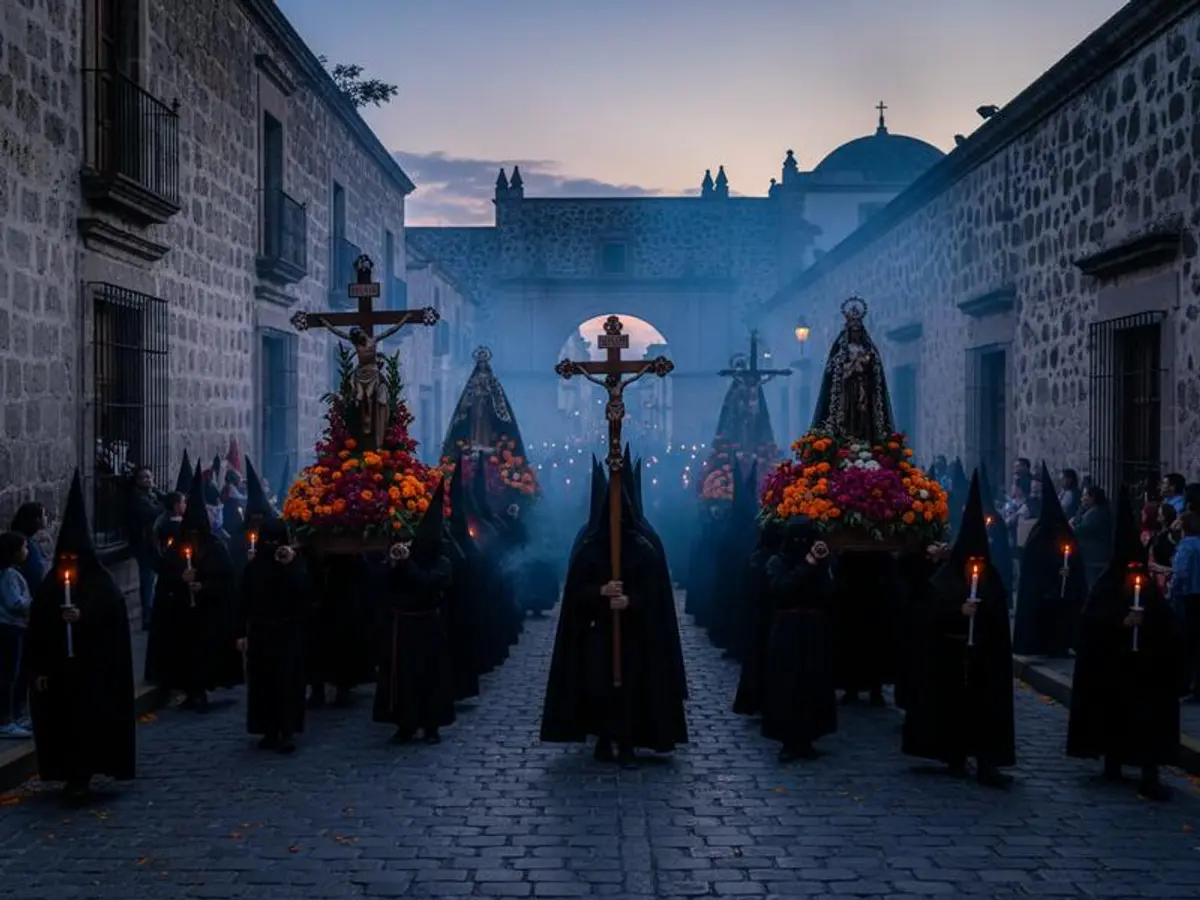
Semana Santa in Mexico 2026: Dates, Traditions, and 10 Best Cities
Semana Santa in Mexico runs from Palm Sunday, March 29, to Easter Sunday, April 5, 2026. It is the country’s busiest domestic travel week, with packed beaches, sold-out buses, and some of Mexico’s most dramatic religious processions. If you want the best overall experience, go to Taxco, San Miguel de Allende, Oaxaca, or Iztapalapa. If you want a quiet beach trip, avoid this week.
| Semana Santa in Mexico in 30 Seconds | Details |
|---|---|
| 2026 dates | March 29 to April 5 |
| Biggest procession destination | Taxco |
| Biggest passion play | Iztapalapa, Mexico City |
| Best colonial-city experience | San Miguel de Allende or Oaxaca |
| Worst fit for a calm beach trip | Cancún, Los Cabos, Puerto Vallarta, Tulum |
| Main traveler mistake | Booking transport and hotels too late |
Growing up in Mexico, Semana Santa wasn’t just a holiday. It was the week the whole country changed rhythm. Schools shut down, families packed the highways, churches filled with incense, and city centers turned into open-air stages for processions that had been repeated for generations.
That is why Semana Santa in Mexico can feel magical or exhausting, depending on where you go and how well you plan. If you want culture, this is one of the best weeks of the year. If you want empty beaches and cheap hotels, it is one of the worst.
What Is Semana Santa?
Semana Santa (literally “Holy Week”) is the most important religious celebration in Mexico, commemorating the Passion, Death, and Resurrection of Jesus Christ. In 2026, Semana Santa in Mexico runs from Palm Sunday, March 29, through Easter Sunday, April 5, and it is one of Mexico’s “big three” holidays alongside Christmas and Day of the Dead.
But calling it just a religious holiday undersells it. Semana Santa is when Mexico essentially shuts down. Schools close for two weeks (the full period is called Semana Santa y Pascua), factories halt production, and an estimated 20 million Mexicans travel domestically. It’s simultaneously a sacred observance, a family reunion, and a national vacation.
The traditions you’ll see during Semana Santa are a fascinating blend of Catholic practices brought by Spanish colonizers and indigenous customs that predate the conquest by centuries. Aztec drums accompany Catholic processions. Pre-Hispanic purification rituals happen alongside candlelit vigils. It’s Mexico at its most culturally layered.
When Is Semana Santa in Mexico in 2026?
| Day | Date | What Happens |
|---|---|---|
| Palm Sunday (Domingo de Ramos) | March 29 | Processions with palm fronds, blessing of palms at churches |
| Monday–Wednesday | March 30–April 1 | Daily processions in many cities, altars displayed in churches |
| Holy Thursday (Jueves Santo) | April 2 | Last Supper reenactments, visitation of 7 churches, evening processions |
| Good Friday (Viernes Santo) | April 3 | Passion plays, crucifixion reenactments, silent processions — the most dramatic day |
| Holy Saturday (Sábado de Gloria) | April 4 | Burning of Judas, water celebrations, beach parties begin |
| Easter Sunday (Domingo de Pascua) | April 5 | Celebratory masses, family gatherings, resurrection processions |
The 10 Best Cities to Experience Semana Santa
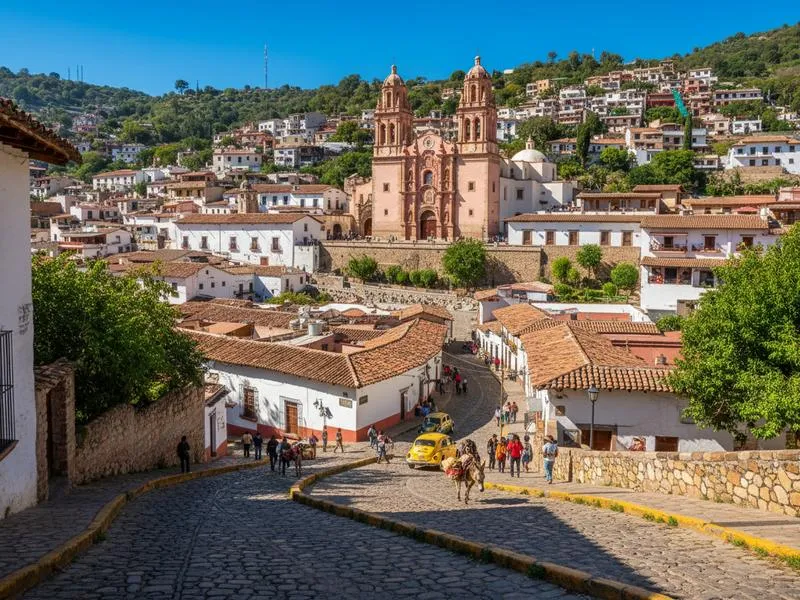
1. Taxco, Guerrero — The Most Intense Processions in Mexico
If you see one Semana Santa celebration in your life, make it Taxco. This silver-mining town in the mountains of Guerrero hosts the most viscerally powerful Holy Week processions in all of Mexico — and possibly the world.
Three religious brotherhoods (hermandades) dating back to the 1600s carry out penitential processions that will leave you speechless:
Las Ánimas (“The Bent Ones”) walk hunched through narrow cobblestone streets with chains around their ankles, carrying candles in complete silence. They wear black robes and hoods that hide their identities, accompanied by children dressed as angels. The only sounds are chains scraping on stone and the shuffle of bare feet.
Los Flagelantes walk shirtless carrying wooden crosses that weigh over 45 kg (100 lbs) while striking their bare backs with metal-tipped whips. This isn’t theatrical — the blood is real. They do this nightly during Holy Week, reopening wounds each evening.
Los Encruzados carry bundles of blackberry thorns weighing up to 45 kg across their outstretched arms, their bodies forming a cross shape.
Between Palm Sunday and Easter, Taxco hosts ten major processions — six in the evening and four during the day. Each covers about 2.5 km and takes two hours to complete. The most powerful is Holy Wednesday night, when all three brotherhoods process through town. On Good Friday, a crucifixion reenactment takes place at the Santa Prisca Church.
Getting there: Taxco is about 2.5 hours south of Mexico City by car or bus from Terminal Tasqueña (Metro Line 2). ADO buses run 190–280 MXN. See our complete Mexico City to Taxco guide for schedules, Semana Santa timing, and driving advice. Book accommodation well in advance — the town fills up completely.
Cost: Free to watch. Hotels in Taxco range from $30–$80 USD ($520–$1,400 MXN) per night during Semana Santa, but book early — they sell out. See our Taxco Semana Santa guide for the full Holy Week schedule, Ley Seca rules, photography tips, and where to stay. Also: things to do in Taxco.
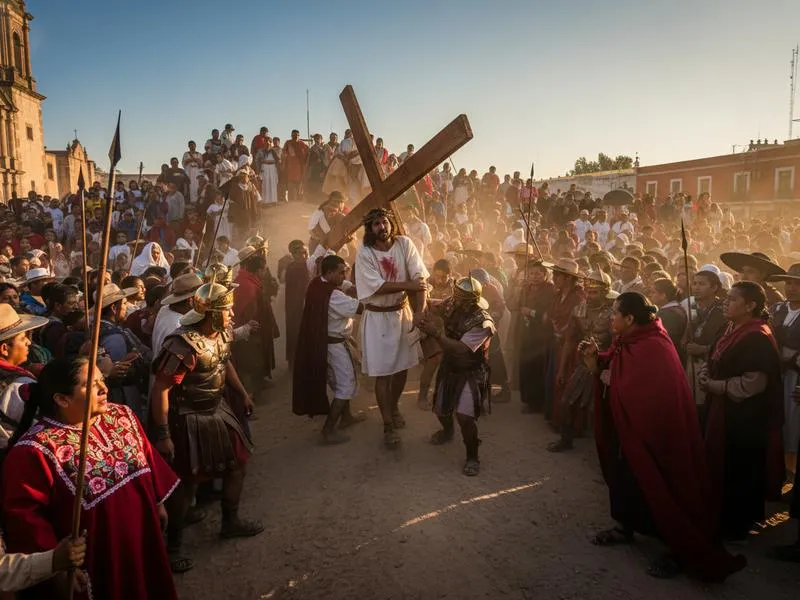
2. Iztapalapa, Mexico City — The World’s Largest Passion Play
The Iztapalapa Passion Play is the single largest Holy Week event in the Western Hemisphere. Over 4,000 local residents perform, and up to 2 million spectators watch over the course of the week. In December 2025, UNESCO recognized it as Intangible Cultural Heritage of Humanity.
The tradition started in 1843 after a cholera epidemic devastated Iztapalapa. Survivors vowed to reenact Christ’s Passion annually if God spared them, and they’ve kept that promise for over 180 years.
The performance runs from Palm Sunday through Good Friday, with the climactic crucifixion reenactment at Cerro de la Estrella (Star Hill). What makes it extraordinary is the commitment of the participants — Nazarenos wear real crowns of thorns and carry actual heavy crosses through the streets. The actor playing Jesus is selected a year in advance and undergoes months of physical and spiritual preparation.
The route starts at Iztapalapa’s main square (where Pontius Pilate delivers his sentence), then winds over 1.5 km through eight historic neighborhoods to Cerro de la Estrella for the crucifixion scene. Aztec drums mix with Catholic hymns. Roman soldiers march alongside pre-Hispanic dancers.
How to attend: The event is completely free. Take Metro Line 8 to Iztapalapa station and follow the crowds. Arrive early on Good Friday (by 8 AM) for the crucifixion — it draws the biggest crowds. Wear comfortable shoes (the terrain is hilly), bring water and sunscreen, and leave valuables at your hotel.
Getting there: From central Mexico City, it’s about 45–60 minutes by public transport. Take Metro Line A toward Iztapalapa station. See our dedicated Semana Santa in Mexico City guide for the full schedule, Ley Seca rules (CDMX has none), Teotihuacan Holy Week timing, and safety tips for Iztapalapa.
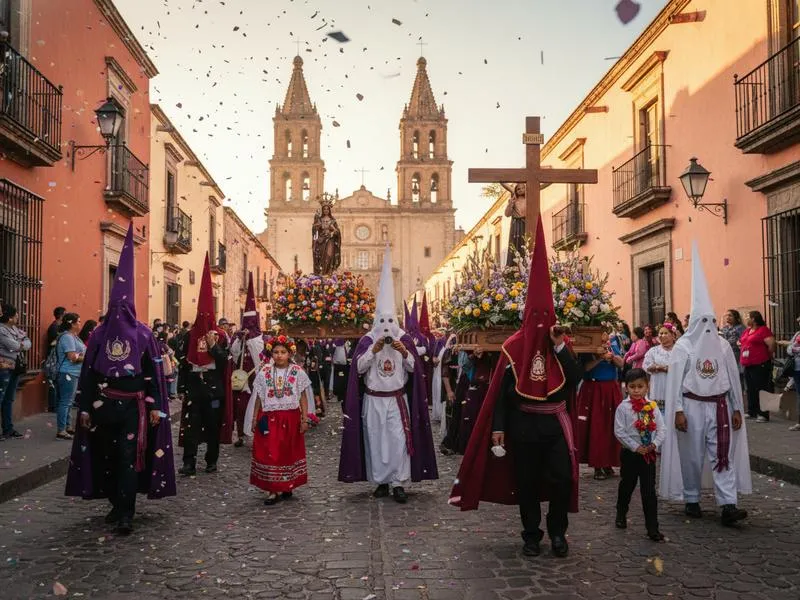
3. San Miguel de Allende, Guanajuato — Two Weeks of Daily Processions
San Miguel de Allende does Semana Santa with colonial grandeur. The celebrations here span a full two weeks — starting two Sundays before Easter — with at least one procession every single day.
The centerpiece is El Señor de la Columna, a life-sized statue of Christ bound to a column. The Friday before Palm Sunday, thousands of devotees carry it in a midnight procession from the Sanctuary of Atotonilco (12 km outside town) to San Juan de Dios church, arriving at dawn amid fireworks, church bells, and drums. Homes along the route are decorated with purple and white paper flowers.
Key events:
- Friday of Sorrows: Altars with wheat sheaves, bitter oranges, and gold foil appear in homes and businesses throughout town
- Palm Sunday: Two main processions converge at La Parroquia — buy woven palm crosses from street vendors
- Holy Thursday: Visit altars in churches depicting the Last Supper, then join the 2.5-hour Holy Burial procession from the Oratorio de San Felipe Neri
- Good Friday: Multiple processions including El Señor de la Columna’s journey to La Parroquia, led by children dressed as disciples and Roman centurions on horseback. After dark, a solemn all-black funeral procession fills the streets
- Holy Saturday: The Burning of Judas (Quema de Judas) in the main jardín — effigies rigged with fireworks launch from trees to balconies
San Miguel attracts a mix of Mexican families, expats, and international visitors. The atmosphere is reverent but accessible — you don’t need to be Catholic to appreciate the artistry and emotion.
Cost: Hotels in San Miguel range from $60–$200 USD ($1,050–$3,500 MXN) per night during Semana Santa. Restaurants keep normal prices. All processions are free. See our dedicated Semana Santa in San Miguel de Allende guide for the full day-by-day schedule, mojigangas guide, Ley Seca (no dry law in Guanajuato state), and last-minute hotel strategy.
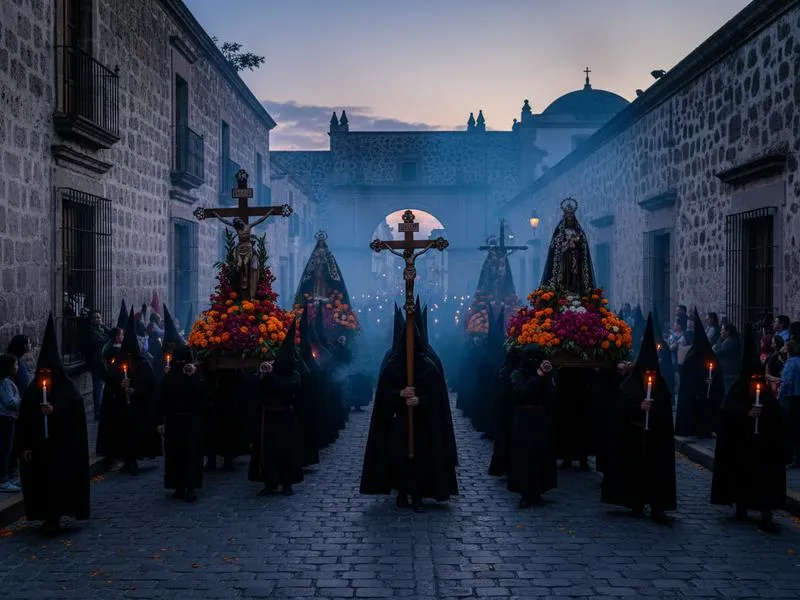
4. Oaxaca City — Indigenous Traditions Meet Catholic Ceremony
Oaxaca brings its characteristic cultural depth to Semana Santa. The celebrations here blend Zapotec and Mixtec indigenous traditions with Catholic observance in ways you won’t see anywhere else.
The highlight is the Procession of Silence on Good Friday evening. Thousands of participants walk through the historic center carrying candles and religious statues in absolute silence. The procession starts at the Templo de la Soledad and winds through the city’s colonial streets to the main plaza. No music, no talking — just the sound of feet on stone and flickering candlelight reflected off green cantera buildings.
Throughout the week, Oaxaca’s indigenous communities bring their own traditions into the celebration. You’ll see elements of pre-Hispanic ritual woven into Catholic ceremony — copal incense (used in Zapotec rituals long before the Spanish arrived), traditional medicine plants placed on altars, and community celebrations that feel more like ancient harvest festivals than European religious observance.
Oaxaca is also a phenomenal food destination during Semana Santa. Special dishes appear during Lent and Holy Week: capirotada (bread pudding with cheese and piloncillo), romeritos (a wild herb served with mole and shrimp patties), and various seafood dishes replace meat. Oaxacan food is already among Mexico’s best — during Semana Santa, it gets even more interesting.
Cost: Hotels $40–$150 USD ($700–$2,600 MXN) per night. Oaxaca’s food scene is affordable year-round — market meals from $3–$5 USD ($50–$90 MXN). See our Oaxaca Semana Santa guide for the Holy Week schedule, alfombra tradition, Ley Seca rules (Friday only), and day trip ideas. Also: things to do in Oaxaca.
5. San Cristóbal de las Casas, Chiapas — Highland Maya Traditions
San Cristóbal offers the most intimate Semana Santa experience on this list. At 2,200 meters elevation in the Chiapas highlands, the cool mountain air and small-town atmosphere make it feel like stepping back in time.
The Tzotzil Maya communities surrounding San Cristóbal add layers of indigenous tradition that make Semana Santa here unique. In San Juan Chamula (just 10 km away), the Tzotzil celebrate Holy Week with a syncretic mix of Maya and Catholic rituals. The famous church — where candles, pine needles, and Coca-Cola are used in healing ceremonies year-round — takes on special significance during Semana Santa.
In San Cristóbal proper, solemn processions move through the cobblestone streets between the city’s many colonial churches. The processions are smaller and more personal than in Taxco or San Miguel — you might find yourself walking alongside the participants rather than watching from behind a crowd.
The Chiapas food scene during Semana Santa features special Lenten dishes alongside local favorites like tamales de chipilín and sopa de pan.
Full guide: Semana Santa in San Cristóbal de las Casas 2026 — Chamula ceremonies, no Ley Seca, and complete 2026 schedule.
Getting there: Fly to Tuxtla Gutiérrez (TGZ) and take a 1-hour colectivo ($2–$4 USD / $35–$70 MXN) to San Cristóbal. Coming from Oaxaca? See our Oaxaca to San Cristóbal transport guide — including the overnight bus and bloqueo warning. Day trips from San Cristóbal are easy to arrange.
Cost: One of the most affordable destinations on this list — hotels from $25–$80 USD ($440–$1,400 MXN), meals from $2–$8 USD ($35–$140 MXN).
6. Pátzcuaro, Michoacán — Purépecha Lakeside Traditions
Pátzcuaro is famous for its Day of the Dead celebrations, but its Semana Santa is equally extraordinary — and far less crowded. The town sits on the shore of Lake Pátzcuaro in the Michoacán highlands, surrounded by Purépecha indigenous communities that have maintained their own Holy Week traditions for centuries.
The lake islands play a central role. On Good Friday, fishing boats decorated with flowers and religious icons form a procession across the lake. The combination of candle-lit boats on dark water, surrounded by mist-covered mountains, is one of the most visually stunning moments of any Semana Santa in Mexico.
In town, alfombras (carpets) made from flower petals, colored sawdust, and pine needles line the processional route through the colonial streets. Purépecha artisans create intricate designs depicting religious scenes, and the smell of copal incense and fresh flowers fills the air.
Pátzcuaro’s markets are exceptional during Semana Santa — look for corundas (triangular Purépecha tamales), fresh lake fish like white fish (pescado blanco) and charales, and artisan crafts from nearby villages like Santa Clara del Cobre (copper) and Quiroga (lacquerware).
Full guide: Semana Santa in Pátzcuaro 2026 — Good Friday lake boat procession, alfombras, and Purépecha traditions.
Cost: Hotels $30–$100 USD ($520–$1,750 MXN). Market meals from $2–$5 USD ($35–$90 MXN).
7. Puebla — Colonial Architecture and Culinary Traditions
Puebla puts on a grand Semana Santa centered on the city’s stunning colonial architecture. The Great Procession of Good Friday winds through streets lined with talavera-tiled buildings, featuring participants in elaborate costumes, floats with religious statues, and musical ensembles.
What sets Puebla apart is the food. Semana Santa is when you’ll find the best seasonal dishes: romeritos con mole (wild herbs in mole sauce with shrimp patties), capirotada (a bread pudding layered with cheese, piloncillo syrup, peanuts, and dried fruit — every family has their own recipe), and tortitas de camarón (shrimp fritters in red or green sauce).
Cholula, just 15 minutes from Puebla, hosts its own processions around the Great Pyramid and the dozens of churches that dot the town. See our dedicated Semana Santa in Puebla guide for the full Holy Week schedule, Cholula pyramid masses, Ley Seca rules, and Huejotzingo Franciscan convent. Also: things to do in Puebla and best time to visit Puebla.
Cost: Hotels $35–$120 USD ($610–$2,100 MXN). Puebla is one of Mexico’s best food cities — meals from $3–$10 USD ($50–$175 MXN).
8. Querétaro — The Underrated Colonial Option
Querétaro doesn’t appear on most Semana Santa lists, and that’s exactly why it belongs on yours. This UNESCO World Heritage city — 2.5 hours from Mexico City by bus — hosts solemn Good Friday processions through its 74-arch aqueduct-lined streets that rival anything in the better-known cities.
The highlight is the Via Crucis procession on Good Friday evening, which winds from the city’s historic center past the Convento de la Santa Cruz (the convent with the thorn-shaped crosses) and toward Cerro de las Campanas — the same hill where Emperor Maximilian was executed in 1867. The symbolic weight of that setting adds a layer of meaning that secular visitors often find unexpectedly moving.
Querétaro is also 30-40% cheaper than San Miguel de Allende for everything from hotels to meals, making it the smart alternative if SMA is sold out. The Aeropuerto Internacional de Querétaro (QRO) has direct flights from US cities including Chicago and Dallas/Fort Worth.
Getting there: From Mexico City, Terminal Norte (NOT TAPO — this is the most common mistake) to Querétaro takes 2.5-3.5 hours by ETN or Primera Plus, 200-500 MXN. See our complete Mexico City to Querétaro guide. From San Miguel de Allende, it’s 60-75 minutes by bus.
Cost: Hotels $35-100 USD ($610-1,750 MXN). Market meals from $2-5 USD ($35-90 MXN). One of Mexico’s best value cities.
9. Tlaxcala City — The Semana Santa Secret Nobody Mentions
Tlaxcala is 1.5 hours from Mexico City and hosts some of the most elaborate Semana Santa celebrations in central Mexico — yet almost no international travel guide covers it. This tiny state capital (population 90,000) punches far above its weight during Holy Week.
The Tlaxcala tradition blends pre-Hispanic Nahua and Otomí practices with Spanish Catholic ceremony in ways that differ visibly from Oaxaca or Michoacán. The city’s indigenous communities never fully converted during the colonial period — they negotiated Christianity into their existing worldview — and the result is a Semana Santa that still feels genuinely syncretic rather than simply Catholic.
What makes Tlaxcala special:
- Cofradia processions — Indigenous religious brotherhoods (cofradías) in elaborate pre-Hispanic-influenced costumes carry the same statues they’ve been carrying for 400 years
- Holy Thursday altars — Some of the most elaborate in Mexico, combining Catholic imagery with regional flowers, corn, and native motifs
- Good Friday passion play at the Cerro de la Malinche foothills — smaller than Iztapalapa but far more intimate, with full community participation
- Zero crowds — Tlaxcala is one of Mexico’s most-overlooked states. During Semana Santa, you’ll be surrounded by Mexican families, not other tourists
Tlaxcala city center is a 15-minute walk across: every colonial church is walkable, accommodation is a fraction of the price of San Miguel or Oaxaca ($30–$70 USD/night), and the ADO bus from TAPO runs every 30 minutes (90 min, ~$5 USD / 90 MXN).
The hidden bonus: Cacaxtla and Xochitécatl archaeological sites are 15 minutes from the city — the Cacaxtla murals (jaguar warriors in Mayan style, painted by Olmec-Xicalanca people) are among the best-preserved pre-Hispanic murals in Mexico and likely the least-visited major site in the country. Combine Tlaxcala Semana Santa with a Cacaxtla morning and you have a near-perfect 2-day trip from CDMX.
Cost: Hotels $30–$70 USD ($520–$1,220 MXN). Market meals from $2–$5 USD ($35–$90 MXN). Genuinely affordable even during Semana Santa.
10. Guadalajara, Jalisco — Big City Celebrations
Guadalajara offers a full range of Semana Santa experiences for those who want urban convenience with religious spectacle. The city’s colonial core — centered on the Cathedral and Teatro Degollado — hosts daily processions during Holy Week, with the Plaza de Armas serving as the main gathering point.
The Burning of Judas on Holy Saturday is particularly festive in Guadalajara. Effigies are often crafted to look like unpopular politicians, then stuffed with fireworks and exploded to cheering crowds. It’s the release valve after a solemn week.
Jalisco is one of the states that traditionally enforces Ley Seca (dry law) on Thursday and Friday of Holy Week, restricting alcohol sales at retail stores. Restaurants and bars with food service can still serve drinks. See our dedicated Semana Santa in Guadalajara guide for the full Holy Week program, Tlaquepaque schedule, and Ley Seca details.
Cost: Hotels $40–$150 USD ($700–$2,600 MXN). As Mexico’s second-largest city, Guadalajara has options at every price point.
Mérida, Yucatán — Izamal Pilgrimage + No Dry Law
Mérida is the most underrated Semana Santa destination in Mexico. Yucatán state enforces no Ley Seca at all — bars and restaurants stay open Good Friday, every day of Holy Week. The big draw is Izamal, 36 km east: Mexico’s golden-yellow pilgrimage city, where thousands of pilgrims walk or cycle to the Convento de San Antonio de Padua (built atop a Maya pyramid, largest atrium in the Americas after St. Peter’s). The Procesión del Silencio on Good Friday evening — thousands of candles, no amplification, through the Plaza Grande — is one of Mexico’s most atmospheric Holy Week events. With Chichen Itza 120 km away, Ek Balam, and Valladolid’s cenotes all accessible, Mérida offers Holy Week culture plus Yucatán’s full ruins circuit. See the complete Semana Santa in Mérida guide.
Day-by-Day Guide to Semana Santa
Palm Sunday (Domingo de Ramos) — March 29
The week begins with the blessing of palm fronds at churches across Mexico. Vendors sell woven palm crosses, flowers, and intricate palm-frond creations outside every church. In many cities, processions reenact Jesus’s triumphal entry into Jerusalem.
What to do: Attend a morning Mass and get your palm fronds blessed. Browse the artisan vendors outside churches. In San Miguel de Allende, watch the two main processions converge at La Parroquia.
Monday–Wednesday — March 30 – April 1
These are the build-up days. Processions happen nightly in cities like Taxco and San Miguel. Churches display elaborate altars. The mood shifts gradually from celebratory to somber as the week progresses.
What to do: Visit churches to see their altars. In Taxco, the penitent processions begin — Holy Wednesday night is particularly intense, with all three brotherhoods processing simultaneously.
Holy Thursday (Jueves Santo) — April 2
Holy Thursday commemorates the Last Supper and Jesus’s arrest in the Garden of Gethsemane. Many Mexicans practice the tradition of visiting seven churches (visita de las siete casas) in a single evening, one for each word Jesus spoke on the cross (or, in some traditions, one for each church where the apostles searched for him).
This is when things get serious. Banks and government offices close. Some states begin Ley Seca. The evening processions take on a heightened solemnity.
What to do: Join the seven-church walk — it’s one of the most communal Semana Santa experiences. In San Miguel de Allende, attend the 2.5-hour Holy Burial procession from the Oratorio de San Felipe Neri.
Good Friday (Viernes Santo) — April 3
The most dramatic day of the entire year. Good Friday is when Mexico stops.
In Iztapalapa, 2 million people gather to watch the Passion Play’s crucifixion at Cerro de la Estrella. In Taxco, the flagellants process through streets lit only by candles. In Oaxaca, the Procession of Silence fills the historic center. In San Miguel, an all-black funeral procession follows the darkened streets after sunset.
Across the country, Passion plays and Via Crucis (Stations of the Cross) reenactments take place in town squares, churchyards, and hillsides. Many families eat traditional Lenten meals: capirotada, romeritos, fish, and shrimp dishes.
What to do: Pick your city and commit to it — trying to hop between locations on Good Friday is logistically impossible. Arrive early for the main events. In Iztapalapa, be there by 8 AM. In Taxco, secure a spot along the procession route by late afternoon.
Holy Saturday (Sábado de Gloria) — April 4
The mood shifts abruptly. After the solemnity of Good Friday, Holy Saturday is when Mexico lets loose.
The signature tradition is the Quema de Judas (Burning of Judas). Neighborhoods across the country create papier-mâché effigies of Judas — often dressed as unpopular politicians, TV characters, or other figures — and stuff them with fireworks. At noon, the effigies are lit, and the fireworks inside explode in a spectacular display of controlled chaos.
In many communities, people throw water at each other (a cleansing ritual that predates Christianity). Kids run through streets with water balloons. Beach towns go from reverently quiet to full vacation mode.
What to do: Find a neighborhood Quema de Judas — the best ones are in smaller towns where the whole community participates. Bring a change of clothes if you’re in a town with water-throwing traditions.
Easter Sunday (Domingo de Pascua) — April 5
Easter Sunday is a family day. Mexicans attend celebratory masses, then gather for large family meals. Some cities have resurrection processions in the morning, but the overall mood is festive and relaxed.
You might see cascarones — confetti-filled eggshells that people crack over each other’s heads. Kids hunt for Easter eggs, though this tradition is less universal in Mexico than in the U.S.
What to do: Attend an Easter morning Mass (arrive early for a seat). Enjoy a family-style meal at a restaurant. If you’re at a beach destination, this is when the crowds start thinning as people head home.
Traditions You’ll Only See During Semana Santa
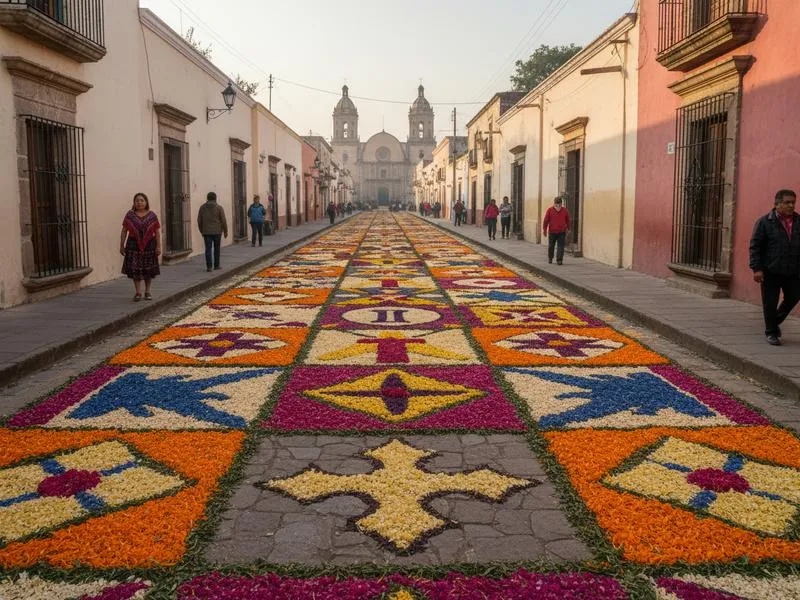
Alfombras (Processional Carpets)
In cities like Pátzcuaro, Antigua Guatemala, and parts of Oaxaca, residents create elaborate carpets (alfombras) on the streets where processions will pass. Made from colored sawdust, flower petals, pine needles, and sometimes coffee grounds or rice, these intricate designs depict religious scenes, geometric patterns, and natural motifs. The procession then walks directly over them, destroying hours of work — the impermanence is part of the devotion.
Cascarones (Confetti Eggs)
Hollowed-out eggshells filled with confetti (cascarones) are sold at markets and outside churches throughout Semana Santa. Cracking one over someone’s head is supposed to bring good luck. Kids target each other, but nobody is off limits.
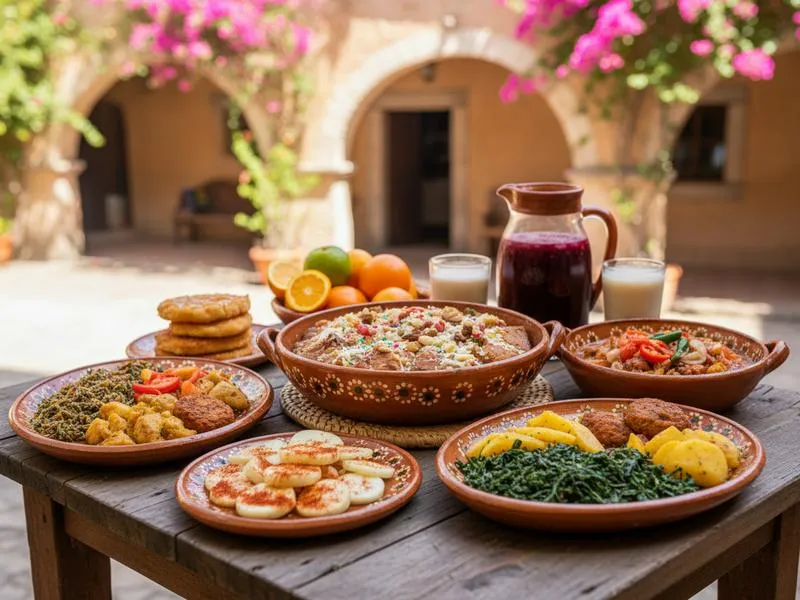
Lenten Foods
Meat is traditionally avoided on Fridays during Lent and throughout Holy Week (particularly Thursday and Friday). This has created an extraordinary tradition of seafood and vegetable dishes:
- Capirotada — Bread pudding made with piloncillo syrup, cheese, peanuts, raisins, and cinnamon. Every region (and every grandmother) has a different recipe.
- Romeritos — A wild herb similar to rosemary, cooked in mole with dried shrimp patties (tortitas de camarón). A Mexico City classic.
- Tortitas de camarón — Dried shrimp fritters in red or green sauce. Found nationwide during Semana Santa.
- Chiles rellenos de queso — Poblano peppers stuffed with cheese instead of the usual meat filling.
- Seafood everything — Ceviche, fish tacos, shrimp cocktails, and seafood stews become the default meals.
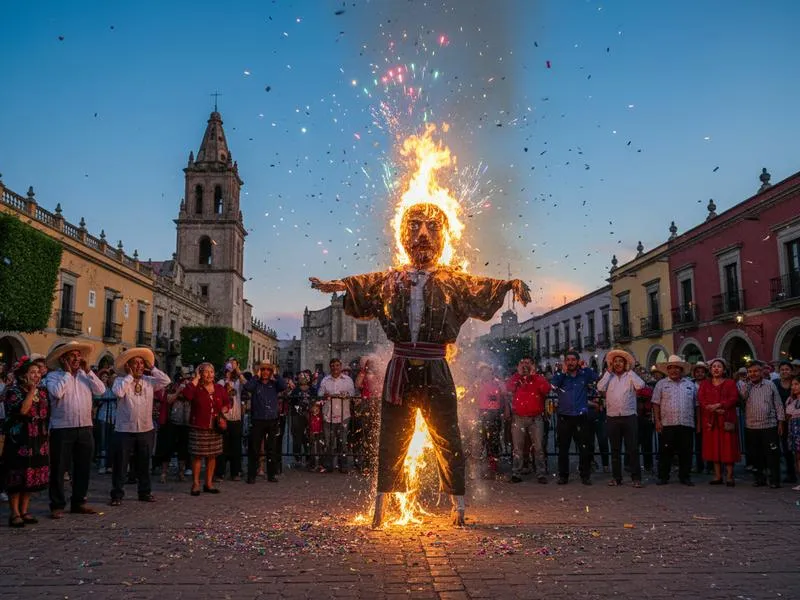
The Burning of Judas (Quema de Judas)
On Holy Saturday, papier-mâché effigies of Judas are destroyed with fireworks. The tradition has evolved into political satire — effigies are often modeled after unpopular politicians, with crowds cheering as they’re blown apart. It’s cathartic, chaotic, and uniquely Mexican.
Last-Minute Planning: 11 Days Out (March 18)
Semana Santa 2026 starts in 11 days (March 29). If you’re reading this and haven’t booked, here’s exactly what’s still doable.
What’s still available:
- Day trips from Mexico City — No booking required. The Iztapalapa Passion Play (Good Friday, April 3) is completely free and accessible by Metro. You can decide the morning of. Taxco is 2.5 hours by bus from Tasqueña — same thing.
- Less-visited cultural cities — Pátzcuaro, Tlaxcala, Cholula, and Cuetzalán still have rooms. These are authentic and far less crowded than Taxco or San Miguel.
- Airbnbs — Hotel inventory in Taxco and San Miguel is likely gone, but entire apartments are showing availability. Oaxaca and Puebla have more options than most assume.
- Hostels and budget hotels — Mid-range and luxury sell out first. Dorms and budget options survive longer.
- Querétaro — 2.5 hours from CDMX, beautiful UNESCO centro, solemn processions, and not on most tourists’ radar for Semana Santa. Genuinely underrated. See details below.
What’s probably gone:
- Mid-range hotels in Taxco, San Miguel de Allende, and Oaxaca city center
- Beach resort rooms in Cancún, Puerto Vallarta, and Mazatlán at any reasonable price
- First-class bus seats on popular routes (Mexico City → Taxco, → Oaxaca) for Holy Week dates
- Domestic flights to Cancún, PVR, and Mazatlán at reasonable prices
The CDMX base strategy (almost nobody considers this): Stay in Mexico City and day-trip everything. The Iztapalapa Passion Play, multiple processions in Coyoacán and the Centro Histórico, and a same-day return trip to Taxco (2.5 hrs each way by ADO from Tasqueña) are all doable from a CDMX base. Mexico City accommodation is available, prices haven’t spiked like resort destinations, and you get the best Passion Play in the world for free.
What’s Open and What’s Closed During Semana Santa
| Holy Thursday (Apr 2) | Good Friday (Apr 3) | Holy Saturday (Apr 4) | Easter Sunday (Apr 5) | |
|---|---|---|---|---|
| Banks | ❌ Closed | ❌ Closed | ✅ Open | ✅ Open |
| Government offices | ❌ Closed | ❌ Closed | ❌ Closed | ❌ Closed |
| Supermarkets | ✅ Open (reduced hours) | ✅ Open (reduced hours) | ✅ Open | ✅ Open |
| Liquor stores (Ley Seca states) | ❌ Closed | ❌ Closed | ✅ Open | ✅ Open |
| Restaurants | ✅ Open | ✅ Open (Lenten menu) | ✅ Open | ✅ Open |
| Hotels | ✅ Open | ✅ Open | ✅ Open | ✅ Open |
| ATMs | ✅ Operating | ✅ Operating | ✅ Operating | ✅ Operating |
| OXXO / convenience stores | ✅ Open | ✅ Open | ✅ Open | ✅ Open |
| Museums | Varies | ❌ Many closed | Varies | ✅ Most open |
| Public transport | ✅ Running | ✅ Running (reduced) | ✅ Running | ✅ Running |
Key action: Withdraw cash before Thursday, April 2. Lines at ATMs get long when banks close and everyone is buying last-minute supplies.
Practical Tips for Traveling During Semana Santa
Book Everything Early
Book accommodation at least 6-8 weeks ahead. For popular destinations like Cancún, Puerto Vallarta, Mazatlán, or Sayulita, 2-3 months early is better. Colonial cities like San Miguel de Allende and Oaxaca fill up fast too.
Understand Ley Seca (Dry Law)
Several Mexican states restrict alcohol sales during Holy Week, typically on Holy Thursday and Good Friday. This is called Ley Seca (dry law). Key things to know:
- It varies by state and municipality. There’s no nationwide rule. Jalisco and Guanajuato enforce it more strictly; Oaxaca generally doesn’t.
- Retail stores are affected. Supermarkets, convenience stores (OXXO, 7-Eleven), and liquor stores cannot sell alcohol.
- Restaurants, hotels, and bars with food service can still serve alcohol. You won’t go thirsty — you just can’t buy a bottle at the store.
- Stock up before Thursday. If you want drinks at your Airbnb or hotel room, buy them by Wednesday.
Ley Seca 2026 — Which States Enforce It:
| State | Holy Thursday (Apr 2) | Good Friday (Apr 3) | Notes |
|---|---|---|---|
| Jalisco | ❌ Dry | ❌ Dry | Strictly enforced — Guadalajara, PV |
| Guanajuato | ❌ Dry | ❌ Dry | SMA, Guanajuato city, Querétaro |
| Queretaro | ❌ Dry | ❌ Dry | Enforced in most municipalities |
| Guerrero | ❌ Dry | ❌ Dry | Taxco, Acapulco — strictly enforced |
| Estado de México | Partial | ❌ Dry | Some municipalities |
| Michoacán | Partial | ❌ Dry | Varies by municipality |
| Puebla | ❌ Dry | ❌ Dry | Puebla city, Cholula |
| Mexico City (CDMX) | ✅ Open | ✅ Open | No Ley Seca — unique nationwide |
| Quintana Roo | ✅ Open | ✅ Open | Cancún, Tulum, PDC — no restrictions |
| Yucatán | ✅ Open | ✅ Open | Mérida Semana Santa guide — no restrictions |
| Oaxaca | ✅ Open | ✅ Open | Generally not enforced |
| Chiapas | Partial | Partial | Some municipalities enforce it |
The CDMX advantage: Mexico City is one of the few major destinations with no Ley Seca, which partly explains why urban tourism in the capital surges during Semana Santa even as cultural cities go dry.
Banks and Government Offices
Banks close Thursday and Friday of Holy Week. Government offices close Thursday through the following Sunday. ATMs remain operational, but lines can be long — withdraw cash before Thursday.
Most restaurants, shops, and tourist services remain open, though some may reduce hours on Good Friday.
Transportation
- Highways: Expect heavy traffic leaving Mexico City on the Wednesday and Thursday before Semana Santa, and returning on Easter Sunday and Monday. The Mexico City–Acapulco, Mexico City–Veracruz, and Mexico City–Querétaro highways are notoriously congested.
- Buses: First-class bus companies (ADO, ETN, Primera Plus) sell out early. Book 2-3 weeks ahead.
- Flights: Domestic flights to beach destinations surge in price. Book as early as possible.
- Local transport: In cities with processions, expect street closures and rerouted traffic. Walk, take the Metro (in Mexico City), or use rideshare apps.
What to Wear
If you’re attending processions or visiting churches:
- Cover shoulders and knees when entering churches
- Wear comfortable walking shoes — processions cover long distances on cobblestone streets
- Bring layers for highland cities (San Cristóbal, Pátzcuaro) where evenings get cold
- On Good Friday, many locals wear black or dark colors — you don’t have to, but it shows respect
- On Holy Saturday, wear something you don’t mind getting wet if you’re in a water-throwing town
Crowd Tips
- Arrive 1-2 hours early for major processions to secure a good viewing spot
- Restaurants near procession routes fill up quickly — eat early or late
- Keep valuables secure in crowded areas
- Consider watching from a restaurant or hotel balcony along the route for a more comfortable experience
- Bring water, sunscreen, and a hat for daytime events
Where NOT to Go During Semana Santa (Unless You Love Crowds)
If you’re looking for a relaxed vacation, avoid these destinations during Holy Week:
- Cancún and Riviera Maya — Packed with both international spring breakers and Mexican families. Prices at their highest, beaches at their most crowded. No Ley Seca — bars and clubs run full tilt through Good Friday. See the Cancún Semana Santa guide, Tulum Semana Santa guide, and Playa del Carmen Semana Santa guide for what to expect, what to book, and escape options.
- Acapulco — Mexico City’s default beach escape. The highway getting there is a parking lot on Wednesday/Thursday.
- Puerto Vallarta — Beautiful but very busy. Ley Seca applies Holy Thursday + Good Friday (Jalisco). See the Puerto Vallarta Semana Santa guide for Ley Seca details and what’s open.
- Huatulco — Growing in popularity as a Semana Santa destination. Still more manageable than Cancún.
Better alternatives for a quieter holiday: Sayulita (before the weekend crowds hit), the Riviera Nayarit beaches (north of PV, more spread out), Mazunte/Zipolite on the Oaxaca coast, or Baja California Sur (too far for most domestic travelers to drive).
Costs: Semana Santa vs. Normal Season
| Category | Normal Season | Semana Santa | Increase |
|---|---|---|---|
| Beach hotel (mid-range) | $60–$120 USD | $120–$300 USD | 100-150% |
| Colonial city hotel | $40–$80 USD | $60–$150 USD | 50-90% |
| Domestic flight (one-way) | $40–$80 USD | $80–$200 USD | 100-150% |
| First-class bus ticket | $20–$50 USD | $25–$60 USD | 20-25% |
| Restaurant meal | $5–$15 USD | $5–$15 USD | No change |
| Tours and activities | $20–$60 USD | $25–$70 USD | 10-20% |
Money-saving tips:
- Choose cultural cities over beach resorts — Oaxaca, Puebla, San Cristóbal, and Pátzcuaro are significantly cheaper and offer richer Semana Santa experiences
- Book accommodation on Airbnb — prices rise less than hotels during peak season
- Travel by bus instead of flying — price increases are much smaller
- Eat at markets and street stalls — prices barely change
- Stay in secondary cities near major destinations (e.g., Cholula instead of Puebla city center, Chapala instead of Guadalajara)
Getting There: Key Transport Guides
Getting to Semana Santa cities from Mexico City requires planning — buses sell out fast. Here are the specific routes:
| Route | Time | Cost | Guide |
|---|---|---|---|
| Mexico City → Taxco | 2.5 hrs (ADO bus from Tasqueña) | 190–280 MXN | Full guide |
| Mexico City → Oaxaca | 5.5-7 hrs (bus) or 55 min (flight) | 400-650 MXN bus / 600-2,500 MXN flight | Full guide |
| Mexico City → Querétaro | 2.5-3.5 hrs | 200-500 MXN | Full guide |
| Mexico City → San Miguel de Allende | 3.5-4 hrs from Terminal Norte (NOT TAPO) | 320-650 MXN | Full guide |
| Mexico City → Guadalajara | 5.5-6.5 hrs (bus) or 1 hr (flight) | 450-750 MXN bus | Full guide |
| Mexico City → Puebla | 2 hrs (every 15 min from TAPO) | 180-280 MXN | Full guide |
| Mexico City → Morelia | 3.5-4.5 hrs (Terminal Poniente) | 220-480 MXN | Full guide |
| Guadalajara → San Miguel | 5-6.5 hrs via Querétaro | 300-650 MXN | Full guide |
| Oaxaca → San Cristóbal | 10-12 hrs overnight (OCC bus) | 650-950 MXN | Full guide |
| Puebla → Mexico City | 2 hrs (ADO from CAPU) | 150-220 MXN | Full guide |
| Cancún → Anywhere (fly) | 1-2 hrs | 600-2,500 MXN | Airport transport |
Key reminder: For San Miguel de Allende and Querétaro, buses leave from Terminal Norte, not TAPO. This is the #1 booking mistake. TAPO serves Oaxaca, Puebla, and southeastern destinations; Terminal Norte serves the Bajío.
Photography Guide: What You Can and Can’t Shoot
Semana Santa is visually extraordinary — but there are rules, and ignoring them can get you kicked out or worse. Here’s what you need to know before you raise your camera.
Always Ask (or Read the Signs)
Taxco penitent processions: Photography is allowed from the streets. Do not approach flagellants or try to photograph their faces up close. The processions move in silence — don’t use flash, don’t shout directions, don’t tell people to “look here.” Telephoto lenses give you better shots and keep a respectful distance. The most powerful moments are in the candlelight: bump up your ISO (3200–6400) rather than using flash.
Iztapalapa Passion Play: Crowd photography is completely open. Performers in costume expect to be photographed — they’re giving a performance for 2 million people. Keep your phone or camera above your head in dense crowds to clear the heads in front of you.
San Juan Chamula: No photography inside the church — ever. Cameras and phones are strictly prohibited inside the Tzotzil temple. Fines and confiscation are common; conflicts have escalated into physical confrontations. Outside is fine. If you don’t know the rule before you walk in, you’ll find out the hard way.
San Miguel de Allende: Generally open to photography from public streets. Many procession participants are happy to be photographed — they take visible pride in the tradition. The all-black Good Friday procession is dimly lit and moving: high ISO, slow shutter (accept some motion blur as atmosphere), no flash.
Oaxaca Procession of Silence: The clue is in the name. Keep your camera on silent mode. No flash. The darkness is the point — expose for the candles.
Best Shots by City
| City | Best Shot | Time | Tip |
|---|---|---|---|
| Taxco | Penitents on cobblestone street with candlelight | After dark (8–11 PM) | High ISO, no flash, telephoto |
| Iztapalapa | Crucifixion scene at Cerro de la Estrella | Good Friday noon | Arrive by 9 AM for position |
| San Miguel | Gold-lit La Parroquia with procession in foreground | Good Friday sunset | West-facing façade glows at 5–6 PM |
| Oaxaca | Procession of Silence with green cantera buildings | Good Friday 9–11 PM | Candles as only light source |
| Pátzcuaro | Flower boats on Lake Pátzcuaro | Good Friday evening | Rent a rowboat for water-level shots |
| Guadalajara | Quema de Judas fireworks explosion | Holy Saturday noon | Fast shutter speed (1/1000+), wide angle |
Respect First, Shots Second
These are not performances for your Instagram — they’re living religious traditions. Participants are in genuine states of devotion. If you’re ever unsure whether photography is appropriate in a specific moment, put the camera down and just watch. Some of the most powerful things you’ll see during Semana Santa won’t photograph well anyway.
Why Semana Santa Is Worth It
I’ll be honest: traveling during Semana Santa is more expensive, more crowded, and more logistically challenging than any other time of year. So why do it?
Because you’ll witness something you literally cannot see at any other time. The penitents of Taxco, the 4,000-person Passion Play in Iztapalapa, the silent procession through Oaxaca’s colonial streets, the midnight arrival of El Señor de la Columna in San Miguel — these are living traditions that connect modern Mexico to its colonial and pre-Hispanic past in ways that are impossible to replicate.
As someone who grew up with these traditions, I can tell you they’re not performances for tourists. They’re genuine expressions of faith, community, and cultural identity. The fact that you can witness them is a privilege. Come with respect, arrive with patience, and let Semana Santa show you a side of Mexico that no beach resort ever could.
For a broader guide to visiting Mexico during this season — including beach destinations, costs, and safety tips — check out our complete Spring Break in Mexico 2026 guide. Planning to experience Semana Santa in San Miguel de Allende? See our complete timing guide and how to get there from CDMX. For Querétaro, see the full city guide. For everything happening in March — the Chichen Itza equinox, gray whale final season, and CDMX jacarandas — see the Mexico in March 2026 guide. For what comes after Easter (late April’s sweet spot), see the Mexico in April guide.
Planning a deeper dive into Mexican culture? Explore our guides to traditional Mexican clothing, types of Mexican embroidery, indigenous groups in Mexico, and Mexican crafts.